On this page
You set the rules at the start: use g = 9.8 m/s², give a hint before the answer, keep units in SI. Forty messages later the chatbot uses g = 10 and prints full solutions. It has not decided to ignore you, and the fix is quick.
What is a context window in AI?
A context window is all the text a language model can refer to when it writes a reply, including the reply itself, according to Anthropic's documentation on context windows. The same page calls it the model's “working memory”, separate from the data it was trained on.
Each time you send a message, the whole conversation so far is fed back in as input. The window is measured in tokens (chunks of words) and has a limit. Anthropic's page notes that chat apps can manage it on a rolling “first in, first out” basis, so in a very long chat the oldest turns, often the ones where you set your rules, can be the first to go.
For the basics of tokens, read how large language models work, explained simply.
Why does AI forget what I said earlier in a long chat?
Three things work against you.
More text, less accuracy. As the token count grows, accuracy and recall degrade, a problem Anthropic's documentation calls “context rot”.
The middle gets lost. A study by Nelson Liu and colleagues, published in Transactions of the Association for Computational Linguistics, found that models often did best when the information they needed sat at the beginning or end of a long input, and that performance “significantly degrades” when the key detail is in the middle.
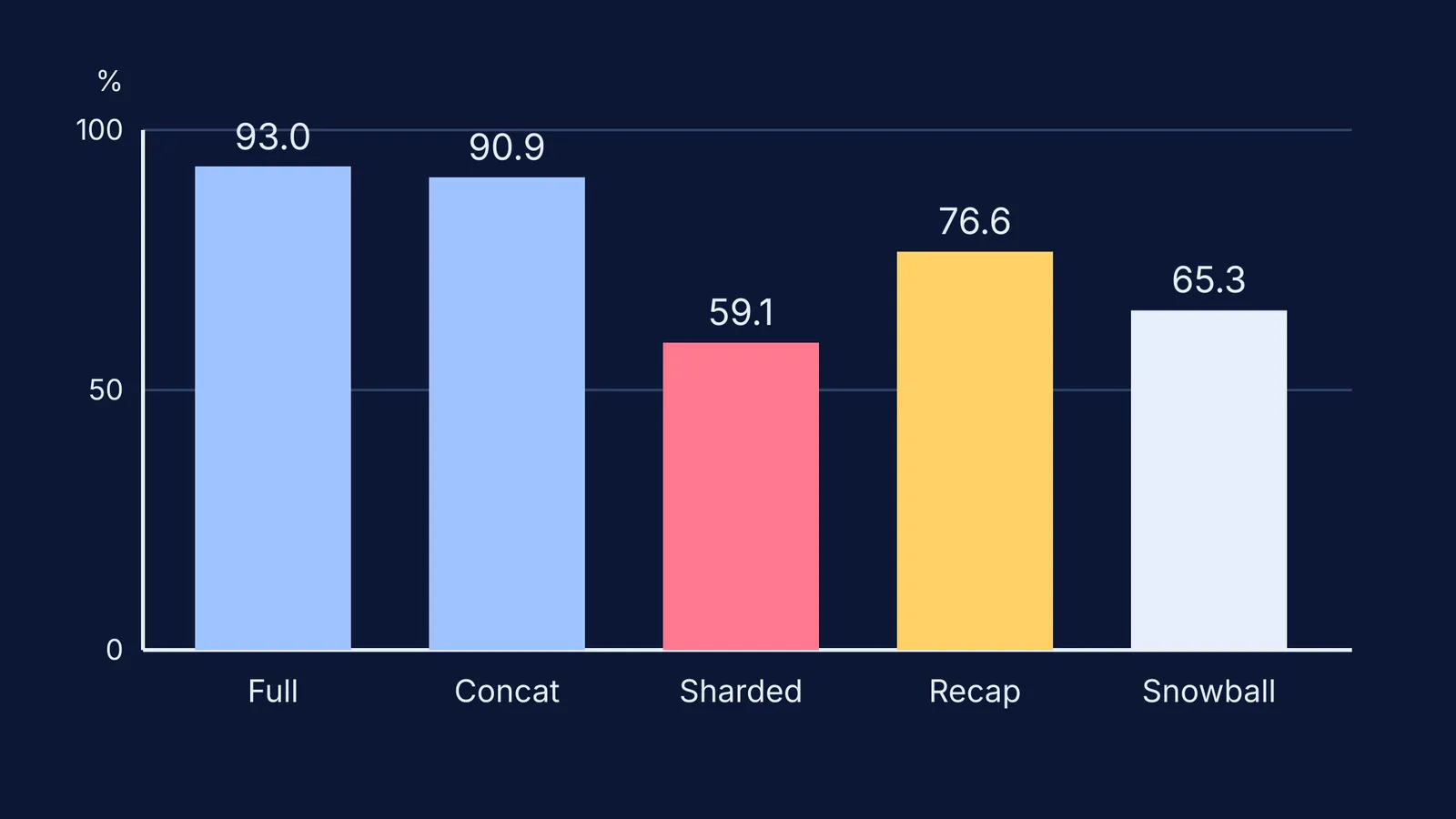
Wrong turns stick. Philippe Laban and colleagues ran over 200,000 simulated conversations with 15 models and found an average 39% drop in performance when a task was given in pieces over several turns instead of in one message (Laban et al., 2025). Models made early assumptions and leaned on them. In the authors' words, “when LLMs take a wrong turn in a conversation, they get lost and do not recover.”
A study chat often has this shape: you add rules one at a time (“shorter, please”), and each lands in a growing middle.
How do you restart a chat with a short summary?
The same paper tested a fix. When a final message recapped all of the user's earlier instructions, GPT-4o's average score across four tasks rose from 59.1% to 76.6%, while giving everything in one message from the start scored 93.0% (Laban et al., full paper). The authors suggest that if a conversation is not going well, a new one that repeats the same information might work better than carrying on.
In the old chat, send: “Summarise this chat in under 120 words for a fresh start: my class and exam, the rules I set for how you explain, the symbols and values we agreed, what I have understood, and where I am stuck. Use bullet points.”
Check the summary and fix anything the model misremembered.
Open a new chat and paste the corrected summary as your first message.
A worked example for a drifted physics chat:
I am a Class 11 student preparing for JEE Main. Topic: projectile motion.
Rules: give one hint before any full solution. Use g = 9.8 m/s² and SI units. Keep each reply under 150 words.
Agreed symbols: θ is measured from the horizontal; u is the launch speed.
Understood: time of flight and maximum height.
Stuck on: why range is greatest at 45° on level ground.
Next: ask me one question to check the range formula, then continue.
The rules sit at the top and the next step at the end, the two places where the Liu study found models often use information best.
When should you start a new chat?
Start fresh when you notice any of these:
It breaks a rule you set, such as giving full answers when you asked for hints.
Units, symbols or values change from earlier in the chat.
It repeats a wrong idea after you have corrected it.
You are moving to a new chapter or subject.
A drifting chat can slip in its working too, so test final answers with a five-step check for AI maths mistakes, and use five quick ways to check you understood an AI explanation after a long session.
What does this mean for students and parents?
Forgetting in long chats comes mainly from how these models handle long text, not from anything the student did wrong. Keep chats short, put rules at the top, and restart with a summary.
Fermi's AI tutor holds a line of reasoning across a whole session, works out what you already know and builds a plan for the session, and your progress and notes stay in your library. If you are stuck on the method for a numerical, the Fermi Problem Library has worked problems with a step-by-step solver that explains the reasoning.
Next step: write your rules card and open your next study chat with it.