

On this page
A steel nail sinks in a bucket of water, but a steel ship floats. Saying "density" is the easy part; predicting what will happen before the object hits the water is harder. In a study of university students, Loverude, Kautz and Heron found that standard instruction on hydrostatics leaves many science and engineering majors unable to predict and explain the sinking and floating behavior of simple objects. A simulation can help with exactly this, as long as you commit to a prediction before you click.
What decides whether an object sinks or floats?
Density is mass per unit volume, ρ = m/V (OpenStax College Physics 2e, section 11.2).
Archimedes' principle: the buoyant force on an object equals the weight of the fluid it displaces (OpenStax, section 11.7).
The same OpenStax section gives the rule you will test again and again: if an object's average density is less than that of the surrounding fluid, it floats. For a floating object, the fraction submerged equals ρ(object) divided by ρ(fluid). That ratio, when the fluid is water, is called specific gravity: below one floats, above one sinks.
What density values do you need for the simulation?
These are from the density table in OpenStax section 11.2, in kg/m³:
Fresh water at 4°C: 1000
Seawater: 1025
Glycerin: 1260
Olive oil: 920
Ethyl alcohol: 790
Ice at 0°C: 917
Wood: 300 to 900
Cork: 240
Aluminium: 2700
Steel or iron: 7800
Six sink-or-float predictions to test with blocks
Write down a number before each run. All values come from the OpenStax table above.
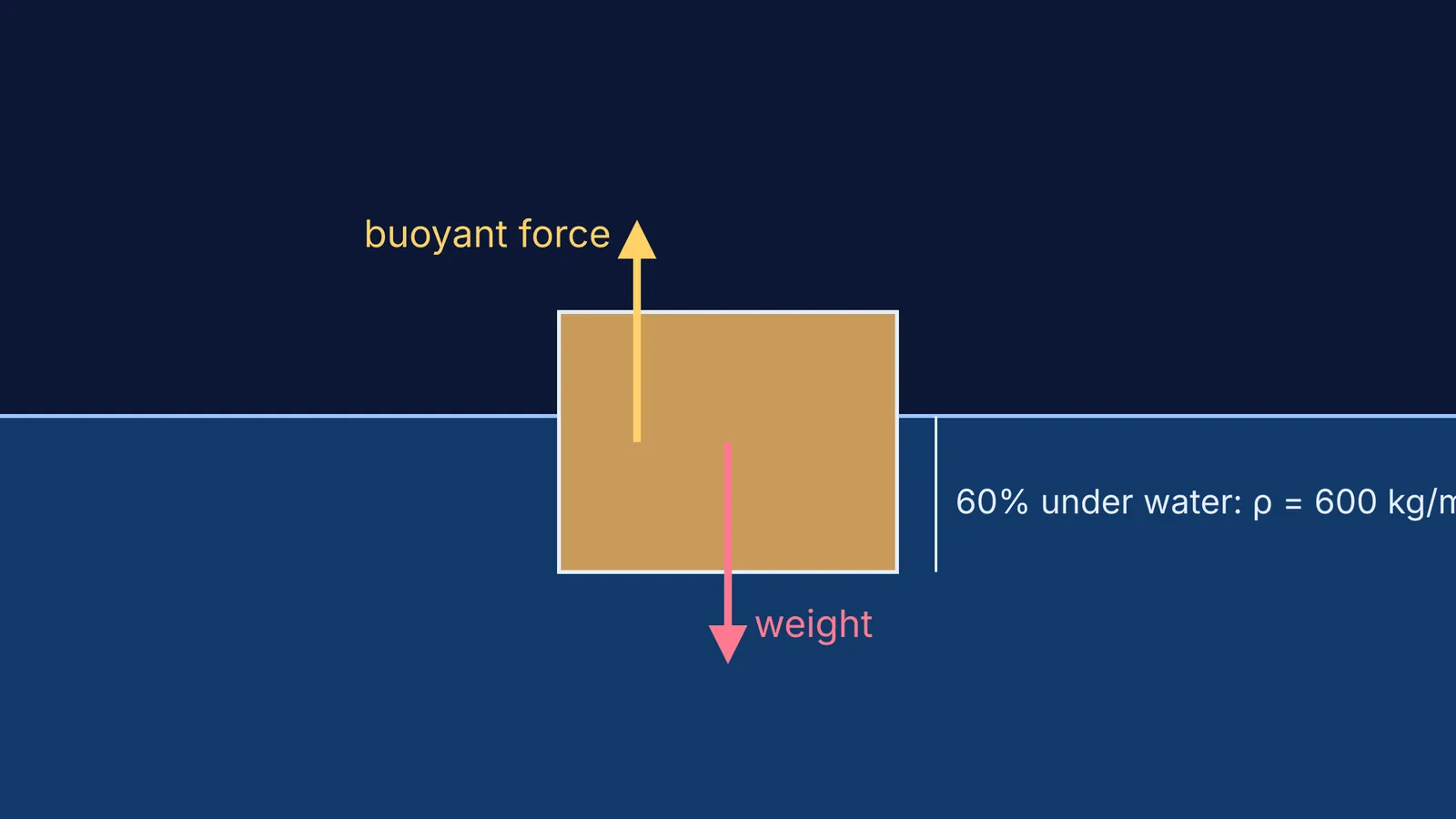
A wooden block of 600 kg/m³ in water. Floats, with 600/1000 = 60% under the surface. Now switch the fluid to glycerin: it rides higher, with 600/1260, about 48%, under.
Ice in fresh water, then seawater. 917/1000 is 91.7% submerged; 917/1025 is about 89.5%. Saltier water lifts the same ice a little higher.
Ice in ethyl alcohol. Sinks, because 917 is more than 790. It is easy to assume ice floats in every liquid.
A bigger block of the same wood. Same result, same 60% under. Size does not decide sinking; density does.
A 10 cm aluminium cube in water. Its volume is 1 litre, so its mass is 2.7 kg and its weight about 26.5 N (using g = 9.8 m/s²). Fully under water it displaces 1 kg of water, a buoyant force of about 9.8 N. It sinks, but a spring scale holding it reads about 16.7 N instead of 26.5 N.
Ice in olive oil. 917/920 means it floats, but with about 99.7% under. A simulation that rounds values may show it hovering or sinking, so check how many digits your tool uses.
How does a steel boat float if steel sinks?
Take 1 kg of steel. As a solid lump its volume is 1/7800 m³, about 128 cm³, so it can only displace 128 g of water. It sinks.
Now shape the same 1 kg into an open hull that holds 3 litres below its rim. The hull plus the air inside has an average density of 1 kg per 3 litres, about 333 kg/m³, so it floats with a third of its 3-litre volume below the waterline. It can displace up to 3 kg of water before the rim goes under, which means it can carry about 2 kg of cargo.
Test it step by step. Add cargo in 0.5 kg steps and predict how much of the hull's volume sits below the waterline each time: the fraction is (1 + cargo) ÷ 3. At 2 kg the water reaches the rim; the next step swamps it. In OpenStax's full-size version, 10,000 metric tons of steel shaped to displace 1.00 × 10⁵ m³ of water gives a maximum buoyant force ten times the steel's weight, so the ship can carry a load nine times its own weight.
How do you learn from a simulation instead of just watching it?
Use the same four-step loop for every run:
Predict with a number: sink or float, and what fraction under.
Change one thing only: the fluid, the mass or the volume.
Explain the result in one sentence that uses ρ(object)/ρ(fluid).
Do the arithmetic by hand and compare with the screen.
If you are in Class 9, this is the buoyancy you meet in the new gravitation chapter. For what Archimedes actually wrote, read Archimedes on buoyancy and levers. For the errors that cost marks in fluids questions, see pressure, buoyancy and Bernoulli mistakes to avoid.
To run these tests without any setup, the Fermi Simulation Lab has interactive simulations for the ideas that are easier to see than to read. And if a result still puzzles you, Fermi's AI tutor can run the simulation with you and check your understanding as it goes.
Start with prediction 3, ice in alcohol. It is the easiest one to get wrong if you think ice always floats.


