On this page
You were probably told to memorise d/dx(e^x) = e^x. It sticks better once you have seen why it is true, and a graph, a ruler and a calculator are enough. The idea: slide a tangent along the curve y = b^x and compare its slope with the height of the point it touches.
What happens to the slope of 2^x as you move along the curve?
Take y = 2^x. At x = 1 the height is 2, at x = 2 it is 4, at x = 3 it is 8. Using the derivative rule in OpenStax Calculus Volume 1, section 3.9, the slopes of the tangents there are about 1.39, 2.77 and 5.55. Divide slope by height and you get the same number every time: about 0.693. Doubling the height doubles the slope.
That is not a coincidence. The same OpenStax section shows that if B(x) = b^x, then B′(x) = b^x · B′(0). The algebra is one line:
(b^(x+h) − b^x)/h = b^x · (b^h − 1)/h
As h shrinks to 0, the second factor becomes the slope at x = 0, which does not depend on x.
So for every exponential, slope = height × (slope at x = 0), at every point on the curve. Differentiating b^x comes down to one number per base.
Which base makes the slope equal the height?
The OpenStax section gives a table of estimates of that number, the slope at x = 0, for several bases:
b = 2: about 0.6931, so the curve rises more slowly than its height
b = 2.7: about 0.9932
b = 2.718: about 0.9999
b = 3: about 1.0986, so the curve rises faster than its height
Somewhere between 2 and 3 the multiplier passes through exactly 1. From the table, OpenStax concludes that this base lies between 2.7182 and 2.7183, and it defines e as the unique base whose slope at x = 0 is 1. For that base, slope = height × 1. That is the whole reason d/dx(e^x) = e^x.
To more digits, e = 2.71828 18284 59045..., as listed by the NIST Digital Library of Mathematical Functions.
The multiplier has a name too. The same OpenStax section states d/dx(b^x) = b^x ln b, so the numbers above are ln 2 ≈ 0.693 and ln 3 ≈ 1.099, and ln e = 1.
How can you check it with a ruler?
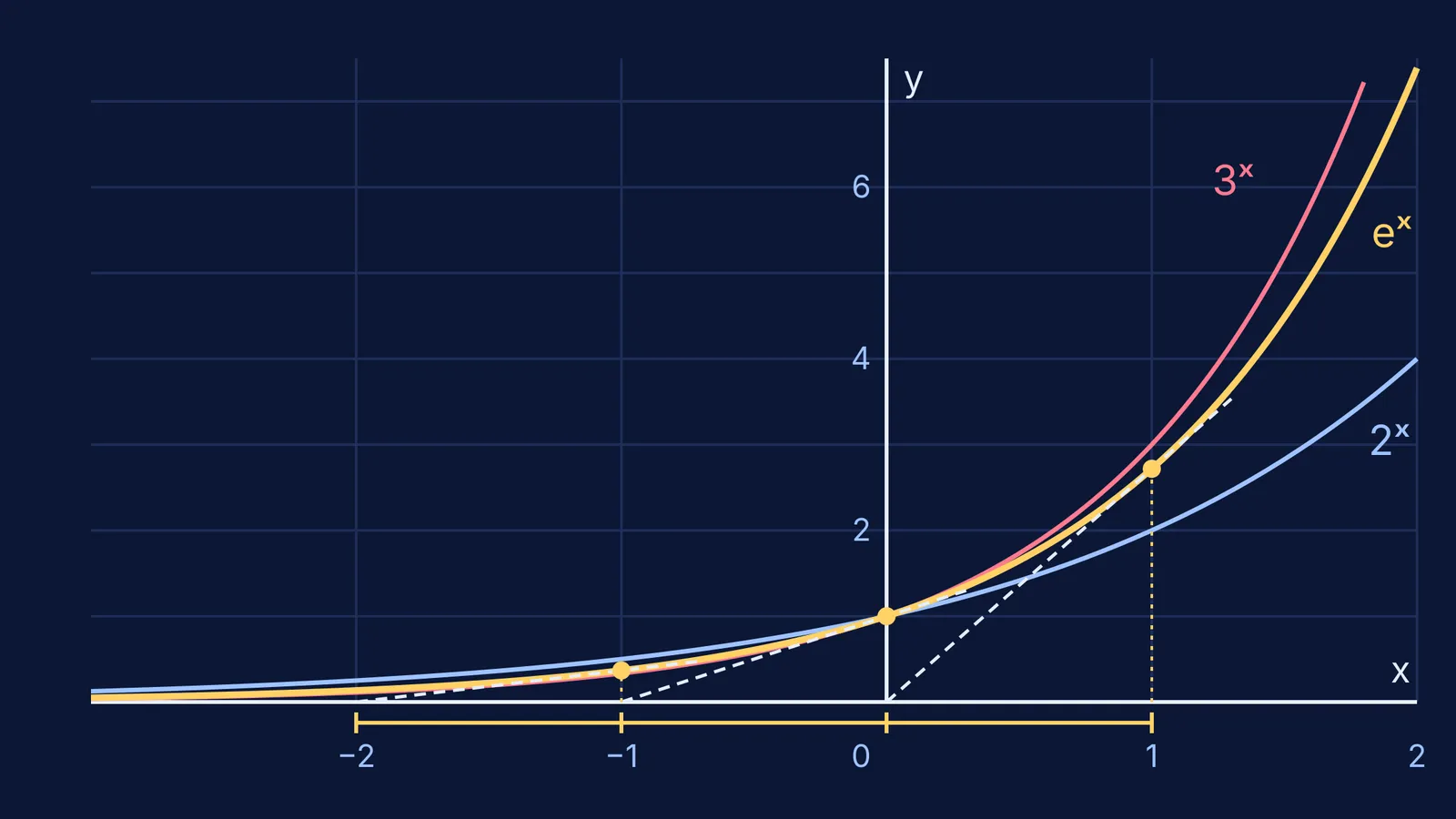
This is what the diagram at the top draws. Using the OpenStax derivative rule for b^x, the tangent to y = b^x at any point has slope height × ln b. Follow that tangent down to the x-axis and it lands a horizontal distance of height ÷ slope = 1 ÷ ln b to the left of the point. The height cancels, so the distance is the same everywhere on the curve:
For 2^x: about 1.44 units to the left
For 3^x: about 0.91 units to the left
For e^x: exactly 1 unit to the left
Try it on graph paper:
Plot y = e^x for x from −2 to 2, using e^(−1) ≈ 0.37, e ≈ 2.72 and e^2 ≈ 7.39, with a large scale.
At x = 1, lay a ruler so it just touches the curve without cutting it.
Mark where the ruler meets the x-axis. It should land near x = 0.
Repeat at x = 0 and x = −1. The ruler should land near −1 and −2.
Now plot y = 2^x on the same axes and repeat. The ruler lands about 1.44 units to the left instead.
Hand-drawn tangents are never perfect. If you land within a tenth of a unit or so, you have seen the property for yourself. If you would rather drag a point than redraw, the Fermi Simulation Lab has interactive simulations for ideas that are easier to see than to read.
Why does slope equal to height matter outside the exam?
Slope equal to height is the equation dy/dx = y. Anything that grows in proportion to how much of it there already is follows an exponential curve: bacteria, money earning interest, a chain reaction. You can see it in a worked bacteria growth differential equation problem, and compound interest is one of the places e turned up early, in how Jacob Bernoulli found e by compounding interest.
The same habit of tracing a slope works elsewhere: trace the slope of the sine graph and watch cosine appear.
For JEE Main and board exams, keep two lines in your notes: d/dx(e^x) = e^x, and d/dx(a^x) = a^x ln a. If ln itself still feels shaky, the Fermi Concept Library has a lesson for every concept in mathematics, including logarithms.
Your next step: draw the three rulers on e^x tonight, then do the same on 3^x and predict where they will land before you check.