On this page
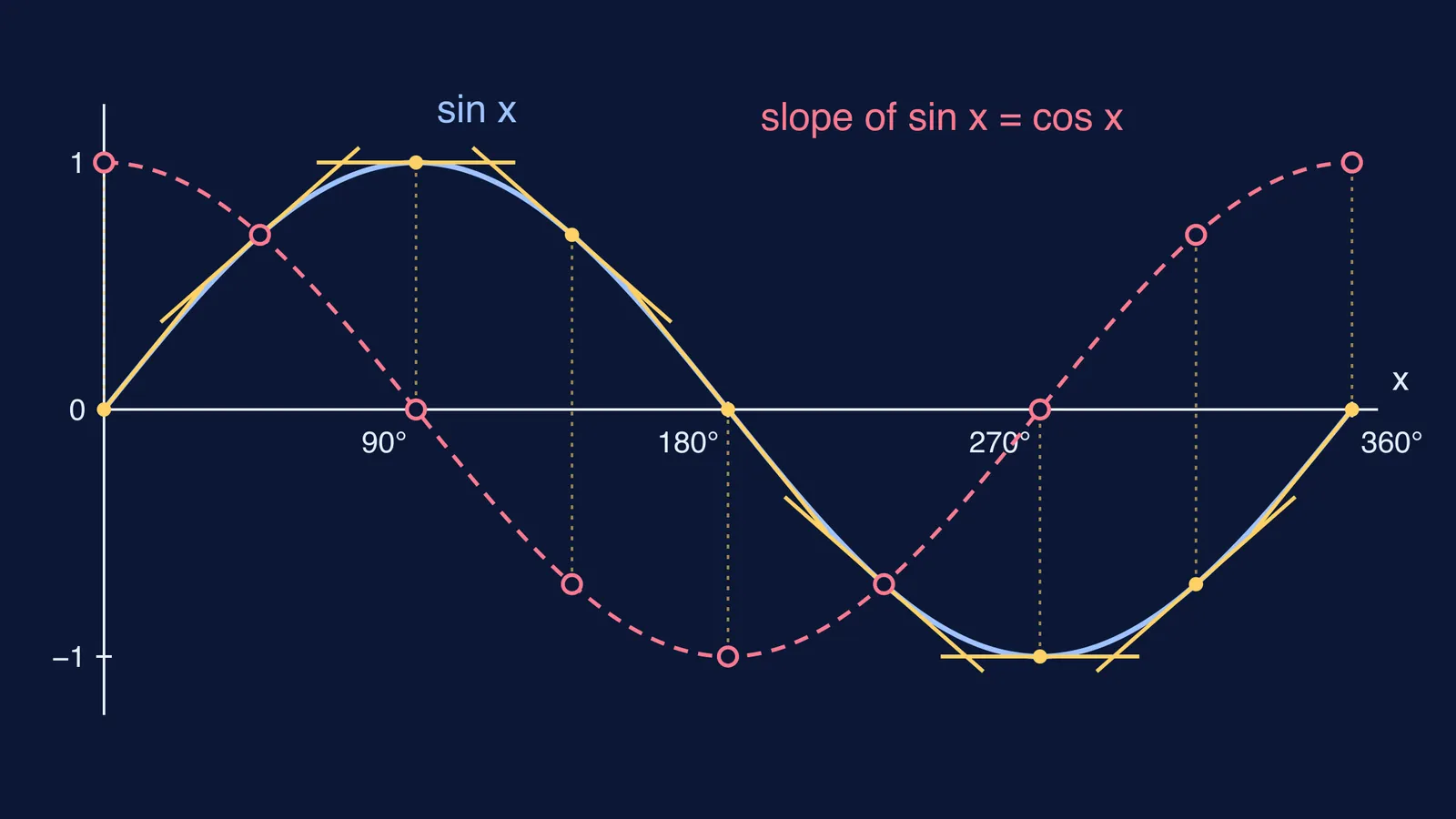
Most students learn "the derivative of sin x is cos x" as a line to memorise. You can also see it with a pencil. Guess how steep the sine curve is at three points, trace that steepness along the whole wave, and a second curve appears. It is cosine.
What is the slope of sin x at 0, 90 and 180 degrees?
Sketch one wave of y = sin x from 0 to 360 degrees. Now guess the steepness at three points:
At 0: the curve starts at zero and climbs. Is it steep, flat or falling?
At 90 degrees: the curve reaches its peak of 1. Steep, flat or falling?
At 180 degrees: the curve crosses zero on its way down. Steep, flat or falling?
Here are the answers, with x measured in radians (90 degrees is π/2, 180 degrees is π):
At 0 the slope is 1. The curve leaves the origin along the line y = x.
At 90 degrees the slope is 0. At the peak the tangent is horizontal.
At 180 degrees the slope is -1. The curve crosses down through zero exactly as steeply as it rose at 0.
You can check these on a calculator in radian mode. Take a small step h = 0.1 and work out (sin(x + h) - sin x) / h. At x = 0 you get sin(0.1) / 0.1 = 0.998. At x = π/2 you get about -0.050, which is close to flat. At x = π you get -0.998. The smaller you make h, the closer these get to 1, 0 and -1.
How does tracing the slope of sine give cosine?
Three points are a clue. Now go along the wave in 45 degree steps and plot each slope as a new point directly below or above the sine curve:
0: slope 1
45 degrees: about 0.71, rising but gentler
90 degrees: 0, at the top
135 degrees: about -0.71
180 degrees: -1, falling fastest
225 degrees: about -0.71
270 degrees: 0, at the bottom
315 degrees: about 0.71
360 degrees: 1, back where you started
Join those points and you have drawn y = cos x. Where sine rises, its slope is positive. Where sine falls, its slope is negative. At every peak and trough, the slope is zero.
OpenStax Calculus Volume 1 states the rule as d/dx(sin x) = cos x. It notes that wherever sin x has a horizontal tangent, cos x is zero. The chapter proves the rule using two limits, sin h / h → 1 and (cos h - 1) / h → 0 as h → 0. Your calculator check above was those two limits in disguise.
If you would rather watch an idea like this move than redraw it by hand, the Fermi Simulation Lab has interactive simulations for ideas that are easier to see than to read.
Why does the derivative of sin x need radians?
Do the same slope check with x in degrees and the curve still looks like sine, but the slopes come out tiny.
The Underground Mathematics gradient activity works through this. It shows that f'(x) = cos x for f(x) = sin x when x is in radians. At a point where sine crosses zero, the gradient is about -1 in radians but only about 0.017 in size in degrees. It also stresses that the derivative of sine depends on the unit your angles are in.
The reason is the width of the wave. In radians, one wave is 2π, about 6.28 units wide. In degrees, the same wave is stretched across 360 units, so every slope gets flattened by the same factor. That factor is π/180, about 0.01745. So in degrees, d/dx(sin x) = (π/180) cos x. The clean rule only works in radians, which is why calculus uses them.
How can you practise tracing the slope of sine?
Draw sin x from 0 to 2π on graph paper, using a scale of 1 cm for each 0.5 unit on both axes, so slopes are honest.
Hold a ruler against the curve as a tangent at 0, π/4, π/2 and so on. Estimate each slope as rise over run.
Plot each slope as a dot on a fresh pair of axes directly underneath.
Join the dots and compare them with cos x. Redo any point that is off by more than 0.2.
Repeat the exercise for cos x. Predict first: the slopes should trace -sin x. Check whether they do.
Step 5 is the real test. If you can predict that cosine's slope is negative just after 0, because cosine starts at its peak, you understand the idea, not just the formula. If the link between slope and derivative still feels shaky, the Fermi Concept Library has a lesson for every concept in mathematics, each placed in a map of the ideas around it.