On this page
In 1896 a Paris physician named Fernand Widal showed that a patient's blood could reveal typhoid indirectly. Mix the clear part of a typhoid patient's blood, the serum, with typhoid bacteria, and the bacteria clump together. That simple observation became the Widal test, which many Indian families may still meet when a fever drags on.
Who was Fernand Widal?
Georges-Fernand Widal was born on 9 March 1862 in Dellys, Algeria, and died in Paris on 14 January 1929 (Wikipedia biography). His father served there as an army doctor, and Widal was elected to the French Academy of Sciences in 1912 (Jewish Virtual Library, from the Encyclopaedia Judaica).
Typhoid was a long project for him. From 1886 he studied its causes, showed that it spreads through water, and with André Chantemesse researched immunity to the disease (Encyclopædia Universalis). He also recognised the part chloride, from table salt, plays in swelling (oedema) (Jewish Virtual Library).
Who invented the Widal test, and how did it begin?
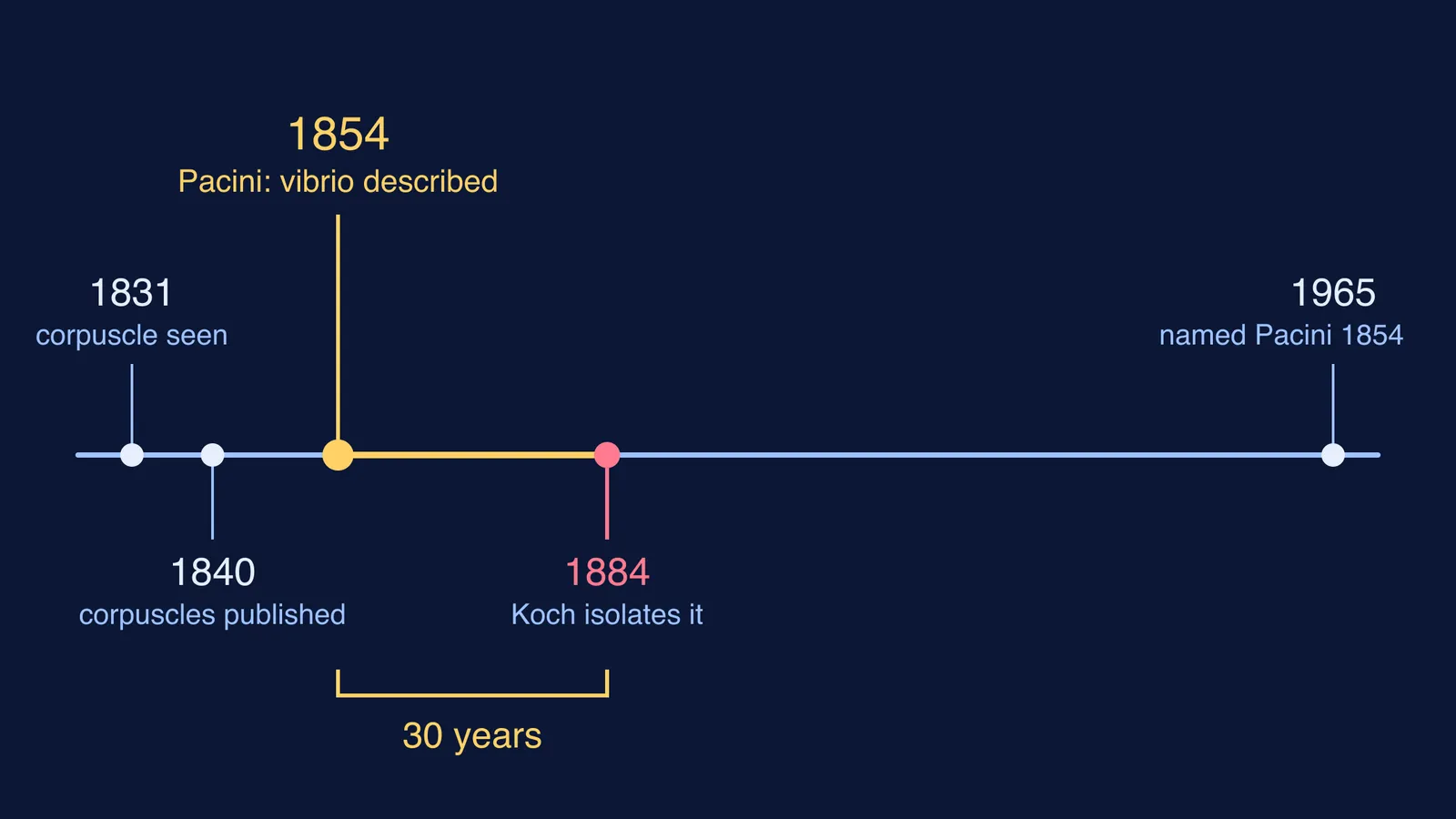
Fernand Widal discovered the serum diagnosis of typhoid fever in 1896, and the reaction carries his name (Encyclopædia Universalis). He did not discover clumping itself. Earlier in 1896, the bacteriologists Herbert Durham and Max von Gruber described specific agglutination, and Widal put their finding to practical use later that year (Wikipedia: Agglutination)).
A 2000 review in the Postgraduate Medical Journal cites Widal's 1896 paper in the bulletin of the Société médicale des hôpitaux de Paris. Who deserved credit has been argued over: a 2009 paper by Heinz Flamm in the Wiener klinische Wochenschrift has a German subtitle that translates as "the priority disputes of Pfeiffer, Gruber and Widal".
How does the Widal test work?
When typhoid bacteria infect you, your immune system makes antibodies that stick to parts of the bacterium called antigens. The Widal test looks for IgM and IgG antibodies against the O (somatic, or body) antigen and the H (flagellar) antigen of Salmonella Typhi and the paratyphoid bacteria A and B (Indian Academy of Pediatrics, Standard Treatment Guidelines 2022). If those antibodies are present, they link many bacteria together, and you see visible clumps: agglutination.
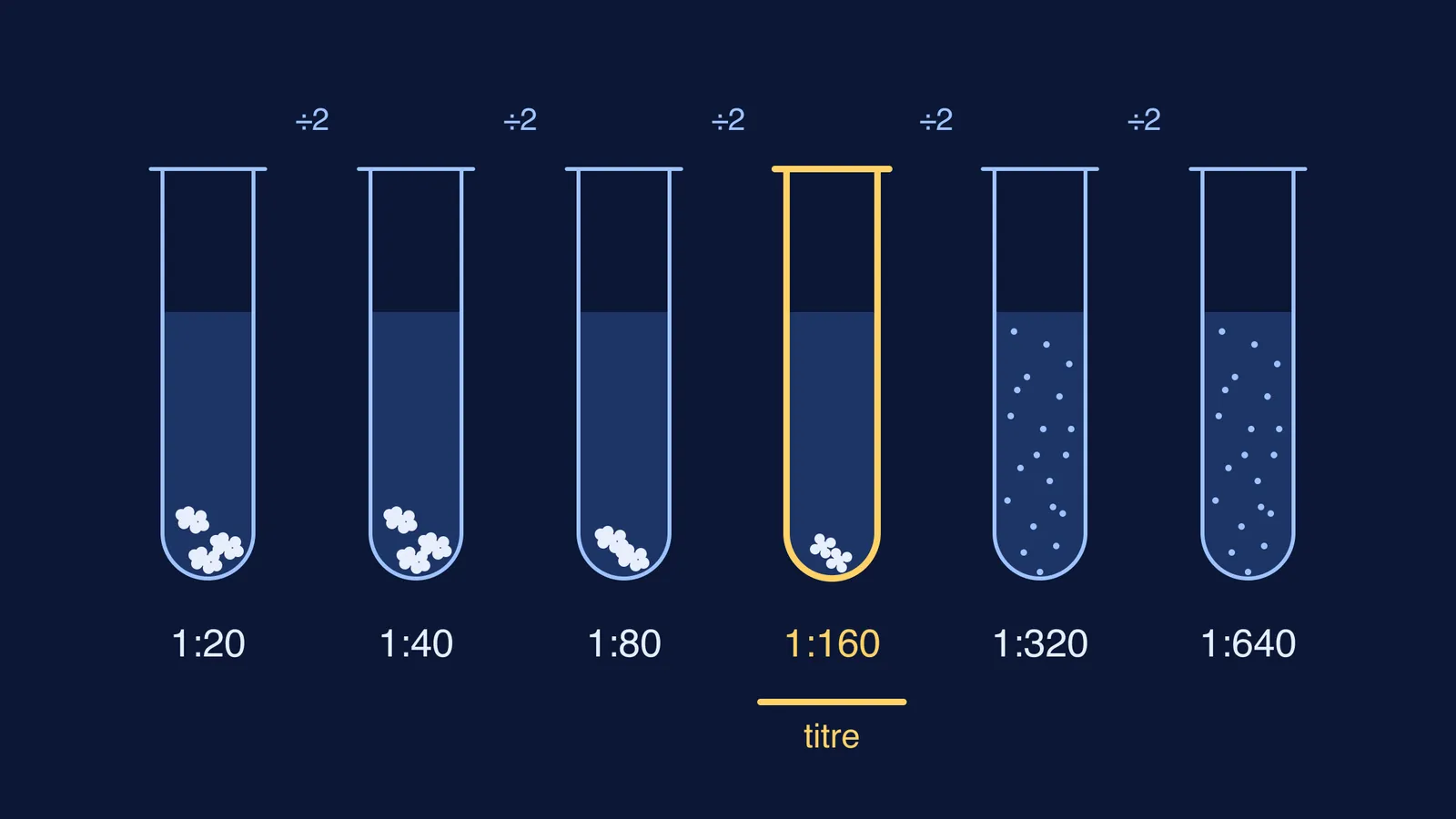
The lab dilutes the serum step by step, halving it each time, and finds the weakest dilution that still clumps. That dilution is the titre. The same IAP guideline says a titre of 1:160 or more for both O and H is taken as positive. It calls a fourfold rise between two samples taken one week apart the conventional method, though less practical. The antibody rise takes 7 to 14 days, which limits the test early in an illness (Wikipedia: Widal test).
Worked example, reading a titre:
The tubes hold serum at 1:20, 1:40, 1:80, 1:160, 1:320 and 1:640. Each one has half the serum of the one before.
Clumps appear in the first four tubes; the last two stay evenly cloudy. The titre is 1:160, the last tube that clumps.
A second sample a week later clumps up to 1:640. That is two tubes further along.
Two halvings means 2 × 2 = 4, so the titre has risen fourfold.
Is the Widal test still reliable today?
Typhoid is still common: the World Health Organization estimates that, as of 2019, 9 million people get sick from it and 110 000 die from it every year. WHO says typhoid can be confirmed through blood testing.
The Widal test has known weak points. A review titled "Widal agglutination test — 100 years later: still plagued by controversy" points to the quality of the antigens used and how results are interpreted, especially where typhoid is endemic (Olopoenia and King, Postgraduate Medical Journal, 2000).
The IAP guideline is direct: serology tests are not diagnostic, may be supportive, and should not be relied upon for patient management decisions. It says the Widal test can be falsely positive in malaria, rickettsial infection or infection with related bacteria, and falsely negative after earlier antibiotics. It calls culture the gold standard, with blood culture giving a 90% yield in the first week of illness and up to 40% in the fourth week.
If a doctor orders a Widal test for someone in your family, these are fair questions to ask:
Which day of the fever are we on, and is that early for this test?
Does it matter that antibiotics were already started?
Would a blood culture help in this case?
Do we need a second sample a week later to compare?
The decisions about testing and treatment belong with your doctor.
What can biology students learn from Widal?
Widal's idea joins three topics you study separately: antigens, antibodies and dilution maths. If antigen, antibody, IgM and IgG still feel like loose words, the Fermi Concept Library covers every concept in biology, each with its own lesson and its place in the map. Then explain the worked example to a friend without notes; where you stall is the gap to fix.