On this page
If a question describes a population growing without limit and asks you for r, you need two equations and one logarithm. Both equations are in the chapter Organisms and Populations of NCERT's Class 12 Biology textbook, and the chapter ends with exactly this kind of exercise.
What do dN/dt = rN and Nₜ = N₀eʳᵗ mean?
NCERT starts with the per capita birth rate b and the per capita death rate d. The change in population size per unit time is dN/dt = (b − d) × N, and writing r = b − d gives dN/dt = rN (NCERT Class 12 Biology, Chapter 11).
The r in this equation is called the intrinsic rate of natural increase, which NCERT's chapter summary describes as a measure of a population's inherent potential to grow (NCERT).
In words, the bigger the population, the faster it grows.
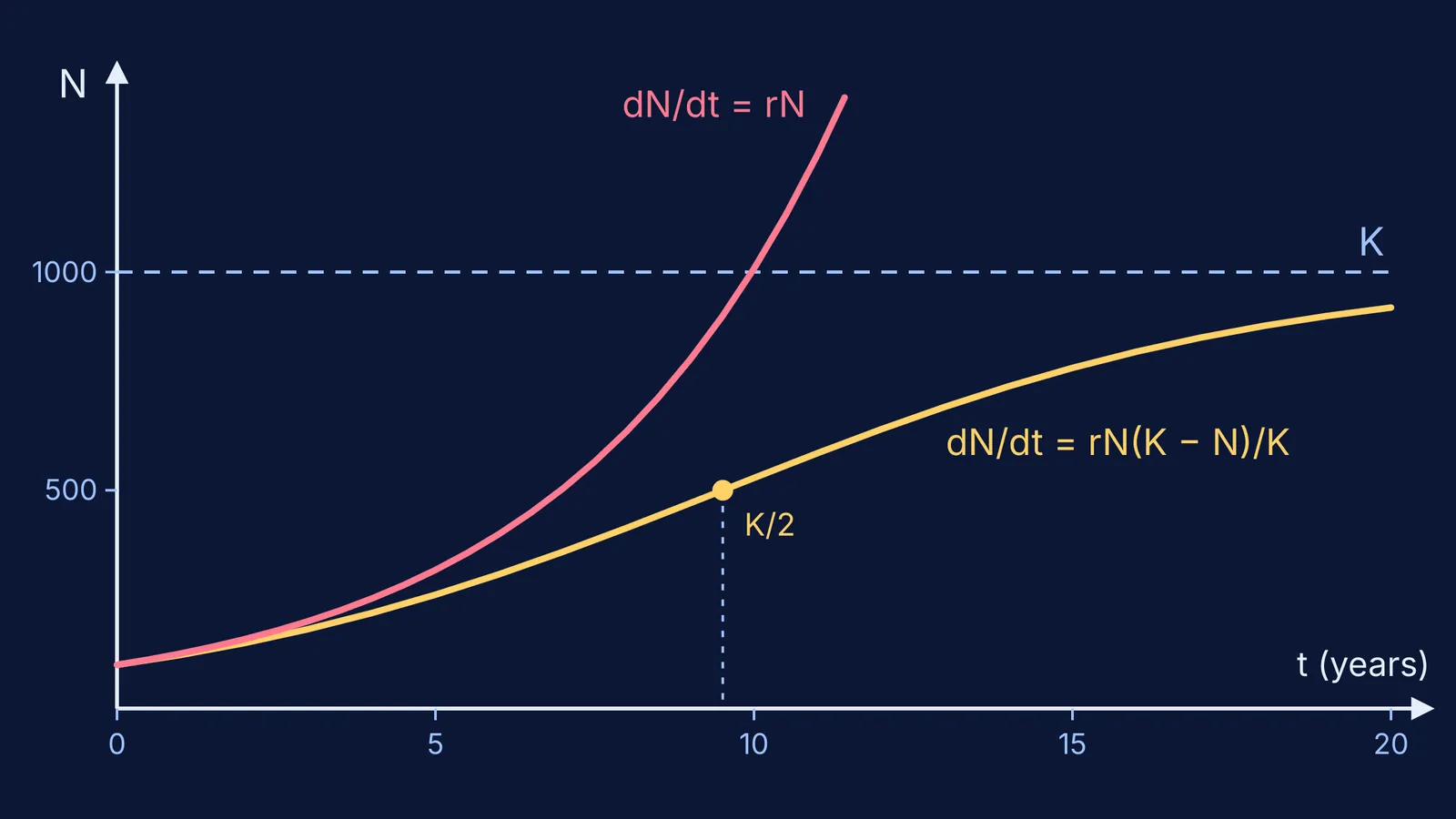
Integrating gives Nₜ = N₀eʳᵗ, where N₀ is the population at time zero, Nₜ is the population after time t, and e ≈ 2.71828 is the base of natural logarithms (NCERT). A plot of N against t is a J-shaped curve. OpenStax Biology 2e describes the same model and the same J shape.
To give you a sense of size, NCERT quotes r = 0.015 for the Norway rat, r = 0.12 for the flour beetle and r = 0.0205 for India's human population in 1981 (NCERT).
How do you find r if a population doubles in 3 years?
This is Exercise 2 at the end of the NCERT chapter. It takes five lines:
Write the model: Nₜ = N₀eʳᵗ.
Doubling means Nₜ = 2N₀ when t = 3 years, so 2N₀ = N₀e³ʳ.
Cancel N₀ to get e³ʳ = 2.
Take the natural log of both sides: 3r = ln 2 = 0.693.
Divide by 3: r ≈ 0.231 per year.
Check it: e^(0.231 × 3) = e^0.693 ≈ 2, so the population does double. N₀ cancelled out, which is why the question never told you how many individuals there were.
Run it backwards and doubling time = ln 2 ÷ r. Reading NCERT's 1981 figure for India, r = 0.0205, as a yearly rate gives 0.693 ÷ 0.0205 ≈ 34 years (NCERT). That is what the rate implies if it never changed, not a forecast.
How is the J-shaped curve different from the logistic curve?
No real population has unlimited resources. NCERT calls the most a habitat can support its carrying capacity, K. Growth in a limited habitat goes through a lag phase, then acceleration, then deceleration, and finally levels off at K. The result is a sigmoid curve called Verhulst-Pearl logistic growth, with dN/dt = rN(K − N)/K (NCERT).
The factor (K − N)/K acts as a brake. When N is small, it is close to 1 and growth looks exponential. As N gets close to K, the factor falls towards 0 and growth stops. OpenStax Calculus Volume 2 gives the solution as N(t) = KN₀eʳᵗ ÷ [(K − N₀) + N₀eʳᵗ]. One of its exercises asks you to show that the population grows fastest at half the carrying capacity, N = K/2.
Here is a comparison you can check on a calculator. Take the doubling population from above (r ≈ 0.231 per year), start it at N₀ = 100 and give the habitat K = 1000:
After 3 years: exponential 200, logistic about 182.
After about 9.5 years: logistic reaches 500 (K/2), where it grows fastest, at about 58 per year (rK/4).
After 10 years: exponential about 1008, logistic about 528.
After 20 years: exponential about 10,159, logistic about 919, still creeping towards 1000.
The two models agree at first and split once resources run short. NCERT calls the logistic model the more realistic one, because most animal populations have finite resources (NCERT).
Which mistakes cost marks in these numericals?
Run this checklist before you write your final answer:
Log base. Use ln, not log₁₀.
Units of r. If t is in years, r is per year. If t is in days, r is per day.
Linear thinking. Doubling in 3 years does not mean r = 1/3 or r = 2.
Rate or size? In logistic questions, check whether you are asked for dN/dt or N. The growth rate peaks at K/2, not at K.
Plug it back in. Put your r into e^(rt) and check that you get the growth factor the question gave you.
If you write the right formula but still get the wrong number, work similar problems in the Fermi Problem Library, where a step-by-step solver explains the reasoning rather than printing an answer. If e and ln feel shaky, the Fermi Concept Library gives every concept in mathematics and biology its own lesson.