On this page
Your school's physics post is empty and the chapters will not wait. Class 11 theory can be learned from the NCERT book and free official videos on a steady routine. The lab work cannot be done alone, so the school has to hear about it too.
CBSE's Physics curriculum for 2026-27 lists 14 chapters for Class 11, from Units and Measurements to Waves. The same document sets a 70-mark theory paper and a 30-mark practical exam. If you are with a state board, check its own syllabus; the plan below still applies.
What should you do if there is no physics teacher in Class 11?
Run three things side by side, starting this week:
Study one NCERT section at a time on a fixed weekly cycle.
Write every doubt down and clear them once a week.
Ask the school, in writing, for a stopgap arrangement, especially for practicals.
Do not wait for a new teacher. Laws of Motion uses the vectors from Motion in a Plane, so falling behind early makes later chapters harder.
Which free official resources cover Class 11 physics?
NCERT textbooks and videos on DIKSHA. DIKSHA, the Ministry of Education's digital learning platform, carries NCERT textbooks along with videos and courses, and Physics is one of its subjects. The QR codes printed in NCERT books open matching material; here is how to use the DIKSHA QR codes in NCERT textbooks.
PM eVIDYA Class 11 lectures. NCERT's list of PM eVIDYA channels names a Class 11 TV channel, DD PM eVIDYA NCERT 11, with a YouTube channel called NCERT - PM eVidya Class 11.
The CBSE curriculum PDF linked above, as your checklist of chapters and of the experiments you must record.
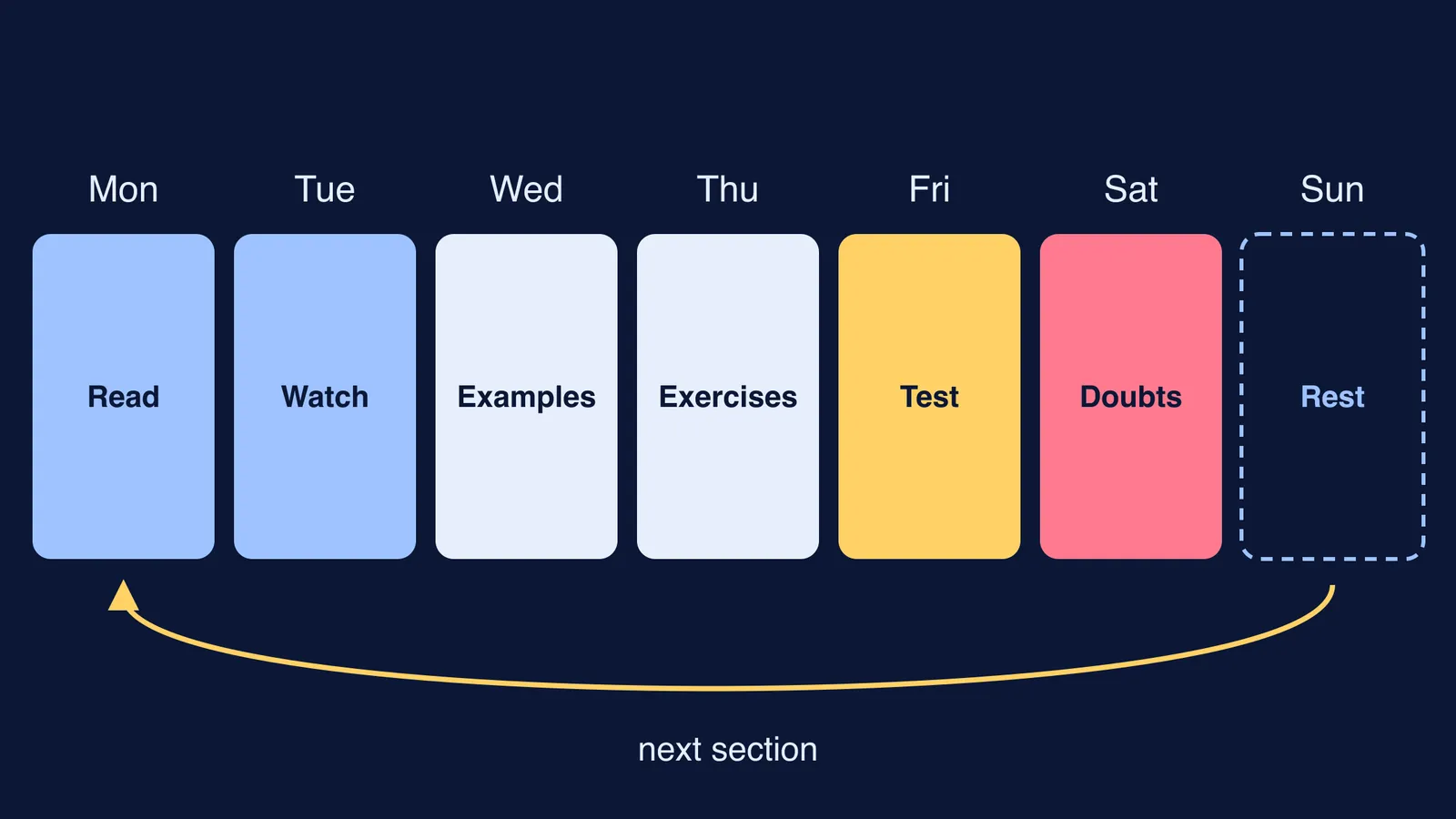
A weekly plan: one NCERT section in seven days
Here is the cycle, worked for Chapter 2, Motion in a Straight Line. Budget about an hour a day.
Monday, read: one section, slowly. Close the book and write three lines on what it said.
Tuesday, watch: find the matching lesson on DIKSHA or PM eVIDYA and note anything it explains differently from the book.
Wednesday, examples: cover each solved example's solution, try it yourself, then compare line by line.
Thursday, exercises: attempt the end-of-chapter questions for that section. Mark every one you could not finish.
Friday, test: with the book closed, write the key equations, derive one of them, and redo one marked question.
Saturday, doubts: work through your doubt log (see the next section).
Sunday, rest or catch up.
Do not skip Friday's closed-book test. In a 2006 study, Roediger and Karpicke found that students who took recall tests on a prose passage remembered more of it two days or one week later than students who restudied it instead.
How do you run a weekly doubt routine?
Keep one notebook page per chapter. For each doubt, write the page number, what you tried and the exact line where you got stuck. “Why is the area under a velocity-time graph the displacement?” is a doubt someone can answer; “I don't get kinematics” is not.
On Saturday, take your top three doubts to whoever can help: your maths or chemistry teacher, a senior who took physics, or a classmate who has solved the question. Our guide to preparing sharp questions for a teacher shows how to tighten them first.
For the doubts still left, Fermi's AI tutor works out what you already know, builds a plan for the session and checks understanding as it goes, so a stuck step becomes a short lesson rather than a copied answer. For a numerical that went wrong, the Fermi Problem Library has a step-by-step solver that explains the reasoning.
How should you raise a vacant physics post with the school?
Write to the principal, politely and briefly, with questions that need dated answers; it can help if several parents sign together. Practicals are your strongest point: the CBSE Physics curriculum says the record submitted at the annual exam must include at least 8 experiments and 6 activities, plus a project report. That needs lab time and someone to supervise it.
A message you can adapt:
“Respected Principal, Class 11 Science has had no physics teacher since [month]. We would like to know when the post is expected to be filled; what arrangement will cover theory until then, such as a guest or visiting teacher; and when students will get supervised lab sessions for the experiments and activities CBSE requires. Our children are keeping up with NCERT at home, and we would be grateful for a reply by [date].”
If months pass without a clear answer, read what parents can do when there is no regular teacher for months.
Start on Monday with the first section of the chapter you are on, and send the letter the same week.