On this page
On a still, sticky July afternoon, washed clothes stay damp till evening. On a breezy March morning they are dry before lunch. The difference is evaporation, the Class 9 idea, and you can measure it with two towels and a kitchen scale.
Why do clothes dry faster on a windy day?
Evaporation is the change of a liquid into a gas at any temperature below its boiling point, as NCERT's Class 9 exemplar problems for Matter in Our Surroundings puts it. It happens only at the surface, where the fastest-moving water molecules break free into the air.
Some drift straight back. A thin layer of air next to the fabric quickly fills with water vapour, and the damper it gets, the more molecules return to the cloth for every one that leaves.
Wind sweeps that damp layer away and brings in drier air, so escaping molecules have somewhere to go. The same exemplar asks which of four vessels of water evaporates fastest; only vessel C has a moving fan above it.
How much faster does wind make clothes dry?
The Engineering ToolBox page on water surface evaporation, written for open tanks and swimming pools, gives the evaporation per hour as g = Θ A (xs − x), with Θ = 25 + 19v kg/m²h, where v is the air speed in metres per second.
Here A is the wet surface area, xs is how much vapour saturated air at the surface holds, and x is how much the surrounding air holds, both in kg of water per kg of dry air.
Only Θ depends on wind. In still air it is 25; in a gentle 2 m/s breeze it is 63, about 2.5 times as much evaporation from the same surface.
The page calls this an empirical equation, and it was built for open water, not fabric. Use it for the direction and rough size of each effect, not exact drying times.
Why do clothes take so long to dry in the monsoon?
Relative humidity is "the amount of atmospheric moisture present relative to the amount that would be present if the air were saturated", according to the US National Weather Service glossary. On a humid day the gap between xs and x is small.
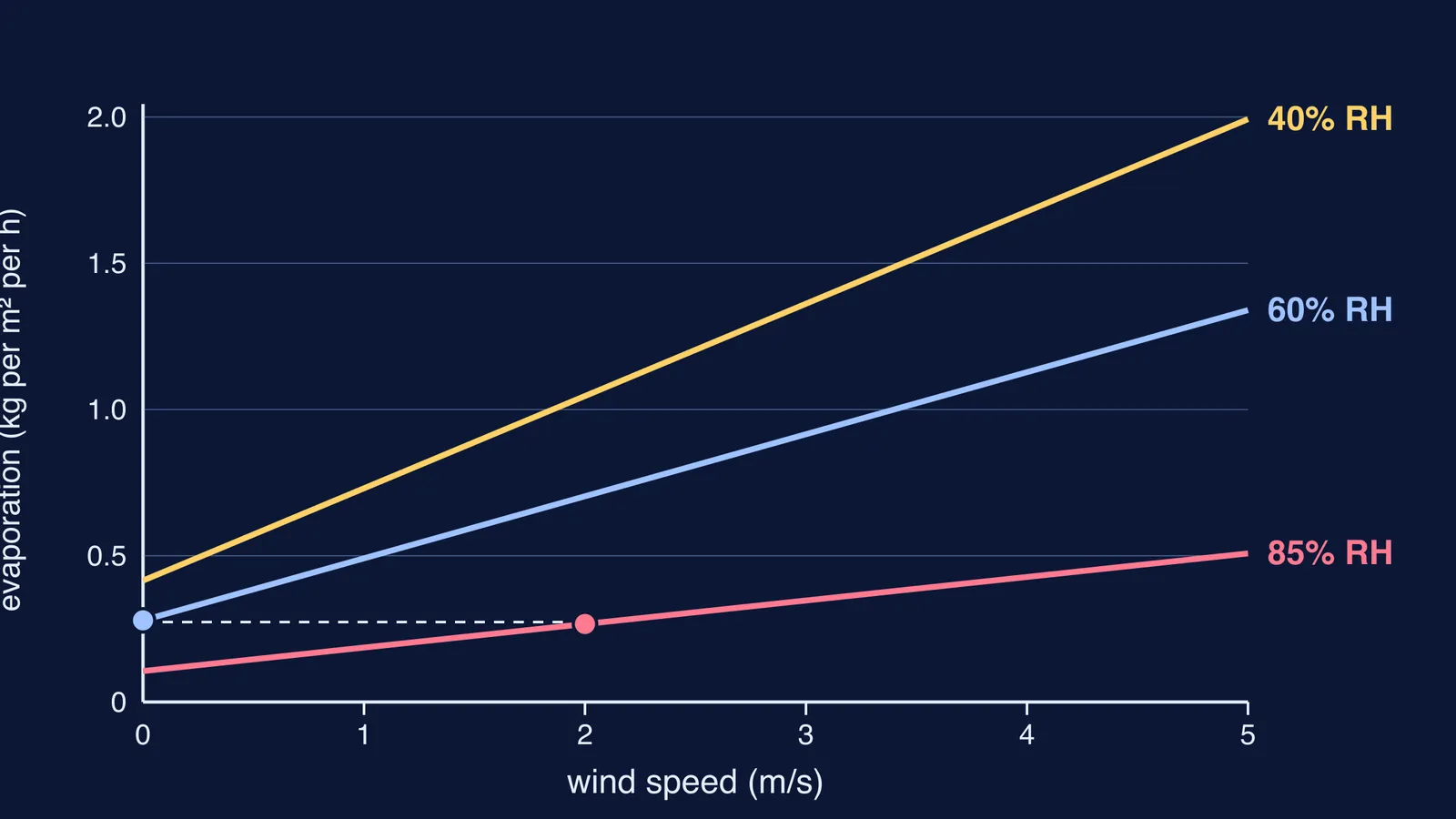
A worked example: at 30°C, water's saturation vapour pressure is 4.247 kPa, from the Engineering ToolBox saturation pressure table. At normal air pressure that gives xs ≈ 0.0272. Air at 60% humidity holds x ≈ 0.0160; at 85% humidity, x ≈ 0.0230. Putting these into the Engineering ToolBox evaporation formula, and assuming the cloth is at air temperature (which overestimates real drying):
Still air, 60% humidity: 25 × 0.0112 ≈ 0.28 kg per square metre per hour
2 m/s breeze, 60% humidity: 63 × 0.0112 ≈ 0.70 kg per square metre per hour
2 m/s breeze, 85% humidity: 63 × 0.0042 ≈ 0.27 kg per square metre per hour
That last line is the monsoon lesson: a breezy but muggy day dries about as slowly as a still, ordinary one, because humidity shrank the gap to well under half.
Why does spreading clothes out help?
A towel folded in four hides most of its water from the air. Spread out, every part faces the air, which raises A in the formula. Warmth helps too, because warmer water evaporates faster.
So when the exemplar asks how to dry a wet shirt quickly, use all four factors: spread it, sun it, hang it in moving air, and avoid damp rooms.
The same physics explains why you feel cold after a bath, why air coolers stop working in humid weather and why alcohol evaporates faster than water.
How can you test it at home with two towels?
You need two identical hand towels, a kitchen scale, a table fan and a notebook.
Soak both towels, wring each the same way, and weigh them.
Hang both spread out in one room, out of direct sun: towel A in still air, towel B in front of the fan on low.
Write a prediction: which loses more water in an hour, and by how many times?
Weigh both every 30 minutes for 2 hours. Mass lost is water evaporated.
Round two: fold towel B in four in front of the fan, with A spread in still air. Does area beat wind?
Round three: repeat round one on a humid day and a dry day.
Your numbers won't match the formula, since cloth wicks water and the fan's speed is unknown. What matters is the direction and whether your prediction held.
If the particle picture still feels abstract, the Fermi Simulation Lab has interactive simulations for ideas that are easier to see than to read, and the Fermi Concept Library gives each concept in physics and chemistry its own lesson.
Run the two-towel test this weekend, and write your prediction down before you switch on the fan.