On this page
If you spill a drop of water on a table, it might sit there for hours. Spill a drop of hand sanitiser or rubbing alcohol, and it disappears in minutes, leaving the surface dry and cold.
The reason lies in the invisible architecture of the liquids. At room temperature, the molecules in both water and ethanol are moving, but the intermolecular forces holding them together are very different.
The sticky network: water vs ethanol
Both water (H₂O) and ethanol (C₂H₅OH) are polar liquids, meaning their molecules have partial positive and negative charges that stick to each other. This stickiness is called a hydrogen bond.
Water is essentially the perfect hydrogen-bonding molecule. According to Chemistry LibreTexts/Physical_Properties_of_Matter/Atomic_and_Molecular_Properties/Intermolecular_Forces/Specific_Interactions/Hydrogen_Bonding), each water molecule can form up to four hydrogen bonds with its neighbours. It has two hydrogen atoms to donate and two lone pairs of electrons on its oxygen atom to accept bonds. This creates a dense, three-dimensional lattice that is very hard to break.
Ethanol also has an oxygen atom with two lone pairs, but it only has one hydrogen atom attached to that oxygen. As a result, an ethanol molecule is limited by its single donor hydrogen and forms fewer hydrogen bonds. Furthermore, the rest of the ethanol molecule is made of a non-polar ethyl group (C₂H₅). This bulky tail cannot form hydrogen bonds at all, meaning large parts of the molecule simply slide past each other without sticking.
If the rules of intermolecular forces and polar bonds feel like a blur of exceptions, the Fermi Concept Library maps out every concept in chemistry so you can see exactly where it fits in the syllabus.
Why does alcohol evaporate faster than water?
Because water is held together by four hydrogen bonds per molecule, you need to supply a lot of kinetic energy (heat) to break a water molecule free from the liquid surface.
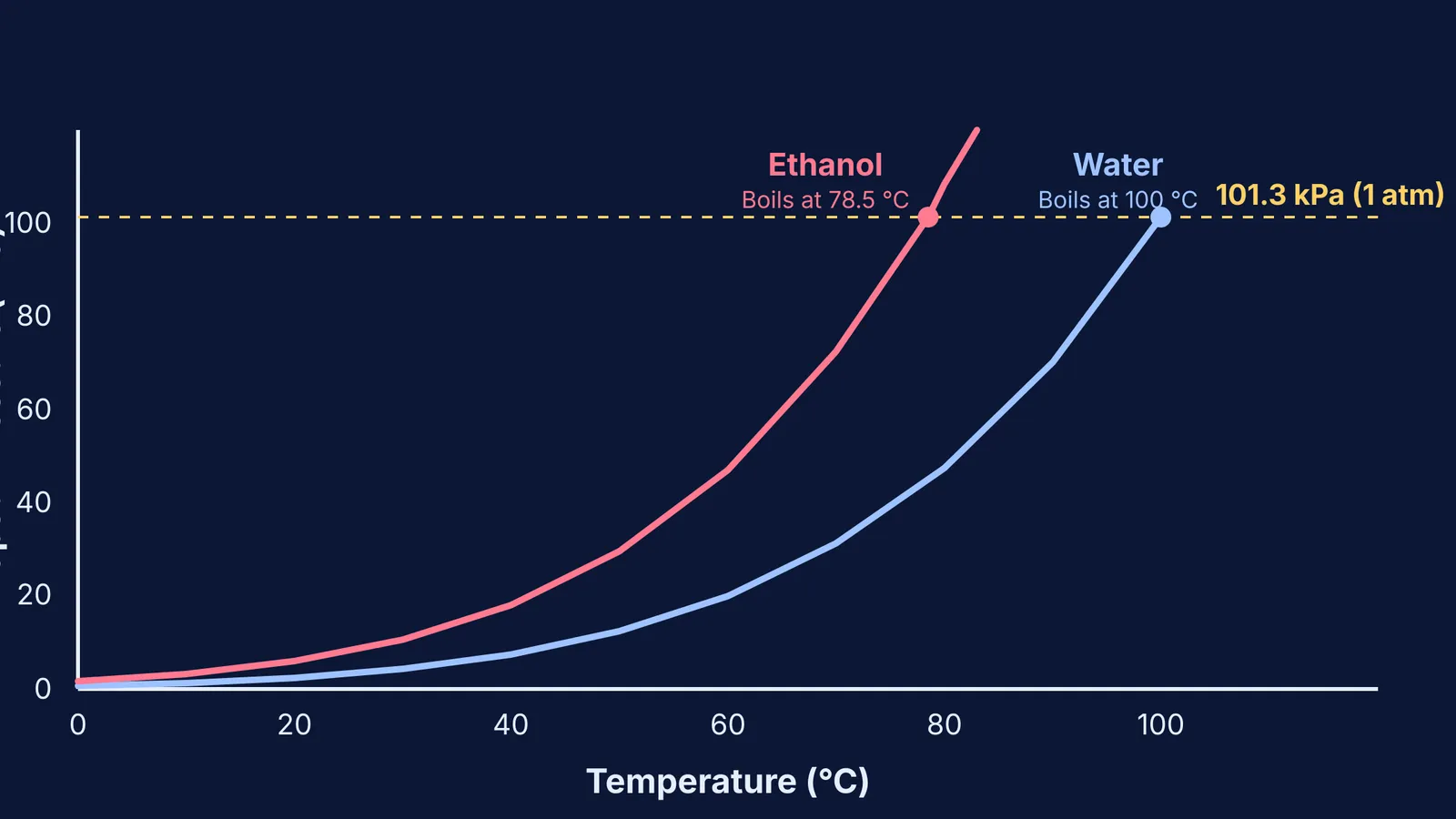
Ethanol's weaker, less extensive network means its molecules require less energy to escape. This is why ethanol reaches its boiling point at 78.5 °C, while water requires 100 °C, according to The Engineering ToolBox. At normal room temperature, ethanol has a much higher vapour pressure. Its molecules simply have an easier time breaking their bonds and crossing into the air as a gas. You can explore how adding solutes affects this process by testing predictions in a Raoult's law simulation.
In chemistry, a substance that easily turns into a gas at room temperature is called volatile. Ethanol is highly volatile precisely because its intermolecular forces are relatively weak.
Why does alcohol feel so cold on your skin?
When a liquid evaporates, it takes heat away with it. The heat required to turn a liquid into a gas is called the latent heat of vaporisation.
Water actually has a massive latent heat of vaporisation—around 2256 kJ/kg—compared to ethanol at 846 kJ/kg, according to data from The Engineering ToolBox. This means evaporating a gram of water removes nearly 2.7 times as much heat from your body as a gram of ethanol. That is why we sweat water when we exercise rather than alcohol: water is a far more efficient coolant for the human body.
So why does alcohol feel colder? Because of the speed. Ethanol evaporates so much faster that it pulls its heat away in a sudden rush. A drop of alcohol might evaporate in a flash, ripping a small amount of heat from your skin almost instantly, creating a sharp chill. A drop of water takes much longer, drawing more heat overall but doing it so slowly that your blood flow easily warms the skin back up. The sudden drop in temperature makes the alcohol feel colder, much like how metal feels colder than wood because it conducts heat away from your hand faster.
An evaporation experiment to try at home
You can test the cooling rate of evaporation with a simple experiment using just water and alcohol (like medical spirit or plain liquid hand sanitiser).
Place a drop of room-temperature water on the back of your left hand.
Place a drop of room-temperature alcohol on the back of your right hand.
Blow gently across both hands at the same time.
You will immediately feel a sharp, icy chill on your right hand as the alcohol's weak hydrogen bonds break and the molecules escape into the air. By the time the alcohol is completely gone, the water drop on your left hand will likely still be sitting there, cooling you slowly but steadily.