On this page
Class 12 asks you to run two races at once: board exams and, for many of you, JEE or NEET. The CBSE date sheet for 2027 has the Class 12 board exams starting on 16 February 2027. Between now and then, your motivation will rise and fall. Here is why, and a plan for the dips.
Why does motivation drop during Class 12?
It is not just you. In a study of 1,051 students in grades 3 to 8, Jennifer Henderlong Corpus, Megan McClintic-Gilbert and Amynta Hayenga found that both intrinsic and extrinsic motivation fell from autumn to spring within a single school year, and the drop in intrinsic motivation was especially steep for the adolescents in grades 6 to 8. Those students were younger than you and studied in the United States, so treat it as a pattern, not a forecast.
The same paper offers a hopeful note. The changes were partly explained by how students saw their school, and the authors suggest that a school-wide focus on mastery, meaning getting better at the work rather than beating others, may limit the decline. You can bring that focus into your own day, even if your coaching centre posts rank lists.
How do small goals help you stay motivated?
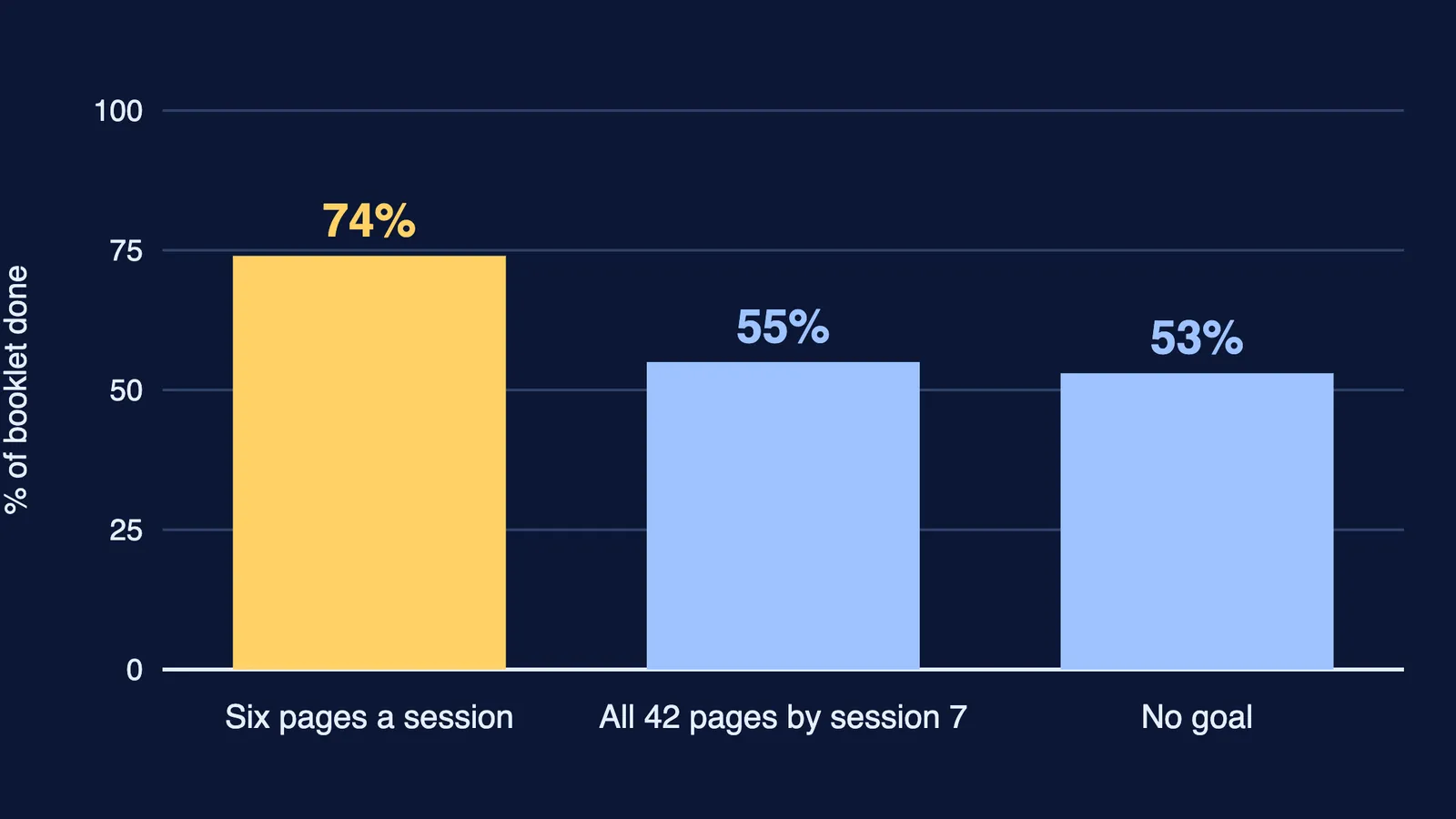
In a 1981 experiment, Albert Bandura and Dale Schunk worked with 40 children, aged 7 to 10, who had serious gaps in subtraction and little interest in it (Journal of Personality and Social Psychology). Three groups worked through the same 42-page self-teaching booklet in 30-minute sessions, while a fourth group, used for comparison, did not. One group was invited to aim for six pages per session, a second to finish all 42 pages by the seventh session, and a third was given no goal.
By the end of four sessions, the six-pages group had completed 74% of the material, against 55% for the big-goal group and 53% for the no-goal group; the gap with the big-goal group was only marginally significant. The six-pages group also grew more confident in their subtraction, and when later given free choice of activities, 90% of them chose to do subtraction problems, compared with about 40% of children in the other groups.
The limits matter: this was one small study from 1981, with young children and simple maths, and it has not been repeated with exam-age students. The idea it supports is still useful: a goal you can finish today gives you a win today, and those wins add up to confidence. "Finish the syllabus by December" is a distal goal. "Do the 12 rotational motion problems after dinner" is a proximal one.
What should you do when you hit a slump?
Plan for slumps before they arrive. Use this four-step check when a week goes badly:
Check sleep first. The American Academy of Sleep Medicine recommends that teenagers aged 13 to 18 sleep 8 to 10 hours in every 24 hours. Short sleep can feel like lost interest.
Shrink the goal, do not drop it. On a bad day, keep a floor: one revision sheet, ten problems, one diagram. Our 45-minute minimum study plan shows what that floor can look like.
Track what you did, not what you missed. Write three small wins every night.
Protect one rest block a week. Rest is part of the plan, not a reward you must earn.
If the flatness lasts for weeks, look at our guide to the signs of student burnout and a week-long recovery plan.
A weekly plan built on small goals
Here is how one week might look for a PCM student balancing boards and JEE:
Sunday evening: write five goals for the week, each finishable in one sitting. Example: "Electrochemistry NCERT exercise, questions 1 to 10."
Monday to Friday: one proximal goal per subject per day, written on a sticky note before school.
Saturday: one timed mock or sample paper, then a short review of mistakes only.
Sunday afternoon: rest. No books.
For turning a goal into a plan you actually follow, try the WOOP and if-then method, for example: "If I feel like scrolling after dinner, then I will open the first problem before I touch my phone."
When a small goal is a set of problems, the Fermi Problem Library has worked problems with a step-by-step solver that explains the reasoning rather than printing an answer, so a stuck problem does not end the session.
When should you talk to someone?
Low motivation now and then is part of a long year. If you feel hopeless, cannot sleep or eat properly, or feel low most days for two weeks or more, talk to a parent, a teacher or your school counsellor. You can also call Tele MANAS on 14416, the government's free mental health helpline, which is open round the clock in around 20 languages.