On this page
The chemistry worksheet waits, your show autoplays, and an hour later you feel guilty about both. Temptation bundling turns that fight into a deal: the thing you want becomes something you only get while doing the thing you should.
The idea comes from a field experiment by Katherine Milkman, Julia Minson and Kevin Volpp. It was about exercise, not exams. Here is what they found, its limits, and how to adapt it.
What is temptation bundling?
Temptation bundling is pairing an instantly enjoyable "want" activity with a "should" activity whose rewards come later, and allowing yourself the want only during the should. That is how Milkman and colleagues defined it in their 2014 paper in Management Science.
It fixes two problems at once: the hard task feels nicer, and the indulgence stops feeling guilty.
What did the temptation bundling study find?
The researchers recruited 226 students, faculty and staff at a large US university for a 10-week gym study in autumn 2011; 86% were undergraduates, according to the full text of the paper.
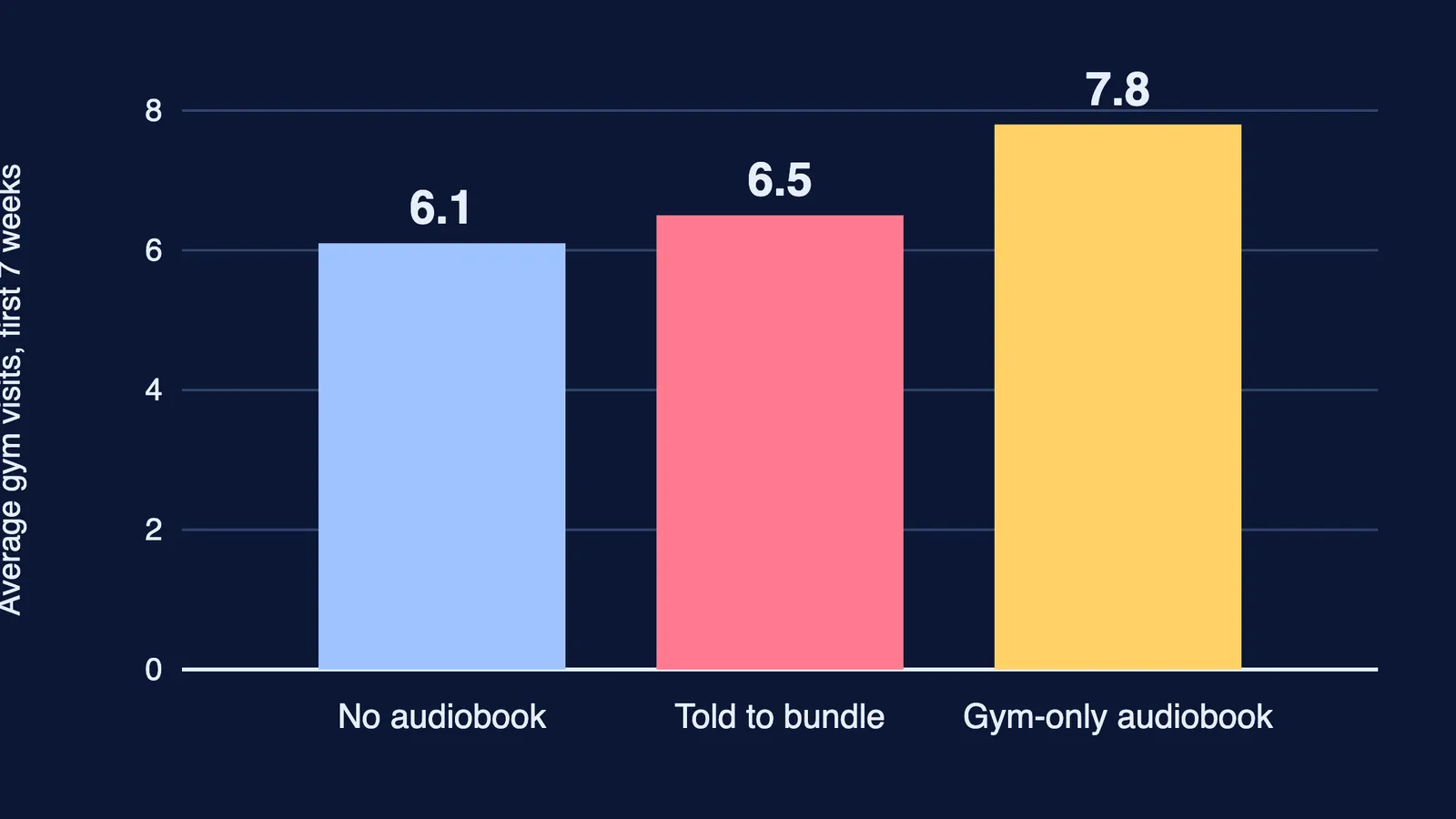
People were randomly put into three groups:
Full bundle: page-turner audiobooks on an iPod that stayed locked at the gym.
Encouraged only: the same audiobooks to take home, with advice to listen only while working out.
Control: a gift card instead.
In the first seven weeks, the gym-only group averaged 7.8 gym visits, the encouraged group 6.5 and the control group 6.1, as the paper reports. The abstract describes the early effect as 51% more gym visits for the full bundle and 29% for the encouraged group.
After the study, 61% of participants opted to pay for gym-only access to an audiobook, the authors found.
Does temptation bundling still work after the novelty wears off?
Partly. In the 2014 study the effect shrank over time and largely disappeared after the Thanksgiving break, when the gym closed and routines broke, as described in the full paper.
In a 2020 field experiment with 6,792 people, Erika Kirgios, Milkman, Angela Duckworth and colleagues found that audiobooks plus encouragement to bundle raised the chance of a weekly workout by 10 to 14% compared with people who got neither, during the four-week programme and for up to 17 weeks after it. Encouragement added only a modest extra effect over simply handing out the audiobook.
So three limits matter for you:
The effect is real but smaller than the first study's early numbers suggested.
In the first study it vanished after a break, so plan for restarts after Diwali or exam holidays.
Both studies tested exercise. We found no trial of temptation bundling for studying, so treat what follows as a sensible adaptation, not proven exam advice.
What can you pair with studying?
Match the want to how much thinking the task needs.
Low-thinking tasks (rewriting notes neatly, colouring diagrams, organising a formula sheet, walking while revising flashcards): a favourite podcast, a comfort playlist or a series in the background can work.
Hard thinking (new concepts, timed problem sets, mock tests): pick pleasures that do not use words. A special snack, your favourite spot on the terrace, good chai, a fancy pen, or a study partner you like. Our guide on when music helps and when it hurts while studying explains why lyrics are risky here.
The rule that makes it a bundle: the want happens only during the task. If you can have the chai any time, it is just chai.
If the bundle gets you to the desk but you freeze on question one, the Fermi Problem Library has worked problems with a step-by-step solver that explains the reasoning rather than printing an answer.
A 7-day temptation bundling plan
Day 1: List three wants you already spend time on and three study tasks you keep avoiding.
Day 2: Make one pairing for a low-thinking task. Write it down: "This podcast only while I rewrite physics notes."
Day 3: Make one pairing for a hard task, using a non-verbal want: "Masala chai only during my 40-minute maths set."
Day 4: Lock it. Delete the podcast app from your phone's home screen or ask a sibling to keep the special snack.
Day 5: Notice whether you started faster. Mark yes or no.
Day 6: Swap any want that has gone stale. Novelty fades, as the studies showed.
Day 7: Keep what worked, drop what did not, and plan your restart for after the next holiday.
If you treat the want as a prize for finishing, that is a reward rather than a bundle; our piece on whether rewards help or hurt motivation covers that difference. And if avoiding study comes from dread rather than boredom, read why procrastination is about feelings, not laziness.
If low mood or stress stays with you for weeks, talk to a trusted adult or school counsellor, or call Tele MANAS on 14416, the government's toll-free mental health helpline, listed in this Health Ministry release.