On this page
Chapter 8 of Exploring Society: India and Beyond, NCERT's Class 6 Social Science textbook (code fees1, First Edition June 2024; the current file carries a February 2026 reprint), is short but packed with examples (NCERT Chapter 8 PDF; book prelims). Here is what it says, a model answer and questions to practise.
CBSE's 2026-27 curriculum page covers Classes IX to XII only (CBSE curriculum 2026-27). Classes 6 to 8 follow the NCERT book, and this chapter is assessed by the school.
What does 'unity in diversity' mean in Class 6?
India shows huge variety, yet shared threads run beneath it: the book calls this "Many in the One". After opening quotations from Rabindranath Tagore and Sri Aurobindo, it asks what the phrase means, which kinds of diversity stand out, and how to spot the unity underneath.
It sets the scale with a few figures (NCERT, Chapter 8):
India has over 1.4 billion people, roughly 18 percent of the global population.
The Anthropological Survey of India, a national body, ran the "People of India" project in the late 20th century, covering 4,635 communities in every State.
That survey, directed by the anthropologist K.S. Singh, counted 325 languages written in 25 scripts.
The book also quotes British historian Vincent Smith, who used the phrase "unity in diversity".
What are the four examples in the chapter?
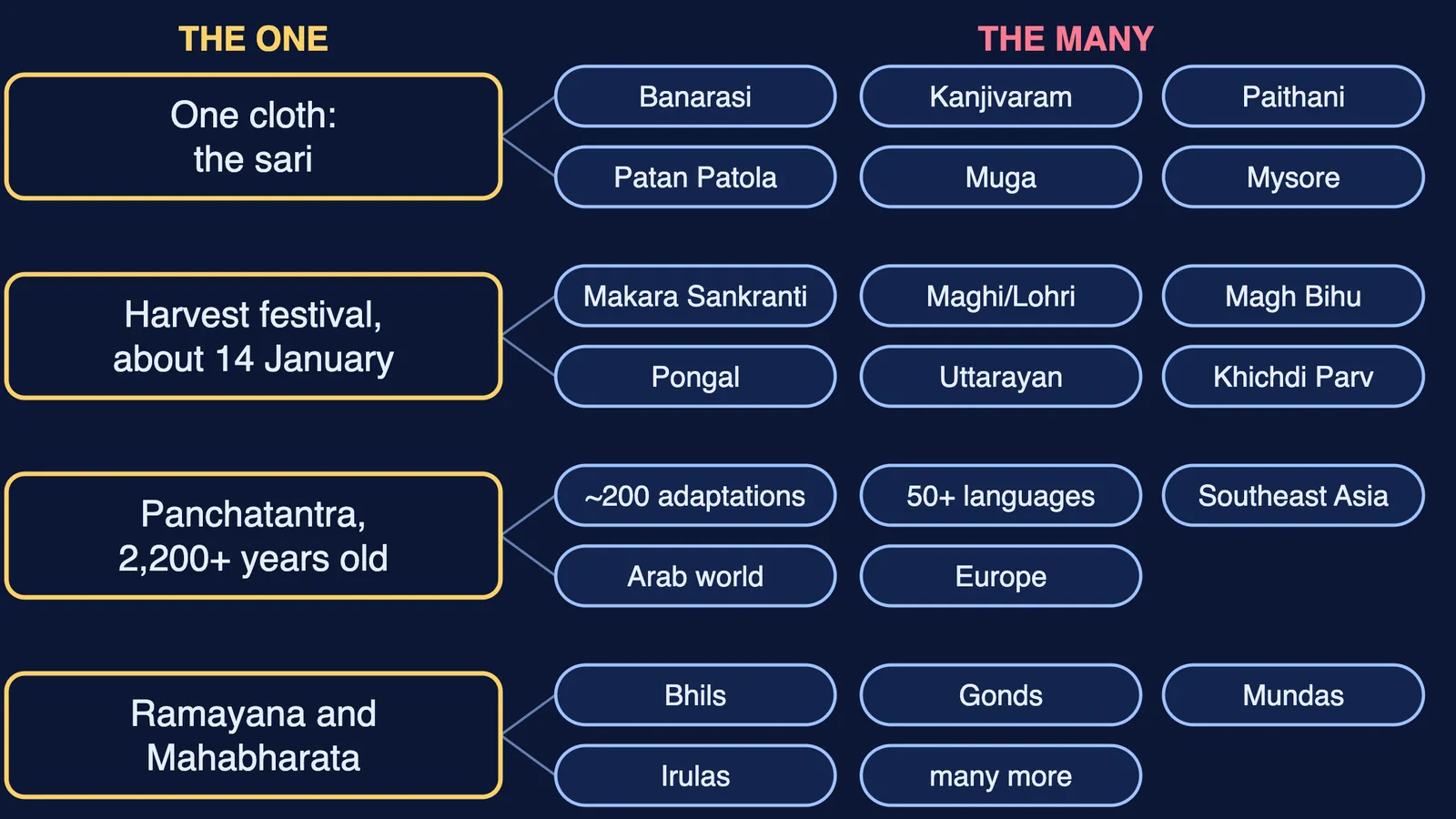
Each follows one pattern: a shared base, many forms (NCERT, Chapter 8).
Food. Staple grains are common to almost every region: cereals (rice, wheat, barley), millets (bajra, jowar, ragi) and pulses. Spices such as turmeric and cumin are used nationwide. Different combinations give endless dishes.
Clothing. The sari is one unstitched length of cloth, worn in most of India in hundreds of varieties. The book names silk types including Banarasi, Kanjivaram, Paithani, Patan Patola, Muga and Mysore. A stone relief from Vaishali, in present-day Bihar, takes it back a few centuries BCE.
Festivals. On or around 14 January, many regions mark the start of the harvest season with a festival that has many names, among them Makara Sankranti, Maghi/Lohri, Magh Bihu, Pongal, Uttarayan and Khichdi Parv.
Literature. The Panchatantra, a Sanskrit collection of animal stories at least 2,200 years old, has an estimated 200 adaptations in more than 50 languages, carried as far as Southeast Asia, the Arab world and Europe. The Ramayana and the Mahabharata, together around 7,000 pages in the original, have countless regional and folk retellings; one scholar counted about a hundred folk Mahabharata versions in Tamil Nadu alone.
Many communities, including tribal communities such as the Bhils, Gonds and Mundas, keep their own versions, often with legends that the heroes visited their region. In the Nilgiris, Irula tribals maintain a shrine to the five Pandava brothers.
How do you write a 'unity in diversity' answer?
Use three steps: name the common thread (the One), list its forms (the Many), then say what the variety adds.
Question (3 marks, our suggestion): How does the mid-January harvest festival show "Many in the One"?
Model answer:
The One: across many regions, a festival marking the start of the harvest season falls on or around 14 January.
The Many: it goes by different names, such as Makara Sankranti, Maghi/Lohri, Magh Bihu, Pongal, Uttarayan and Khichdi Parv.
What it adds: the names do not split it into unrelated events; they show the chapter's closing idea that diversity enriches rather than divides.
How does Chapter 8 connect to the rest of the book?
It sits in Theme C, on cultural heritage, straight after Chapter 7, "India's Cultural Roots", so revise the two together (book contents).
Theme B's history chapters come before it; our guide to the first cities of the Indus valley covers Chapter 6.
Theme D follows, from "Family and Community" (Chapter 9) to local government; see our Panchayati Raj guide for Chapter 11.
Which practice questions should you try?
Marks are our suggestion.
(1 mark) Which national organisation carried out the People of India project?
(2 marks) Name two ways in which saris differ from one another, according to the chapter.
(3 marks) Using two figures from the chapter, show how the Panchatantra went from "one" to "many".
(5 marks) Using food or the epics, explain the shared base, the varieties and why diversity enriches.
Answer hints: (1) the Anthropological Survey of India; (2) any two of fabric (cotton, silk, now synthetic), method of weaving and designing, colour, and way of draping; (3) at least 2,200 years old in Sanskrit, and about 200 adaptations in more than 50 languages.
Not sure what to revise first? Fermi's AI tutor works out what you already know and builds a plan for the session.