On this page
Chapter 12 of the new Class 6 Social Science book takes local government from the village to the city. The book is *Exploring Society: India and Beyond* (NCERT code fees1, First Edition June 2024), and the chapter closes Theme D, "Governance and Democracy" (NCERT textbook contents).
CBSE publishes no separate 2026-27 curriculum for Classes 6 to 8; these classes follow the NCERT book, and the chapter is assessed by the school.
What are urban local bodies?
Urban local bodies are the local government of towns and cities (NCERT Chapter 12). They are decentralised: local people have a direct say in how their area is run.
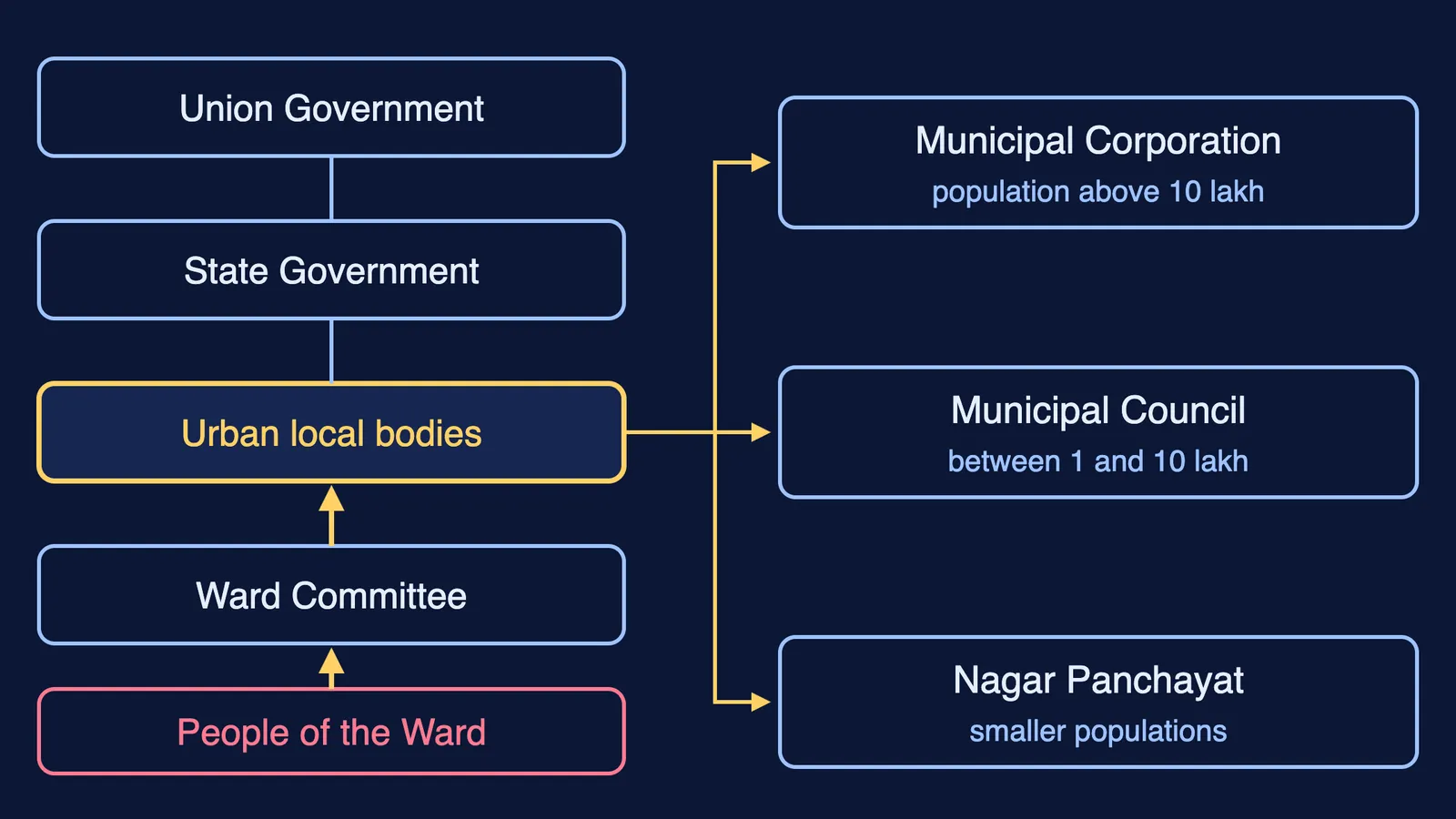
In the chapter's pyramid of government, the Union Government is at the top, the State Government below it and local government at the base. The base has two sides: Panchayati Raj institutions for villages (Chapter 11) and urban local bodies for towns and cities.
Every city or town is divided into smaller units called wards. A ward committee might run a health camp or a campaign against single-use plastics. It also watches for problems such as a leaking pipe, a choked drain or a broken road, and reports them to the authorities. How wards work differs from State to State, depending on each State's rules.
What do urban local bodies do?
The chapter lists a wide range of work (NCERT Chapter 12):
looking after infrastructure
collecting and disposing of garbage
maintaining the burial ground
checking that government schemes are carried out
collecting local taxes and fines
some planning for the area's economic and social development
A figure in the chapter simplifies the Indore Municipal Corporation's services: property tax, water charges, solid waste management, trade licences, marriage certificates, fire services and grievances, plus on-request services such as a water tanker or an ambulance. The book notes that Indore has been named India's cleanest city under the government's Swachh Survekshan scheme seven years in a row.
Citizens have a part too. In a participatory democracy, sorting waste as asked makes garbage collection easier, and reporting a street leak quickly saves water.
The book adds that an East India Company charter issued the year before made Fort St. George and all land within 16 km of it a corporation, and that a Parliamentary Act of 1792 let the corporation levy municipal taxes in the city (NCERT Chapter 12).
Which towns get a Municipal Corporation, Council or Nagar Panchayat?
The highest urban body depends on population (NCERT Chapter 12):
A city with a population above 10 lakh has a Municipal Corporation (Mahanagar Nigam). Chennai and Indore are the book's examples.
A city of between 1 and 10 lakh has a Municipal Council (Nagar Palika) at the top.
For cities and towns with smaller populations, it is a Nagar Panchayat.
Worked example: name the body and route the problem
Three made-up towns, sorted by the book's limits:
Meghpur, 14,50,000 people, is 14.5 lakh. That is above 10 lakh, so its highest body is a Municipal Corporation.
Kalpanagar, 2,40,000 people, is 2.4 lakh. That is between 1 and 10 lakh, so it has a Municipal Council.
Saritaganj, 65,000 people, is 0.65 lakh. That is below 1 lakh, a smaller population, so it has a Nagar Panchayat.
Now a problem in Kalpanagar: a blocked drain near the market floods the road. In the book, ward committees watch for exactly this kind of problem and report it to the authorities, and citizens who spot a problem should report it promptly. The residents' duty is care for their area, such as following waste-segregation instructions so less rubbish reaches the drain.
How does this chapter connect to the rest of the book?
Chapter 10 introduces the three levels of government (local, State and national) and the three organs (legislature, executive, judiciary). Chapter 11 fills in the rural side of the local level, and this chapter fills in the urban side (NCERT Chapter 10).
For the rural side, read our guide to Panchayati Raj, from gram sabha to zila parishad. Theme E turns to work, previewed in our guide to rural and urban livelihoods. Municipalities return in Class 11: see local governments and the 73rd and 74th Amendments.
Practice questions (marks are our suggestion)
What is a ward? Name two things a ward committee may do. (2 marks)
A town has 4 lakh people. What is its highest urban body, and what is its other name? (1 mark)
Give two facts the chapter tells you about the Madras Corporation. (2 marks)
List three functions of urban local bodies and say which one raises money for them. (3 marks)
Using one example, explain why a city's local body needs its citizens to do their duties. (3 marks)
Not sure where to start revising? Fermi's AI tutor works out what you already know and builds a plan for the session.