

On this page
A livelihood is the work a person does to earn the money, food and shelter their family needs. In Class 6 you compare two settings: the village, where much of the work depends directly on land, water and animals, and the city, where most people earn by making things or providing services. This guide gives you the definitions, the real numbers and a worked example.
In the current NCERT book, Exploring Society: India and Beyond, this topic sits in Theme E, "Economic Life Around Us", in Chapter 13 (The Value of Work) and Chapter 14 (Economic Activities Around Us), according to the book's official contents page. If your school uses a different book, check its chapter list; the ideas below apply either way.
What are rural livelihoods in Class 6?
Rural livelihoods split into two groups.
Farm work: growing crops, working as a labourer on someone else's field, raising cattle, goats or poultry, and fishing.
Non-farm work: running a village shop, driving a tractor or tempo, weaving, pottery, carpentry, repairing pumps and phones, or working at a dairy.
Many families do both. A household might grow wheat in one season and run a tea stall or take construction work in another, because farm income depends on rain and harvest.
NCERT gives the textbook name for work that depends on nature: activities "in which people are directly dependent on nature to produce goods are known as primary activities" (NCERT Chapter 14). The same chapter lists agriculture, mining, fishing, raising livestock and forestry as the most common primary activities.
Village work also connects to the village's own institutions. Our guide to Panchayati Raj for Class 6 shows who decides on roads, water and other things farmers depend on, and the story of how the Amul model works through village societies shows village dairy farmers selling milk through a cooperative.
What are urban livelihoods?
In a city, most families buy their food rather than grow it. Work falls into three broad kinds you can name in an exam.
Self-employed work: street vendors selling vegetables or snacks, auto drivers, tailors and small shopkeepers. They earn from their own sales, so income changes day to day.
Factory and workshop work: making clothes, cars, medicines or furniture. NCERT calls this the secondary sector, where people "transform" primary outputs "to produce goods" (NCERT Chapter 14).
Office and service jobs: banks, schools, hospitals, software firms and hotels. NCERT says the tertiary sector "is also called the service sector" (same chapter).
Street vendors have their own national law, the Street Vendors (Protection of Livelihood and Regulation of Street Vending) Act, 2014, and a government loan scheme, PM SVANidhi, described on its official site as "a special micro-credit facility for street vendors".
How do village and city work compare in real numbers?
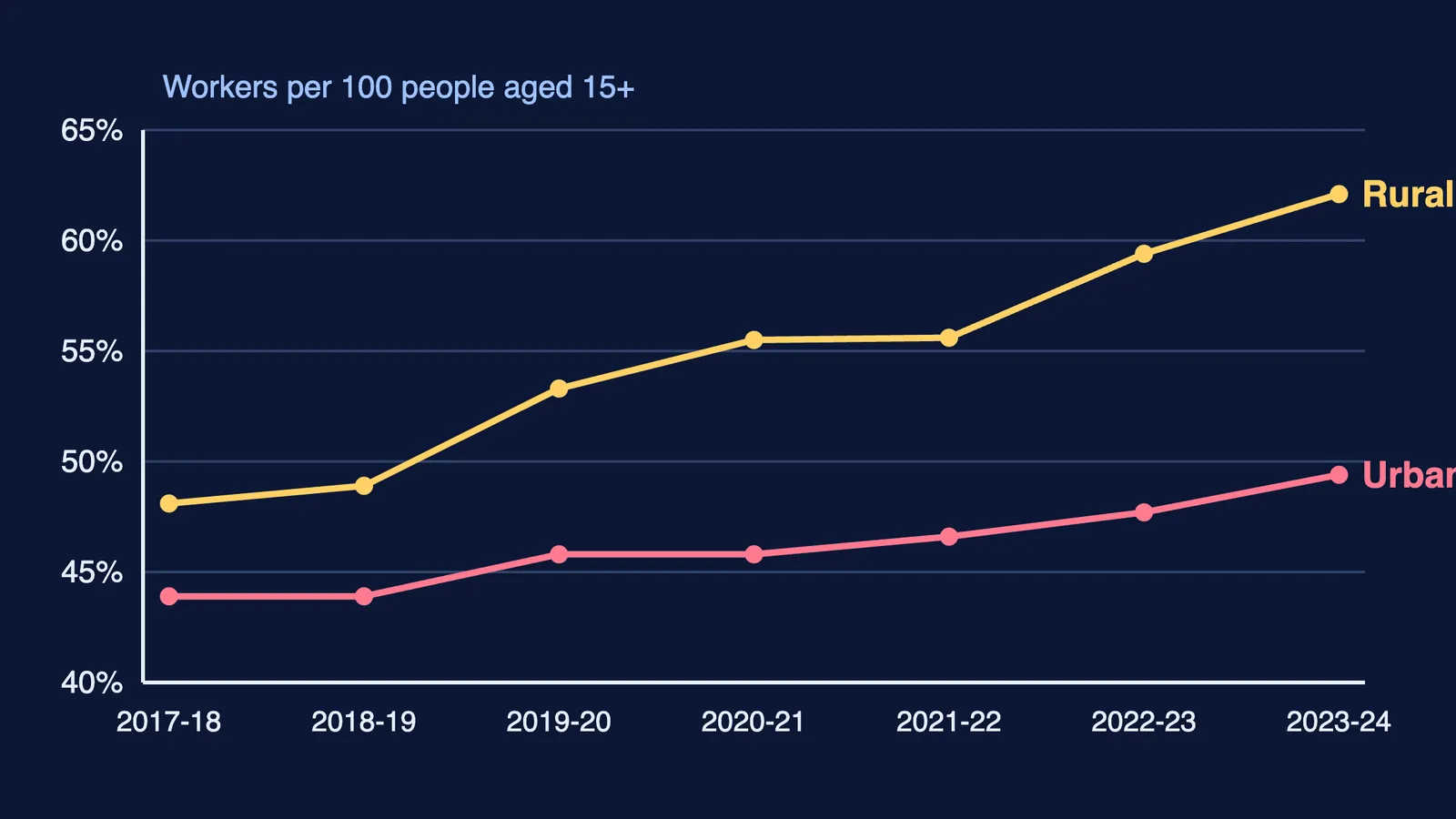
The government's Periodic Labour Force Survey measures who is working. For July 2023 to June 2024, the worker population ratio for people aged 15 and over was 62.1% in rural areas and 49.4% in urban areas (MoSPI PLFS 2023-24 press note).
The same press note gives the unemployment rate as 2.5% in rural areas and 5.1% in urban areas for 2023-24.
In an answer, say what the numbers show and nothing more: a larger share of rural adults is counted as working, and a larger share of the urban labour force (people working or looking for work) has no job.
How does a tomato connect the village and the city?
Here is a worked example that uses all three sectors in one chain.
A farmer in a village grows tomatoes. Primary, because the work depends directly on soil and water.
A truck driver carries crates to the city market. Tertiary, a transport service.
Part of the crop goes to a factory that makes ketchup. Secondary, because raw tomatoes are processed into a new product.
A street vendor sells fresh tomatoes from a cart. Tertiary, a trading service, and self-employed.
A bank clerk processes the vendor's loan. Tertiary, an office job.
Draw this as a flow chart and you have a diagram for a long answer. For more on the farm end of the chain, our Class 10 agriculture notes on farming types and seasons go a step further.
How can you study this chapter in 30 minutes?
10 minutes: list ten jobs you have seen this week and sort each into farm or non-farm, and primary, secondary or tertiary.
10 minutes: interview one family member. Ask: What work do you do? Is your income the same every month? What would make your work easier?
10 minutes: write the tomato chain for another product, such as milk, cotton or fish.
If Class 6 science and maths are next on your list, Fermi's AI tutor can work out what you already know and build a plan for the session, so you sit down to a clear next step.


