

On this page
Agriculture is Chapter 4 of the NCERT Class 10 geography textbook, Contemporary India II. These notes cover three things: the types of farming, the three cropping seasons, and what each major crop needs. They follow the NCERT chapter on agriculture closely, so you can write every number below in your answer.
What are the types of farming in India?
The NCERT chapter describes farming that ranges from subsistence to commercial. Learn four types, each with one defining feature and one example.
Primitive subsistence farming: small patches, simple tools (hoe, dao, digging sticks) and family labour. It depends on the monsoon and the soil's natural fertility. Its slash-and-burn form is called jhumming in the north-eastern states.
Intensive subsistence farming: found where many people depend on little land. It is labour-intensive and uses high doses of biochemical inputs and irrigation.
Commercial farming: heavy use of modern inputs such as high yielding variety (HYV) seeds, fertilisers and pesticides. Rice is a commercial crop in Haryana and Punjab but a subsistence crop in Odisha.
Plantation farming: a single crop grown over a large area for industry, such as tea in Assam and North Bengal or coffee in Karnataka.
What are kharif, rabi and zaid crops?
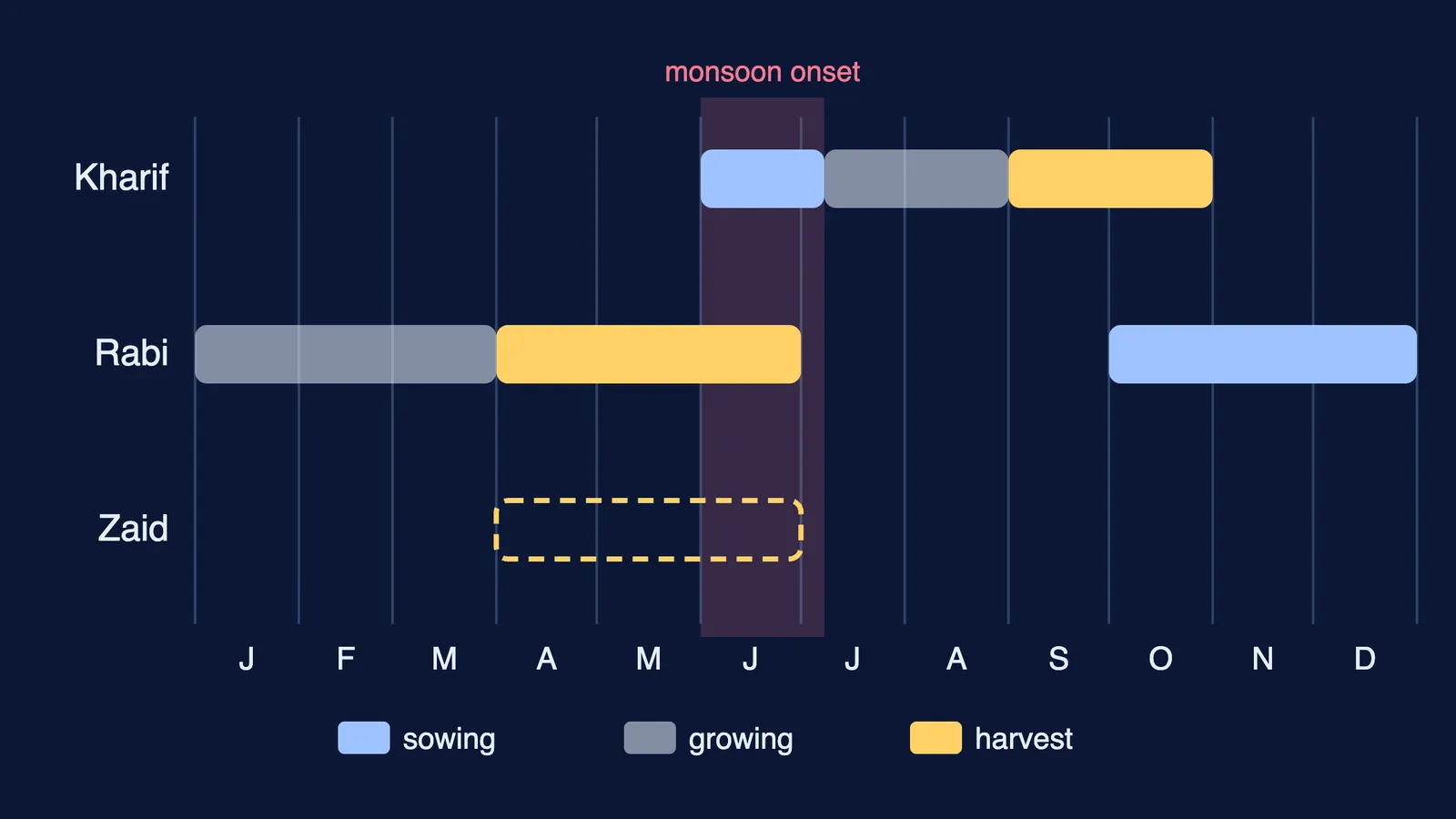
India has three cropping seasons: rabi, kharif and zaid, according to the NCERT textbook.
Rabi: sown in winter from October to December and harvested in summer from April to June. Examples: wheat, barley, peas, gram and mustard. Winter rain from western temperate cyclones helps these crops.
Kharif: sown when the monsoon arrives and harvested in September and October. Examples: paddy, maize, jowar, bajra, tur (arhar), moong, urad, cotton, jute, groundnut and soyabean.
Zaid: a short summer season between rabi and kharif. Examples: watermelon, muskmelon, cucumber, vegetables and fodder crops.
The southwest monsoon normally reaches Kerala by June 1 and covers the whole country by July 8, according to IMD's normal dates as reported by Business Standard. So kharif sowing can begin earlier in the south than in the north-west.
What conditions do the major crops need?
These are the conditions the NCERT chapter gives for each crop.
Rice (kharif): temperature above 25°C, high humidity and annual rainfall above 100 cm. Canals and tubewells let it grow in drier Punjab and Haryana.
Wheat (rabi): a cool growing season, bright sunshine at ripening, and 50 to 75 cm of rain spread evenly. Its two main zones are the Ganga-Satluj plains and the black soil region of the Deccan.
Maize (kharif): 21°C to 27°C and old alluvial soil. In Bihar it is also grown in the rabi season.
Millets: jowar is mostly rain-fed; bajra grows well on sandy and shallow black soils; ragi suits dry regions and is rich in iron and calcium.
Pulses: need less moisture. NCERT says all of them except arhar restore soil fertility by fixing nitrogen from the air.
Sugarcane: 21°C to 27°C and 75 to 100 cm of rain. It takes almost a year to grow.
Cotton (kharif): the drier parts of the Deccan's black soil, high temperature, light rainfall or irrigation, 210 frost-free days and 6 to 8 months to mature.
Tea: a warm, moist, frost-free climate all year, deep fertile well-drained soil, and abundant cheap, skilled labour.
For the nutrition side of millets, read our explainer on why ragi, jowar and bajra are healthy. For how pulses restore soil, see why crop rotation with legumes keeps soil fertile. Nitrogen fixation is also a biology idea, and the Fermi Concept Library gives each biology concept its own lesson.
How do you write a 3-mark answer on crop seasons?
Here is a worked example. Question: "Distinguish between rabi and kharif crops."
Sowing time: rabi is sown in winter (October to December); kharif is sown when the monsoon arrives.
Harvest time: rabi is harvested from April to June; kharif in September and October.
Examples: rabi includes wheat, gram and mustard; kharif includes paddy, cotton and groundnut.
One point per line, the same basis for both crops, and an example for each. That structure works for any "distinguish" question in this chapter.
A 20-minute plan to make these notes stick
Re-reading feels productive but checks nothing. Do this once today and again in three days.
Minutes 0 to 5: draw a January to December line and mark when each season is sown and harvested.
Minutes 5 to 12: from memory, write the eight crops above with their season, temperature and rainfall. Leave gaps blank.
Minutes 12 to 17: check against the textbook and fill the gaps in a different colour.
Minutes 17 to 20: answer one "distinguish" question aloud, using the worked example's structure.
The coloured gaps are your revision list. Our week-by-week plan for Class 10 boards shows where a chapter like this fits. If you are not sure where to start across subjects, Fermi's AI tutor can work out what you already know and build a plan for the session.


