

On this page
Your grandparents may have eaten ragi mudde, jowar bhakri and bajra roti without ever calling them superfoods. India proposed an International Year of Millets, and the UN General Assembly adopted it in March 2021 for 2023. Here is what the numbers say.
Why are millets healthy? What India's food tables say
The most reliable numbers come from the Indian Food Composition Tables 2017, published by ICMR's National Institute of Nutrition in Hyderabad. They analysed composite samples of foods collected across six regions of India. All values below are per 100 g of raw grain or flour.
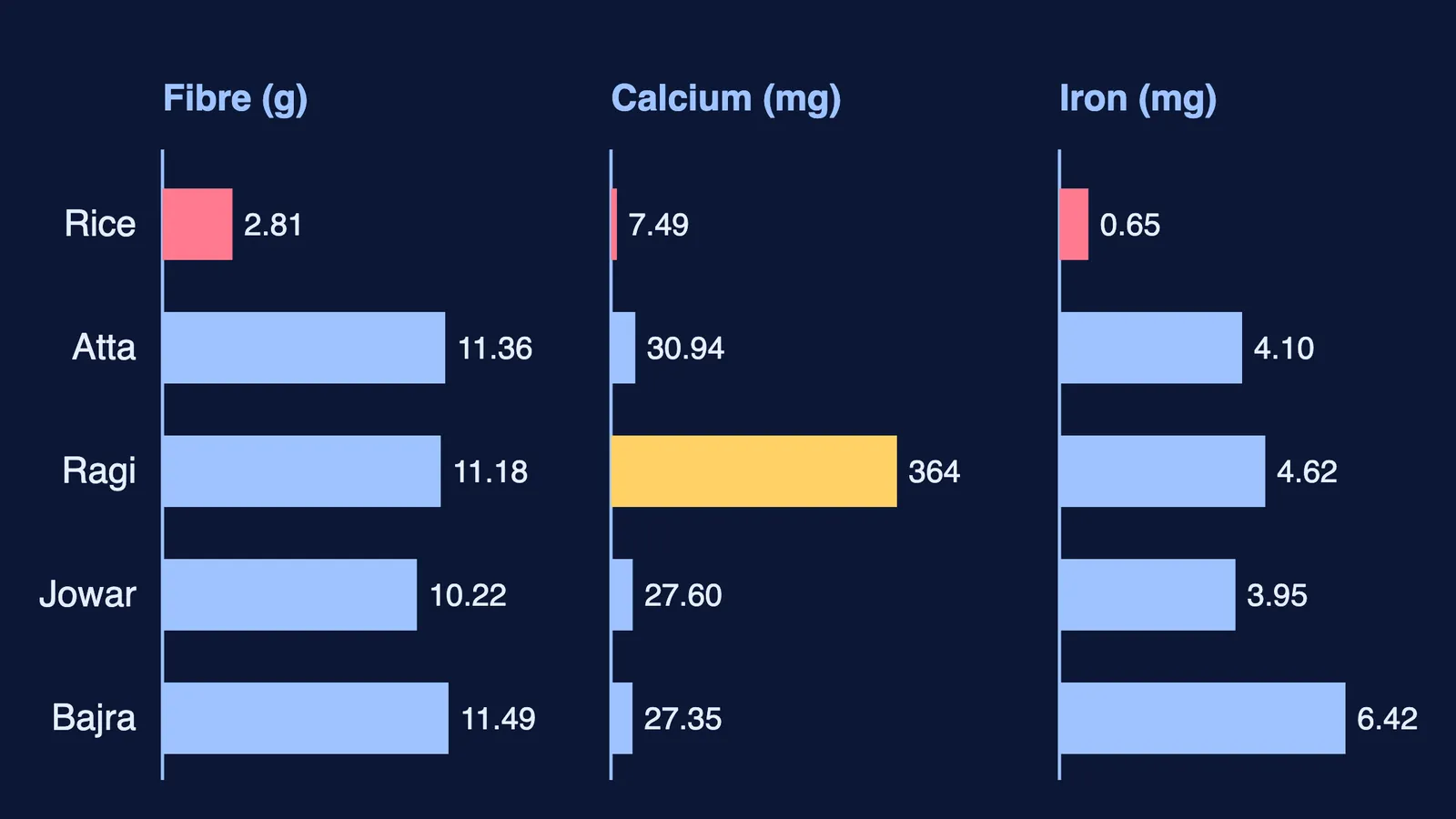
Fibre: ragi 11.18 g, jowar 10.22 g and bajra 11.49 g, against 2.81 g for raw milled rice and 2.76 g for refined wheat flour (maida).
Calcium: ragi 364 mg, against 7.49 mg for milled rice and 30.94 mg for wheat atta.
Iron: bajra 6.42 mg, ragi 4.62 mg and jowar 3.95 mg, against 0.65 mg for milled rice and 4.10 mg for atta.
So the three millets carry between 3.6 and 4.1 times the fibre of polished rice. One caveat: whole wheat atta has 11.36 g, about the same as the millets. The big gap is between millets and *refined* grains, not between millets and every grain.
How much calcium does ragi really have?
According to the IFCT 2017 minerals table, ragi has 364 mg of calcium per 100 g. That is nearly 12 times the calcium in wheat atta and almost 50 times the calcium in milled rice. No other grain in the table's cereals and millets section comes close; the next highest, quinoa, has 198 mg. Jowar and bajra each have about 27 mg, close to atta.
Teenagers are still building bone, so this matters in a vegetarian home where milk is not part of every meal.
Do millets raise blood sugar less than rice and wheat?
On average, yes. The glycaemic index (GI) measures how fast a food raises blood glucose compared with pure glucose. A 2021 systematic review and meta-analysis in Frontiers in Nutrition by Anitha and colleagues pooled studies from around the world. It found a mean GI of 52.7 for millets, against 71.7 for milled rice and 74.2 for refined wheat. Ragi, bajra and jowar themselves sat in the intermediate band (GI 55 to 69), 13 to 35% lower than high-GI comparison foods. In people with diabetes, eating millets over a long period lowered fasting blood glucose by 12% and after-meal glucose by 15%.
The spread was wide (a standard deviation of 10.3 GI points), and both the type of millet and how it is processed made a difference. If anyone in your family has diabetes, plan diet changes with their doctor or a dietitian. This post is not medical advice.
Is the iron in bajra and ragi actually absorbed?
Only part of it. Millets contain phytic acid, which binds iron in the gut. In a 2022 study of Indian women, only 1.3% of the iron in a high-phytate ragi variety was absorbed. A naturally low-phytate ragi line raised that to 3.7%.
Preparation helps. A 2021 systematic review and meta-analysis by Anitha and colleagues reports that fermenting and sprouting millets raised bioavailable iron by 3.4 and 2.2 times in laboratory tests. Across 19 studies of people with anaemia, haemoglobin rose by 13.2% with regular millet meals or drinks, against 2.7% on regular diets.
For the chemistry of how phytic acid holds on to metal ions, the Fermi Concept Library has a lesson for every concept in chemistry and biology.
How can your family add millets this week?
Here is a worked example using the IFCT 2017 values. Swap 75 g of raw milled rice at dinner for 75 g of ragi flour, made as mudde or roti:
Fibre goes from about 2.1 g to 8.4 g.
Calcium goes from about 6 mg to 273 mg.
Iron goes from about 0.5 mg to 3.5 mg (before absorption losses).
A gentle one-week plan:
Pick one meal a day to change, not all three. Breakfast is often the easiest, with ragi porridge or jowar upma. If you wonder whether breakfast matters for school at all, read what trials found about breakfast and school performance.
Days 1 to 3: half-and-half. Mix ragi or jowar flour with atta for rotis, or add ragi to dosa batter.
Days 4 to 5: one full millet dish, such as bajra roti or ragi mudde.
Days 6 to 7: try fermented or sprouted forms, such as ragi dosa or ragi malt.
Ragi is richest in calcium and bajra in iron; any millet beats polished rice for fibre.
If you buy loose flour, you can check it with FSSAI's DART tests for food adulteration at home. And if you want to turn your kitchen into a lab, try our starch, sugar and protein food tests on a ragi roti and a rice ball.


