

On this page
FSSAI, India's food regulator, publishes a free booklet called DART, short for Detect Adulteration with Rapid Test. It covers more than 50 household tests that use water and simple solutions such as tincture of iodine. FSSAI's manual of simple methods for testing common adulterants, marked as suitable for mobile food testing labs and school or college laboratories, runs similar checks with proper reagents.
One caution: the booklet's disclaimer says it exists to create awareness. A home test can raise a flag; it cannot prove a food is safe.
How do you test milk for water, detergent and starch at home?
The DART booklet gives three quick milk checks:
Water: put a drop on a polished, slanting surface. Pure milk stays or flows slowly, leaving a white trail. Watered milk flows at once without leaving a mark.
Detergent: shake 5 to 10 ml of milk with an equal amount of water. Dense lather means detergent; pure milk forms only a very thin layer of foam.
Starch: add 2 to 3 drops of tincture of iodine. A blue colour means starch. For khoa, chhena or paneer, boil 2 to 3 ml of the sample with 5 ml of water and cool it first.
Why iodine turns blue: starch contains amylose, a long glucose chain that coils into a helix, and iodine binds inside that helix to form the blue complex, as a 2024 review in the journal Molecules explains. Milk has no starch of its own, so blue means flour or starch was added. FSSAI's lab manual gives this test a limit of detection of 0.02%; without starch, the iodine stays brown.
Detergent molecules have one end that attracts water and one that avoids it, which is how soaps and detergents lift oily dirt, as the NCERT Class 10 chapter on carbon compounds explains.
How can you tell if turmeric powder has added colour?
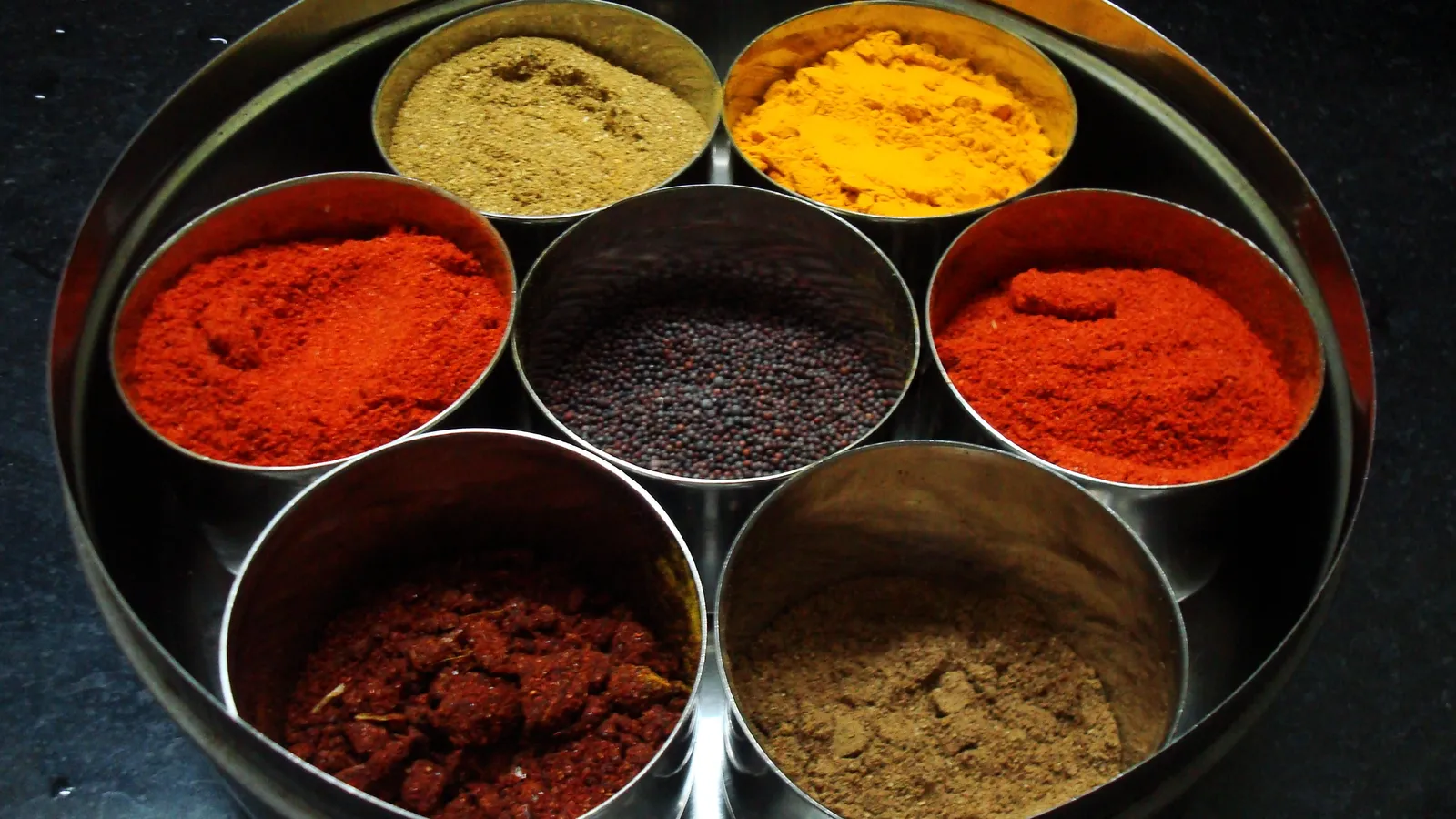
The DART test is a glass of water. Stir in a teaspoon of turmeric powder. Natural turmeric leaves a light yellow colour as it settles; adulterated powder leaves a strong yellow colour. Whole turmeric should leave no colour at all; DART's check for lead chromate says adulterated pieces look bright and colour the water at once.
The chemistry: turmeric's yellow comes from curcumin, which researchers describe as a natural colourant that works as a pH indicator, so its colour shifts with acidity. In FSSAI's lab manual, a few drops of concentrated hydrochloric acid turn real turmeric pink or violet, and the colour fades on dilution; if it persists, that points to metanil yellow, a synthetic dye. The acid also makes chalk-padded turmeric fizz, because chalk is calcium carbonate and carbonates react with acids to give carbon dioxide. Concentrated acid belongs in a school lab with a teacher, not a kitchen. More on curcumin: why turmeric stains fade in the sun.
How do you check chilli powder for dye and sawdust?
Again from DART: sprinkle chilli powder on the surface of water in a glass. Artificial colours start sinking at once in coloured streaks. In a second test, sawdust floats while chilli powder settles at the bottom.
This is solubility and density: a water-soluble dye dissolves and trails down, and sawdust is less dense than water. The lab manual finds brick powder by swapping water for a mixture of chloroform and carbon tetrachloride, in which brick powder and dirt settle at the bottom. Both solvents are suspected carcinogens, so this one stays in the lab.
Is there a reliable home test for honey?
Only partly. DART says to drop honey into a glass of water: pure honey does not disperse, while honey that disperses suggests added sugar.
FSSAI's lab manual detects invert sugar syrup in honey with Fiehe's test, where resorcinol in hydrochloric acid turns pink to cherry red, and even then it says the result should not be taken as conclusive and needs a confirming test. A water-glass drop is weaker still, so treat it as a hint.
What should you do if a home test looks suspicious?
A plan for one weekend morning:
Set out clear glasses, water, tincture of iodine and a white plate.
Test each food beside a sample you trust and compare side by side, the way DART's pictures do.
Note the brand, batch and shop for anything that looks wrong.
Repeat a suspicious test once with a fresh glass.
If it fails again, stop using it, keep the rest sealed with the bill, and raise it with FSSAI through the grievance section of FSSAI's website.
DART also has a potato-and-lemon test that turns blue for iodised salt; here is why iodine is added to salt in India. And some additives are allowed on purpose, like the preservatives and antioxidants that keep packaged food fresh.
The ideas behind these tests are school science: indicators, carbonates, solubility, density, starch and iodine. If one of those ideas is shaky, the Fermi Concept Library has a lesson for every concept in physics, chemistry, biology, mathematics and computing, so you can see why the glass changed colour, not just that it did.


