On this page
You spill dal on a white kurta, scrub it, and a yellow ghost stays behind. Hang it in the sun for a day or two and the ghost often fades. That is a chemical reaction driven by light, and it is the same idea you meet in Chapter 1 of Class 10 science.
Why do turmeric stains fade in sunlight?
The yellow in turmeric comes from curcumin and its close relatives, the curcuminoids. A substance looks coloured because it absorbs some colours of light and reflects the rest. A 2025 study in the journal Molecules tracked the colour of turmeric extract at 435 nm, in the blue part of the spectrum, citing earlier work that found the extract absorbs most strongly there (Kim, Oh and Hong, 2025). Take blue away from white light and what reaches your eye looks yellow.
Absorbing light means absorbing energy, and for curcumin that energy is enough to break the molecule apart. The same paper notes that UV, sunlight and fluorescent light have all been reported to speed up the breakdown of curcuminoids, and that earlier studies found curcumin splits into smaller phenolic compounds such as vanillin, ferulic acid and vanillic acid (Molecules, 2025). Those pieces are not the yellow pigment, so as more curcumin breaks, the stain fades. Chemists have studied this for decades: a 1986 paper by Hanne Hjorth Tønnesen and colleagues examined the photochemical stability of curcumin.
How fast does curcumin break down in light?
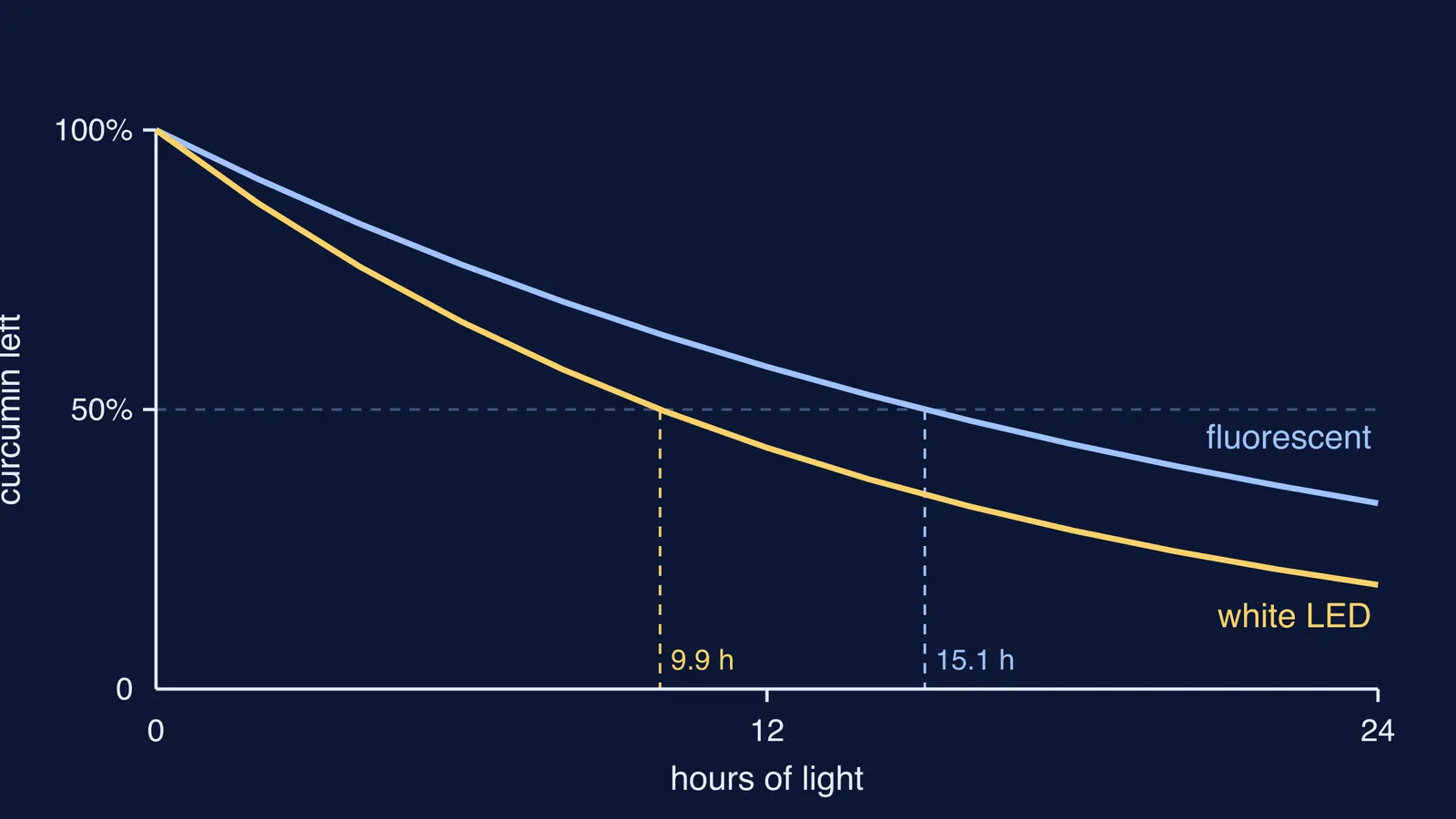
In the 2025 study, turmeric extract dissolved in DMSO was kept at 25 °C under fluorescent light or white LED light, each at 10 W/m², for 24 hours (Kim, Oh and Hong, 2025). Half the curcumin was gone after about 15.1 hours under fluorescent light and 9.9 hours under white LED. The study did not test sunlight or cloth, so treat these numbers as a picture of the idea, not a laundry timetable.
What does this have to do with Class 10 chemistry?
In the NCERT Class 10 science textbook, Activity 1.8 asks you to leave white silver chloride in sunlight. It turns grey because light decomposes it into silver and chlorine: 2AgCl(s) → 2Ag(s) + Cl₂(g) (NCERT Class 10 Science, Chapter 1).
The chapter then makes the key point: decomposition reactions need energy, in the form of heat, light or electricity, to break down the reactants. A turmeric stain in the sun is the light version. Unlike silver chloride, curcumin gives a mixture of products, so there is no single neat equation.
Why does soap turn a turmeric stain red?
This one is in Chapter 2. NCERT points out that turmeric is a natural indicator: a curry stain on a white cloth becomes reddish-brown when soap, which is basic, is scrubbed on it, and turns yellow again when the cloth is washed with plenty of water (NCERT Class 10 Science, Chapter 2). So the red is not the stain getting worse. It is the same pigment telling you it has met a base.
How do you get a turmeric stain out with sunlight?
Combine the two chapters:
Scrape off any food and rinse the stain from the back with cold water.
Wash with soap. If it turns red, that is the indicator effect; rinsing brings the yellow back.
Rinse until the water runs clear, so less curcumin is left in the fabric.
Dry the cloth in direct sun with the stained side facing the light.
If yellow remains, wash and sun it again the next day.
Step 3 may help. In the 2025 study, weaker solutions lost their colour faster: after 24 hours under white LED, only 14.1% of the colour was left at the lowest concentration tested, against 56.4% at the highest (Kim, Oh and Hong, 2025). The authors suggest concentrated pigment may partly screen itself from the light. That was a lab solution, not cloth, but a thinner stain could give the sun an easier job.
Sunlight fades other dyes too, so use this on white or light cotton.
Try it at home: a light-versus-dark test
Turn the stain into an NCERT-style activity.
Smear a little turmeric paste on two strips of old white cotton and let them dry.
Keep strip A outdoors in shade and put strip B in direct sun.
Photograph both side by side at regular intervals, with the same phone and no flash.
Write your prediction first, then what you saw, then the type of reaction.
If B fades and A does not, light is the likely cause. Keeping A outdoors rather than in a cupboard matters, because the sunny strip is also warmer.
The Fermi Simulation Lab has interactive simulations for the ideas that are easier to see than to read. For the theory of decomposition reactions, the Fermi Concept Library covers every concept in chemistry, each with its own lesson and its place in the map.
Next time a yellow stain survives the wash, hang it in the sun and watch Chapter 1 happen on your clothesline.