On this page
The word "iodised" on your salt packet is not marketing. It is a public-health decision India has built on since the 1960s, and it connects directly to the hormones part of Class 10 science.
Why does the thyroid need iodine?
Your thyroid gland, at the front of your neck, makes hormones that regulate growth and metabolism. Iodine is an essential component of the thyroid hormones thyroxine (T4) and triiodothyronine (T3), according to the Linus Pauling Institute at Oregon State University. The numbers in the names are literal: one molecule of T4 carries four iodine atoms and T3 carries three.
Your body cannot make iodine, so it has to come from what you eat. No iodine in, no thyroxine out.
How does too little iodine cause goitre?
Thyroxine output is controlled by a chain of command, described by the Linus Pauling Institute: the hypothalamus releases TRH, which tells the pituitary gland to release thyroid-stimulating hormone (TSH), which tells the thyroid to take up iodine and make hormone.
When thyroxine in the blood falls, the pituitary increases its output of TSH. If TSH stays high for a long time, the thyroid can enlarge; that swelling is called goitre. As an exam answer:
Diet has too little iodine.
The thyroid cannot make enough thyroxine.
Low thyroxine is sensed, and the pituitary releases more TSH.
TSH keeps pushing the thyroid to work harder.
The thyroid grows larger, and a swelling appears in the neck: goitre.
It is a feedback loop that cannot close, because the raw material is missing. Our post on how hormone feedback loops work walks through the same logic for other hormones.
Goitre is the visible sign, but it is not the worst effect. Hypothyroidism caused by iodine deficiency is "most damaging to the developing brain", the Linus Pauling Institute notes. The WHO) links it to impaired mental growth in children, poor school performance and reduced intellectual ability.
Why is iodine added to salt and not some other food?
Other foods can be iodised, but salt has the advantage of being both widely consumed and inexpensive, says the WHO). India also has its own evidence. In a five-year study in the Kangra valley of Himachal Pradesh, published in the Bulletin of the World Health Organization in 1965, S. S. Sooch and V. Ramalingaswami found a "striking reduction" in goitre in areas given iodised salt, while goitre stayed unchanged in the area given plain salt. Based on that study, India started the National Goitre Control Programme in 1962, renamed the National Iodine Deficiency Disorders Control Programme in 1992, as the India Iodine Survey 2018-19 records.
How much iodine does iodised salt actually give you?
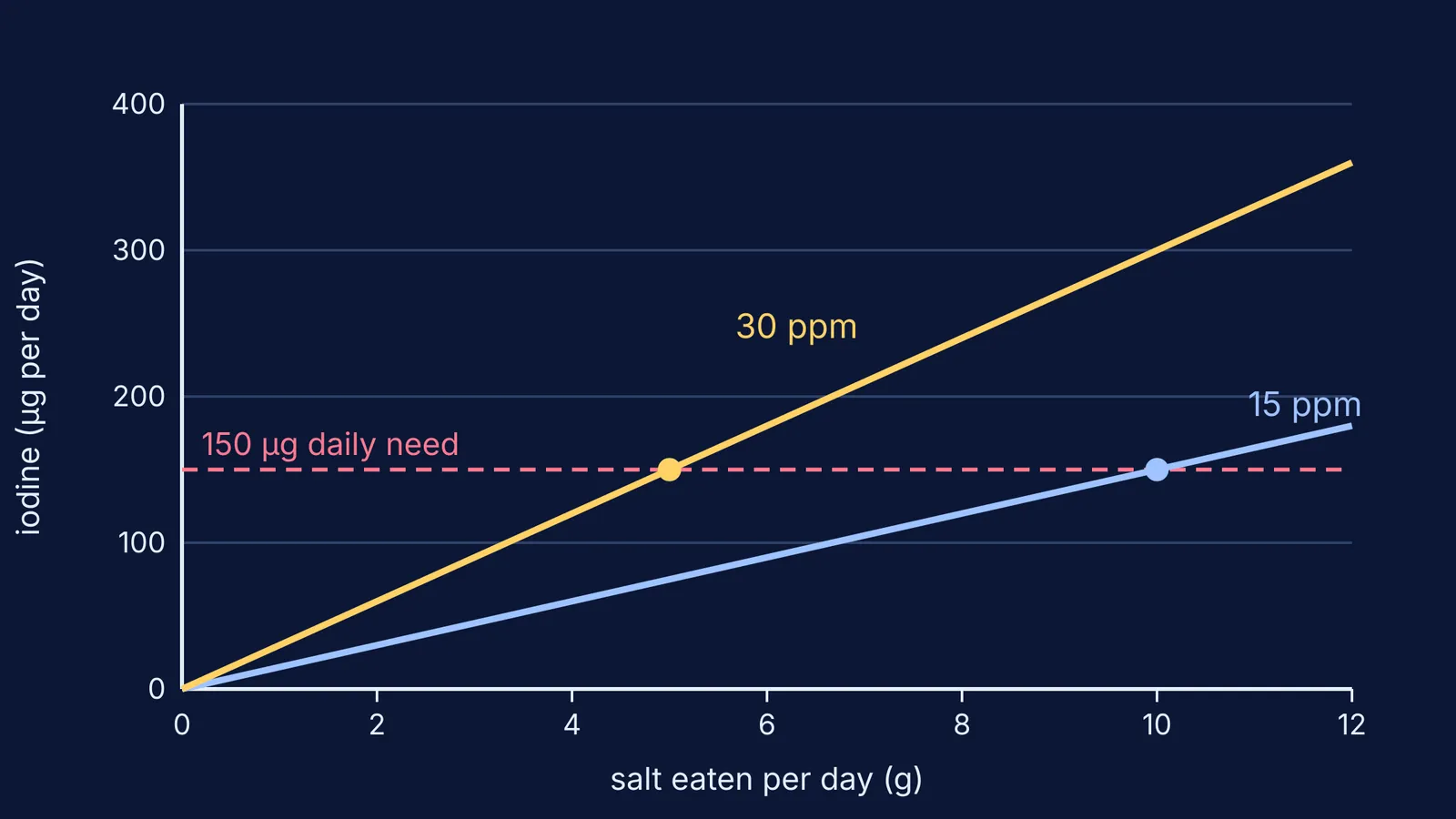
The recommended intake of iodine for people aged 14-18 and adults is 150 µg a day, according to the Linus Pauling Institute. The India Iodine Survey 2018-19 explains that India's salt standard is fixed at 15 parts per million (ppm), assuming an average salt intake of 10 g a day.
15 ppm means 15 mg of iodine in 1 kg (1,000,000 mg) of salt.
That is the same as 15 µg of iodine in every 1 g of salt.
At 10 g of salt a day: 10 × 15 = 150 µg of iodine, which matches the daily need.
At 5 g a day the same salt gives 75 µg, half the daily need.
This is a reason for salt to carry iodine, not to eat more salt.
How well does this work in practice? The India Iodine Survey 2018-19, which covered 21,406 households across 29 states and 7 UTs, found that 76.3% of households used salt with at least 15 ppm iodine and 92.4% used salt with at least 5 ppm. Coverage at 15 ppm or more ranged from 99.8% in Jammu and Kashmir to 61.9% in Tamil Nadu. The WHO) says household access should preferably be above 90%.
What can your family do at home?
Handling matters too. A 2026 study of rural households near Chennai in the Indian Journal of Endocrinology and Metabolism found that 32% exposed their salt to heat, and that people whose salt was moist had lower urinary iodine on average. In that study, moist salt was the only storage or cooking habit linked to urinary iodine. A short kitchen checklist:
Buy salt with "iodised" on the packet.
Keep it dry, in a closed container.
Do not swap it entirely for salts sold without iodine unless a doctor has advised it.
A swelling at the front of the neck is a reason to see a doctor.
For revision, our guide to iron, iodine and calcium deficiency sets goitre beside the other mineral questions, and the Class 10 control and coordination guide places the thyroid within the whole endocrine system.
Some ideas are easier to see than to read. The Fermi Simulation Lab has interactive simulations for ideas like these, and the Fermi Concept Library gives each biology concept, hormones included, its own lesson and its place in the map.