On this page
Food tests are one of the first biology practicals, and a good way to test an AI chatbot. The colours are clear, and a wrong prediction shows up in a test tube within minutes. Here is what each reagent does, why, and a plan for checking an AI against real results.
What colours do the iodine, Benedict's and biuret tests give?
The WJEC food tests guide for teachers and students gives the standard method and results:
Iodine (starch): add 2 drops of iodine in potassium iodide solution to 2 cm³ of the sample; if starch is present it turns blue-black.
Benedict's (reducing sugars): mix 2 cm³ of sample with an equal volume of blue Benedict's reagent and heat in a water bath at 70 to 90°C for 5 minutes; an orange or red precipitate means a reducing sugar.
Biuret (protein): mix 2 cm³ of sample with 2 cm³ of biuret reagent; purple means protein. The Hong Kong Education Bureau's food tests notes add that no heating is needed.
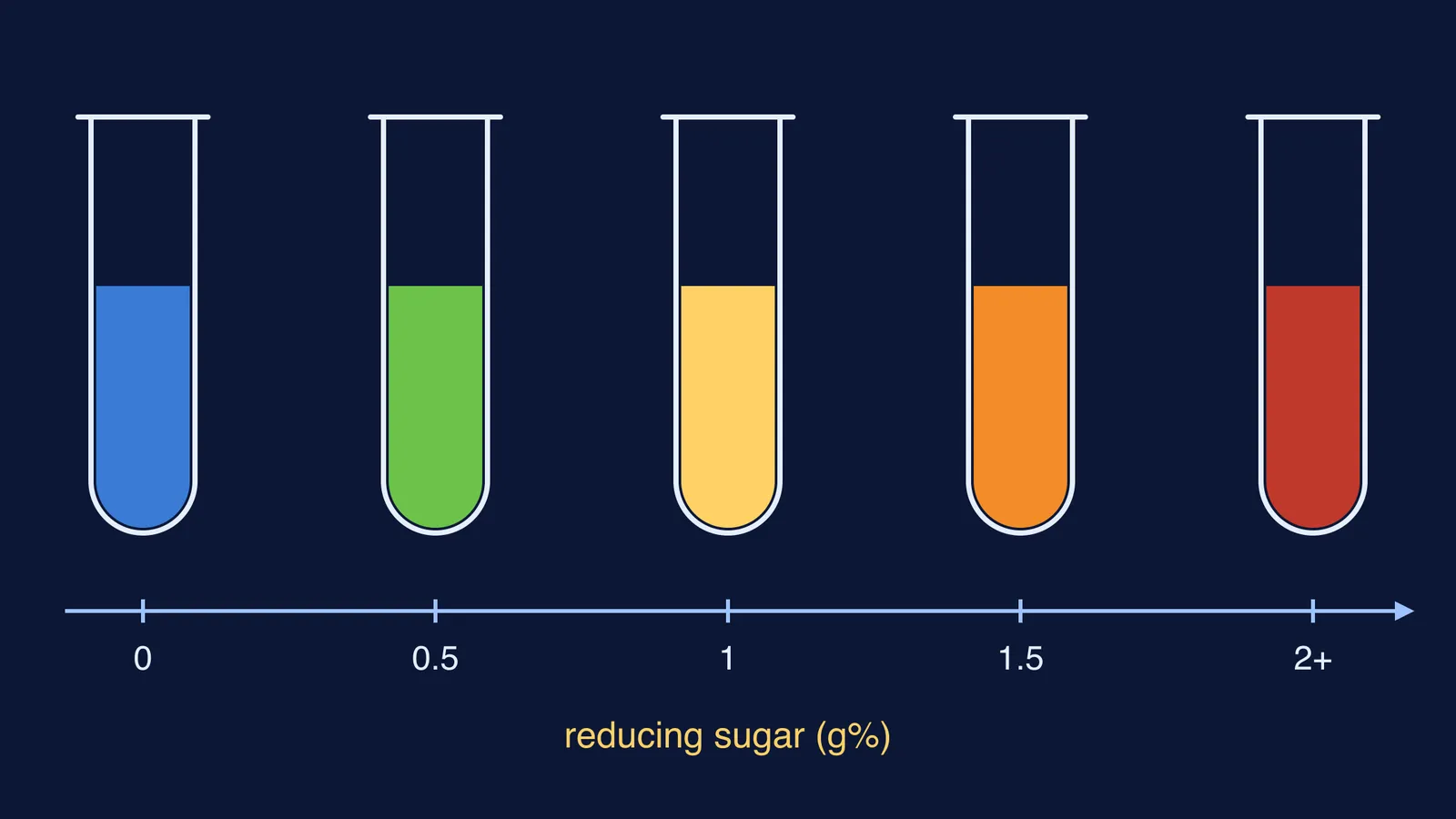
The same WJEC guide says Benedict's is semi-quantitative: about 0.5 g% reducing sugar gives a green precipitate, 1 g% yellow, 1.5 g% orange and above 2 g% red. It also says a deeper violet in the biuret test means more peptide bonds, and so more protein.
Why does each reagent react?
Iodine and starch. Starch is a mixture of two polysaccharides, amylose and amylopectin, and both combine with iodine to give the blue-black colour, according to the Hong Kong Education Bureau's food tests practical notes. A 2022 study in Molecules by Pesek and colleagues confirmed that iodide is needed for the blue colour, and proposed that a repeating I₂–I₅⁻–I₂ unit inside the amylose helix produces it. The WJEC guide notes that iodine dissolves only sparingly in water, which is why the reagent is made up in potassium iodide solution.
Benedict's and reducing sugars. Reducing sugars reduce the blue copper(II) ions in Benedict's solution to insoluble brick-red copper(I) oxide, as the Education Bureau notes explain. All monosaccharides, such as glucose, are reducing sugars, and so are some disaccharides such as maltose. Sucrose, table sugar, is not: the bond joining its glucose and fructose ties up both ring carbons that could open, so neither ring can open to react.
Biuret and protein. In alkaline copper sulphate, nitrogen atoms in peptide bonds form a violet complex with copper(II) ions, according to the same Education Bureau notes. The test detects peptide bonds, not any particular protein.
Related reading: why plants store starch instead of glucose and the Molisch test for carbohydrates.
How do you ask AI to predict food test results?
Make the AI commit to a colour before you test anything. A script you can paste:
"I am going to run the iodine, Benedict's and biuret tests on these foods: boiled potato mashed in water, milk, raw egg white, table sugar dissolved in water, and glucose powder dissolved in water. For each food and each test, predict the final colour and explain in one line which molecule causes it. Say where you are unsure."
What a good answer should contain, so you can mark it:
Potato: iodine blue-black (starch).
Milk: Benedict's should change colour, because lactose makes up around 2 to 8% of milk by mass and lactose is a reducing sugar.
Egg white: biuret violet; egg albumen is the protein the Education Bureau notes use for this test.
Table sugar: Benedict's stays blue, because sucrose is not a reducing sugar.
Glucose: Benedict's green to red, depending on how much you dissolve.
If the AI says table sugar turns Benedict's red, ask it to explain why, and see whether it corrects itself.
How do you check the AI's predictions in the lab?
Do the tests in your school lab with your teacher. The WJEC guide advises gloves and eye protection because biuret is an irritant, and the Education Bureau notes warn that a boiling Benedict's mixture can bump violently, so use a water bath.
Write the AI's predictions in a column before you start.
Run controls: water as a negative, and pure glucose, starch and egg white solutions as positives.
Test three or four foods and record the colour you see, not the one you expected.
Mark each prediction right, wrong or partly right.
For each mismatch, write one reason: too little sample, too little heating, or a wrong idea about the chemistry.
The last step is where the learning happens. If table sugar turns orange, check whether it was heated with acid first: the WJEC non-reducing sugar test heats the sample with hydrochloric acid before adding Benedict's, and acid hydrolysis can turn a non-reducing sugar into reducing sugars.
If a mismatch shows a gap in your understanding of reducing sugars or peptide bonds, the Fermi Concept Library has a lesson for each concept in biology and chemistry, and Fermi's AI tutor notices where you are stuck and decides whether to explain, ask or show. For the other reagents in your practicals, read which stain to use for which slide.