On this page
The Molisch test is the first carbohydrate test in the Class 12 chemistry practical, and it is easy to explain once you know what the acid is doing. This guide follows the NCERT Laboratory Manual Chemistry, Class XII, Unit 11, Experiment 11.1, and adds the reasoning your examiner may ask about in the viva.
What is the Molisch test for carbohydrates?
The Molisch test is a general test for carbohydrates: a deep violet colour appears at the junction of the two liquids when concentrated sulphuric acid is added to a carbohydrate solution containing alcoholic 1-naphthol (NCERT lab manual, Unit 11). The same manual says plainly: "Carbohydrates of all classes give Molisch's test." The test is named after the Austrian botanist Hans Molisch (Wikipedia: Molisch's test). NCERT says 1-naphthol; many guides say α-naphthol. They are the same compound.
How does conc. H2SO4 turn a sugar into furfural?
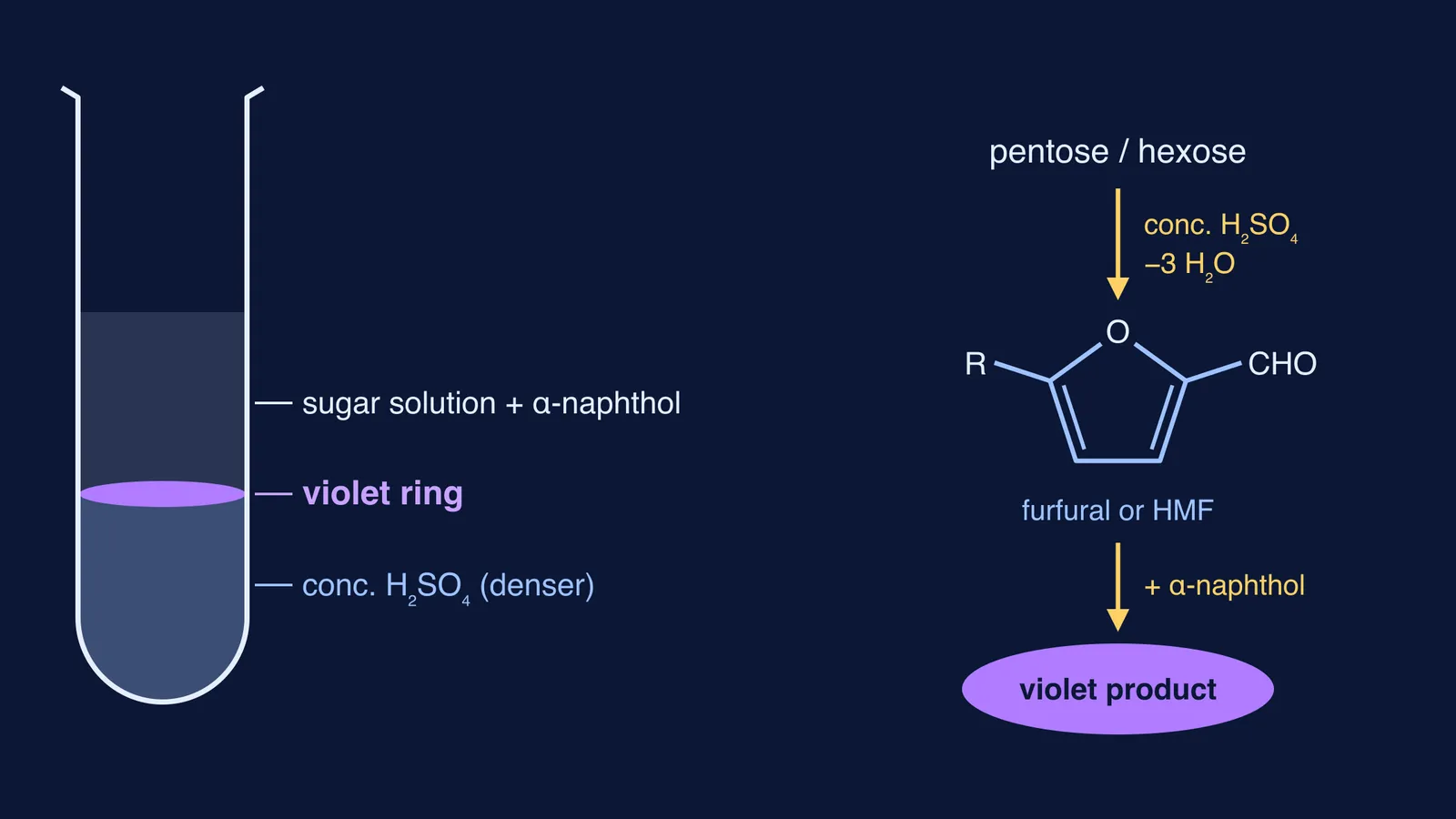
The acid does two jobs, one after the other. According to the NCERT theory section, concentrated sulphuric acid first hydrolyses the glycosidic bonds of a carbohydrate to give monosaccharides, and then dehydrates them to an aldehyde known as furfural. That furfural reacts with 1-naphthol to give an unstable condensation product of deep violet colour.
The NCERT reaction scheme shows which aldehyde forms. Pentoses (five-carbon sugars) give furfural, and hexoses (six-carbon sugars) give 5-hydroxymethylfurfural, often shortened to HMF. Both are a five-membered oxygen ring carrying a -CHO group.
Worked example with sucrose, a disaccharide:
Hydrolysis: the acid splits sucrose into glucose and fructose, both C6H12O6.
Dehydration: each hexose loses three water molecules. C6H12O6 minus 3 H2O leaves C6H6O3, which is HMF.
Condensation: HMF reacts with α-naphthol to form the violet product at the boundary.
The atom count also works for a pentose: C5H10O5 minus 3 H2O leaves C5H4O2, which is furfural. This atom count is a quick self-check.
What is the NCERT procedure for the Molisch test?
The NCERT manual asks you to prepare 1% stock solutions of glucose, fructose and sucrose in separate beakers and divide each into test tubes marked A, B, C and D. For the Molisch test you use tube A.
Add 2-3 drops of an alcoholic solution of 1% 1-naphthol to test tube A.
Pour 2 mL of concentrated H2SO4 down the sides of the test tube, so that it forms a separate layer at the bottom.
Look at the boundary between the two layers.
A purple (violet) ring at the interface of the two layers confirms the presence of a carbohydrate.
The ring forms at the junction because that is where acid, sugar and naphthol meet. The denser acid sinks below the watery layer, so avoid shaking the tube: mixing the layers spoils the clean ring.
Why do all carbohydrates pass the Molisch test?
The test detects what the acid makes from the molecule, not a group in the original. Strong acid breaks starch, sucrose and other oligo- and polysaccharides into monosaccharides, and pentoses and hexoses are dehydrated to the furan ring of furfural or HMF. So mono-, di- and polysaccharides all end up as the same kind of aldehyde.
That is also why sucrose behaves differently in the next tests. The NCERT manual shows sucrose giving no reaction with Fehling's solution, because it is not a reducing sugar, yet it passes Molisch because the acid hydrolyses it first.
There are limits worth knowing for the viva:
Very small sugars are exceptions. A LibreTexts organic chemistry lab manual/09:_Lab_9-_Tests_for_Carbohydrates) describes Molisch's as a common test for all carbohydrates larger than tetroses, and Wikipedia lists trioses and tetroses as exceptions. With fewer than five carbons, they cannot form furfural.
A positive result is not proof on its own. NCERT notes the test may be given by some other organic compounds also, and nucleic acids and glycoproteins, which contain sugar units, also give a positive reaction (Wikipedia).
What should you say in the practical viva?
A short script, one line per likely question:
Principle: "Conc. H2SO4 hydrolyses the carbohydrate to monosaccharides and dehydrates them to furfural or hydroxymethylfurfural, which condenses with α-naphthol to give a violet product."
Why a ring: "The acid is denser, so it forms a lower layer, and the coloured product appears where the two layers meet."
Why sucrose passes: "Molisch is a general test. It does not need a reducing group, because the acid first breaks sucrose into glucose and fructose."
If the chemistry of biomolecules still feels shaky, the Fermi Concept Library gives every concept in chemistry and biology its own lesson, so you can revisit glycosidic bonds before the exam. For practice, the Fermi Problem Library has worked problems with a step-by-step solver that explains the reasoning rather than printing an answer.