

On this page
Grow rice and wheat on the same field year after year, and the soil slowly loses organic carbon. Putting a pulse such as chana, moong or masoor into that sequence is a long-used fix. Here is how it works, what the evidence says, and how to write it up in an exam.
What is crop rotation with legumes?
Crop rotation means growing different crops one after another on the same land instead of the same crop every season. A legume rotation slots a legume between cereal crops: rice, then chickpea, then rice again, for example. Pulses are legumes grown for dry seed, like chana, moong and arhar.
In legumes, nitrogen-fixing bacteria live in small growths on the roots called nodules, as a New Mexico State University extension guide on nitrogen fixation explains. In crop legumes these bacteria are rhizobia, which is why textbooks pair the words Rhizobium and root nodule.
How do legumes add nitrogen to the soil?
Most living things cannot use the N2 in air; our post on why nitrogen gas is unreactive at room temperature explains the chemistry. Biological nitrogen fixation is the process that changes inert N2 into usable ammonia (NH3), according to the NMSU guide. The rhizobia in the nodule do this work.
Most of the fixed nitrogen eventually returns to the soil when the legume's roots, leaves and other parts die and decompose, the NMSU guide notes. The Food and Agriculture Organization (FAO) reports that even dry beans can add up to 70 kilograms of nitrogen per hectare. The same FAO report says rotating legumes with grain crops could save up to 88 kilograms of nitrogen per hectare in Europe.
Our guide to nitrogen cycle steps and the bacteria that run each one shows where fixation fits, and the story of Johanna Döbereiner and nitrogen-fixing bacteria in Brazil shows these microbes at work on real farms.
Why does crop rotation break pest and disease cycles?
Many crop pests, fungi and weeds specialise in one plant family. A wheat disease surviving in soil or stubble finds a fresh host every season if wheat keeps coming back. A legume season gives it nothing to live on. The Zhao et al. meta-analysis lists suppressed pests and diseases among the non-nitrogen benefits of legume pre-crops.
A 2015 review in Crop and Pasture Science by Angus and colleagues was based on more than 900 field comparisons of wheat after another crop versus wheat after wheat (Angus et al., 2015). The average gain ranged from 0.5 tonnes per hectare after oats to 1.2 tonnes per hectare after grain legumes such as field peas, faba beans, chickpeas and lentils. The boost carried into a second wheat crop too: about 60% of the first-year gain after legumes, against 20% after canola.
How much does a legume rotation raise yields?
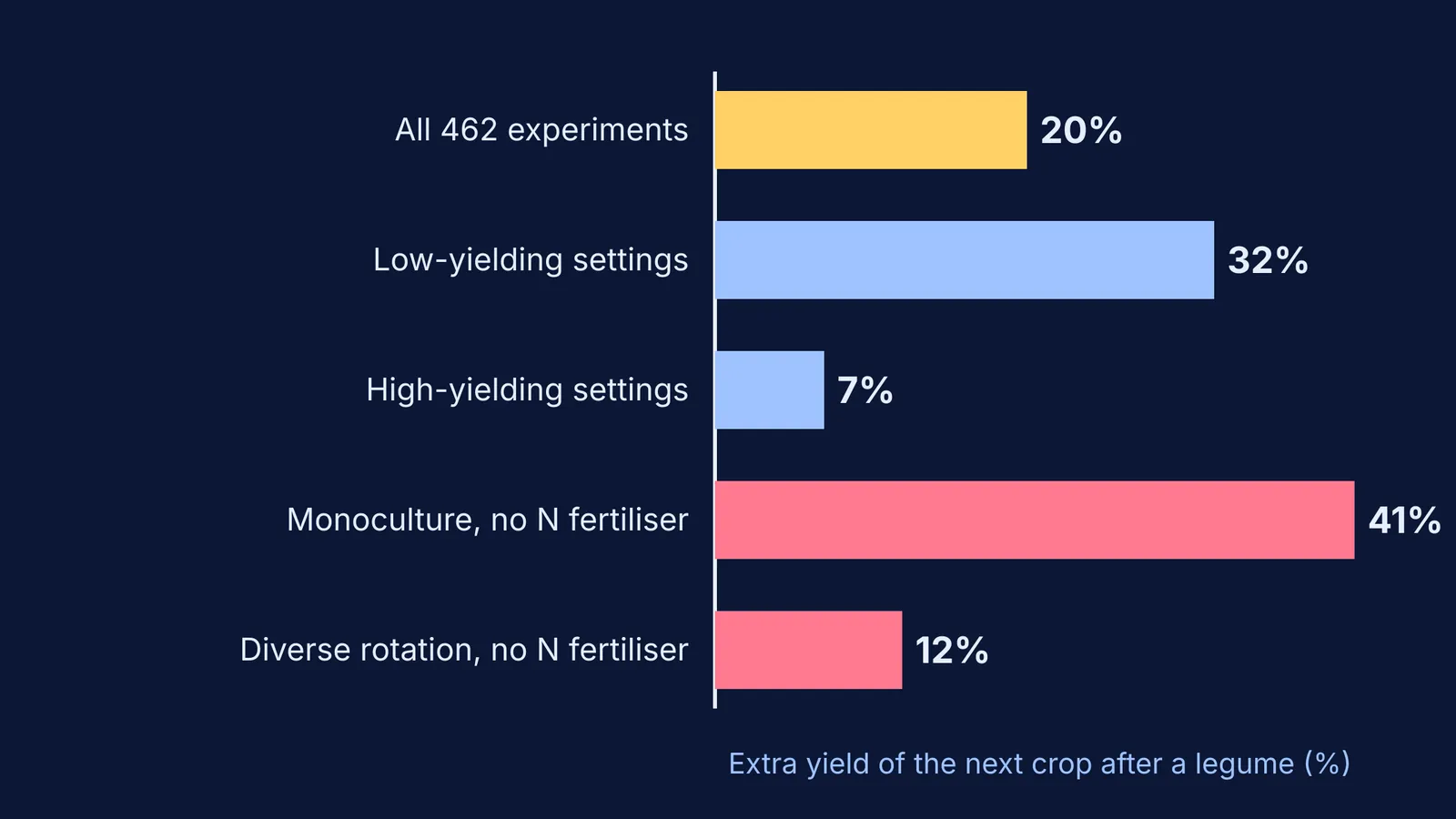
A 2022 meta-analysis in Nature Communications by Zhao and colleagues combined 11,768 yield observations from 462 field experiments (Zhao et al., 2022). Legumes raised the yield of the following main crop by 20%, and the gain held for rice, wheat and maize. It was larger in low-yielding environments (32%) than in high-yielding ones (7%).
Fertiliser changes the picture. In the same study, adding a legume to a monoculture with no nitrogen fertiliser raised yields by 41%, while in already diverse rotations with no nitrogen fertiliser the gain was 12%. The benefit shrank as fertiliser rose and disappeared above 236 kg of nitrogen per hectare.
Does it work on Indian farms?
A long-term trial on the Indo-Gangetic plains by Ghosh and colleagues ran for seven cropping cycles (Ghosh et al., 2012, Experimental Agriculture). A rice-wheat-mung bean system ended with 6% more soil organic carbon and 85% more soil microbial biomass carbon than plain rice-wheat. Replacing wheat with chickpea, every year or in alternate years, also helped restore soil carbon.
How do you plan a legume rotation for an exam answer?
Suppose a farm grows rice in kharif and wheat in rabi every year. Here is a plan combining two systems from that trial.
Year 1 kharif: rice, a heavy nitrogen user.
Year 1 rabi: wheat, the usual rabi cereal.
Year 1 summer: moong before rice. Nodules fix nitrogen; residue returns to the soil.
Year 2 kharif: rice, now following a legume.
Year 2 rabi: chickpea instead of wheat, breaking the cereal disease cycle.
Year 3 rabi: wheat returns after a season away.
If one step of the nitrogen cycle still feels shaky, the Fermi Concept Library has a lesson for every concept in biology and chemistry, each with its place in the map. For numericals such as nitrogen percentage in a fertiliser, the Fermi Problem Library has worked problems with a step-by-step solver that explains the reasoning.
Next time you pass chana growing after a rice harvest, you will know what is happening underground.


