

On this page
Air is about 78% nitrogen gas, yet plants cannot take in N₂ from the air directly, as OpenStax Microbiology explains. Living things depend on a few groups of microbes to break its triple bond. Below, we follow one atom round the cycle and give you a rule for predicting the next microbe.
What are the steps of the nitrogen cycle?
The definitions below follow OpenStax Microbiology unless another source is linked.
Nitrogen fixation: N₂ is converted to ammonia by Rhizobium living in legume root nodules, by free-living Azotobacter and by cyanobacteria.
Assimilation: plants absorb ammonium or nitrate and build them into their own molecules. Most organisms rely on these forms rather than N₂, as a 2018 review in Nature Reviews Microbiology puts it.
Ammonification: bacteria and fungi turn waste and dead remains back into ammonia.
Nitrification: ammonia is oxidised to nitrite by bacteria such as Nitrosomonas, and Nitrobacter oxidises nitrite to nitrate (Applied and Environmental Microbiology, 2015).
Denitrification: Pseudomonas and Clostridium use nitrate in place of oxygen in anaerobic respiration and release nitrogen gas back to the air.
How do you predict which bacteria act next?
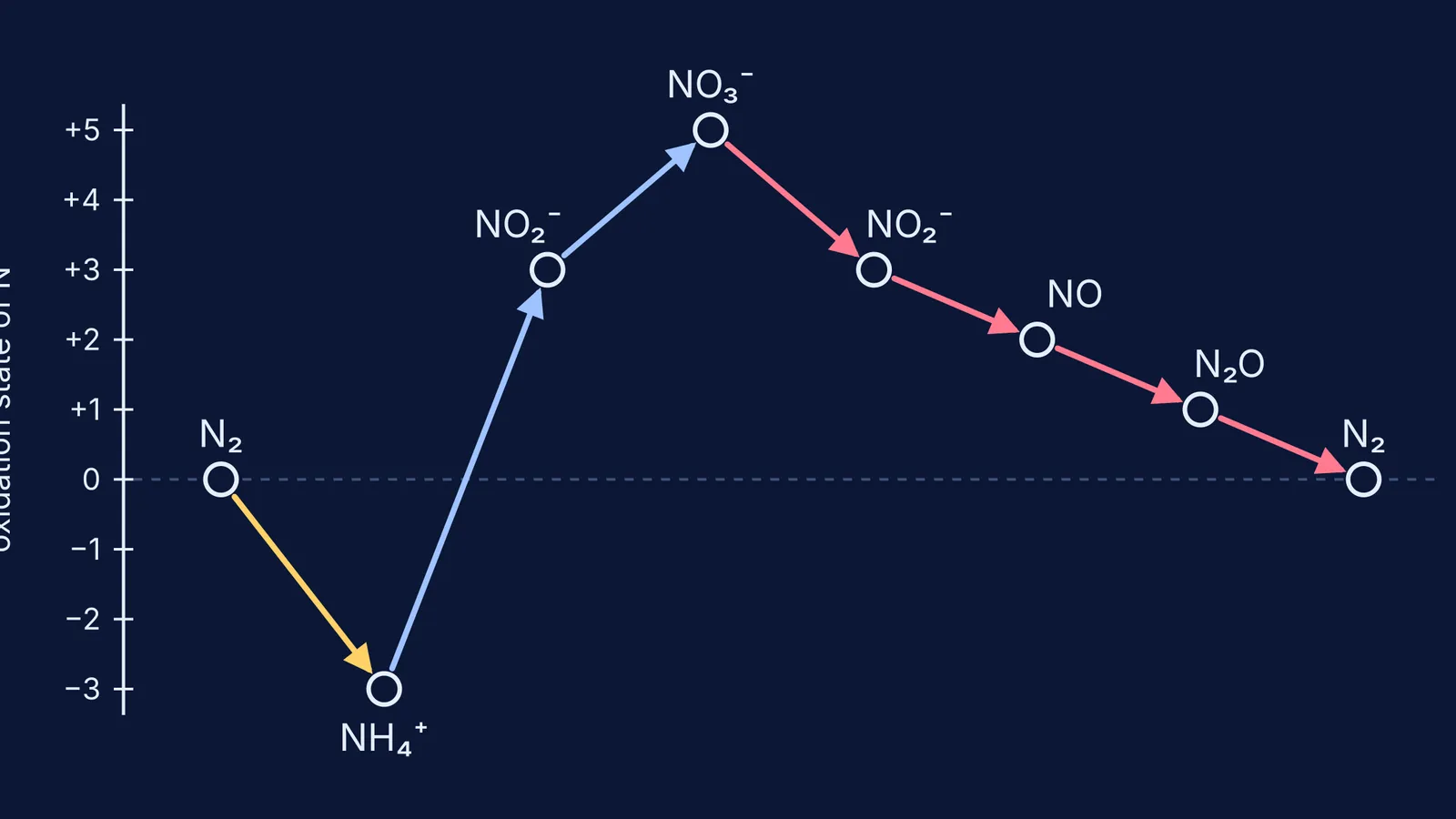
Is it being oxidised or reduced? Track the oxidation state of nitrogen: 0 in N₂, −3 in ammonium, +3 in nitrite, +5 in nitrate, then +2 in NO and +1 in N₂O on the way back to 0. If those numbers feel shaky, our oxidation-state ladder for nitrogen walks through them. Nitrifiers climb the ladder; fixers and denitrifiers come down it.
Is there oxygen? Nitrification is an aerobic, two-step process, as the Nitrobacter study above notes. Denitrification needs anaerobic conditions and nitrate, stepping from nitrate to nitrite, NO, N₂O and finally N₂, as described in a PLOS ONE study of Pseudomonas aeruginosa. Together, the two answers give a decision list:
N₂ beside a legume root with nodules: the nodule bacteria (rhizobia) fix it.
Ammonium in loose, airy soil: Nitrosomonas oxidises it to nitrite.
Nitrite with oxygen around: Nitrobacter oxidises it to nitrate.
Nitrate beside a growing root: the plant assimilates it.
Nitrate in waterlogged soil: Pseudomonas reduces it to N₂.
Nitrogen locked in a dead leaf or dung: decomposers ammonify it.
One twist: in 2015, Daims and colleagues reported in Nature a Nitrospira bacterium that performs both nitrification steps by itself, a split that had puzzled microbiologists for a century.
Worked example: one atom through a pigeonpea field
Start with an N₂ molecule in the air spaces of soil around an arhar (pigeonpea) plant.
Fixation. Inside a root nodule, the rhizobia's nitrogenase reduces it to ammonia. The enzyme needs at least 16 MgATP, eight protons and eight electrons for each N₂ (Annual Review of Biochemistry, 2009).
Protection. Oxygen inactivates nitrogenase, so infected nodule cells build up leghaemoglobin, which buffers oxygen. When researchers switched off leghaemoglobin in the legume Lotus japonicus, nodule oxygen rose, nitrogenase protein was lost and fixation stopped, yet the plants grew normally when fed mineral nitrogen (Current Biology, 2005).
Assimilation. The atom, now in ammonium, is built into organic molecules and carried up to the leaves.
Ammonification. A leaf falls and decomposers release its nitrogen as ammonium.
Nitrification. The soil is moist but airy. Nitrosomonas takes the atom to nitrite, then Nitrobacter takes it to nitrate.
A fork. If the next crop's roots are nearby, the nitrate is assimilated again. If the field floods and oxygen runs out, Pseudomonas respires the nitrate and the atom leaves as N₂, closing the loop.
Why do legumes enrich soil?
The figures below come from Ladha and colleagues' 2022 review in Field Crops Research.
Biological fixation adds about 60 Tg (60 million tonnes) of nitrogen a year to agricultural ecosystems.
Lupin (130 kg per hectare) and faba bean (148 kg per hectare) gave the highest average fixation inputs among the grain legumes reviewed.
The highest regional averages, for faba bean and pigeonpea, had 77–87% of the crop's nitrogen coming from fixation.
Nitrogen left in roots, nodules and residues feeds the next crop. The gain is not automatic: the review notes a crop adds fixed nitrogen only when the share of its nitrogen from fixation exceeds the share removed in grain, and across soybean trials the average balance was negative.
For the history, read how Hellriegel and Wilfarth traced nitrogen gain to root nodules. Factories do the same N₂-to-ammonia reduction at high temperature and pressure, which you can compare in our guide to Haber process conditions.
Cycles are easier to follow when you watch them. The Fermi Simulation Lab has interactive simulations for ideas that are easier to see than to read.
Can you predict the next microbe?
Cover the answers and use the two-question rule.
Ammonium in a well-drained field. Answer: Nitrosomonas (oxidation, oxygen present).
Nitrate in a paddy flooded for a week. Answer: denitrifiers such as Pseudomonas (no oxygen, nitrate available).
A legume whose nodules cannot make leghaemoglobin. Answer: fixation fails, so the plant needs soil or fertiliser nitrogen.
Nitrite in airy soil. Answer: Nitrobacter.
If one step still feels fuzzy, the Fermi Concept Library gives every concept in biology and chemistry its own lesson and its place in the map.


