

On this page
Peas, beans and other dal crops have a reputation for leaving a field richer for the next crop. Why that happens was only proved in the 1880s. Oats and barley cannot use the nitrogen gas in air; legumes seemed to, and for decades nobody could show how. Two German agricultural chemists, Hermann Hellriegel and Hermann Wilfarth, settled it with pots of sand.
Who were Hellriegel and Wilfarth?
Hermann Hellriegel (1831-1895) and Hermann Wilfarth (1853-1904) wrote the report together, according to the catalogue record of their 1888 report. Hellriegel became director of the state agricultural research station at Bernburg, Germany, in 1882, says the Hochschule Anhalt history page. Wilfarth was his assistant, according to the Linda Hall Library.
On 20 September 1886, Hellriegel told a meeting of German naturalists and physicians in Berlin that legumes can fix nitrogen from the air with the help of microbes in their root nodules, as the same Linda Hall page records. The full evidence came in 1888, in a report published by the journal of the German beet-sugar industry: *Untersuchungen über die Stickstoffnahrung der Gramineen und Leguminosen* (studies of the nitrogen nutrition of grasses and legumes).
How did Hellriegel and Wilfarth show legumes fix nitrogen?
They grew plants in pots of washed quartz sand with no nitrogen added, and added 25 to 50 cc of a water extract of fertile soil to some pots, as an 1891 account in Popular Science Monthly describes. Their 1888 report sums up what happened:
Oats and barley in nitrogen-free sand hardly grew, sterilised or not, and soil extract did not help them.
Given nitrate, the cereals grew roughly in proportion to the nitrate supplied, and never ended up with more nitrogen than the soil started with.
Peas, serradella and lupins in sterilised, nitrogen-free sand behaved just like the cereals and slowly starved.
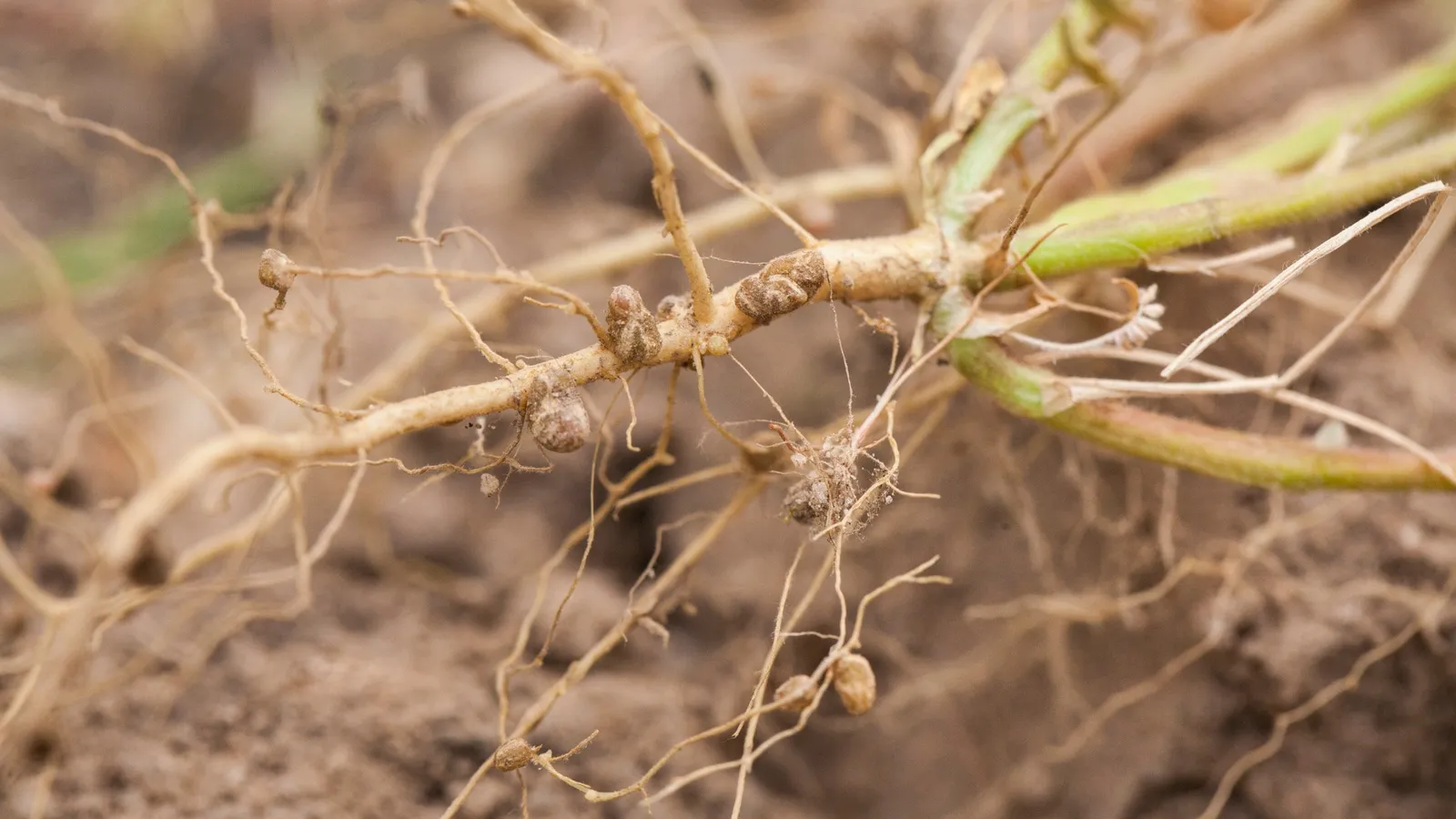
With a small amount of fresh soil extract, the legumes formed root nodules, recovered and ended up with a large nitrogen surplus that could not have come from the soil.
Soil extract that had been boiled, or even heated to 70 °C, lost its effect completely.
In sterile sand, or with an extract that did not work, no nodules appeared at all, even on well-fed plants given nitrate.
They closed with seven conclusions. Legumes have a second nitrogen source that cereals lack, the free nitrogen of the air. They cannot use it on their own; certain soil microorganisms must enter a symbiotic relationship with them. And the nodules are not just protein stores but are causally linked to taking up that nitrogen.
Why did earlier scientists miss it?
In his 1987 Royal Society centenary lecture, P. S. Nutman wrote that the discovery ended 60 years of controversy. Earlier researchers such as Boussingault, Lawes and Gilbert worked so hard to keep ammonia and dust out of their experiments that they also excluded microorganisms, and so missed fixation. Hellriegel and Wilfarth said much the same in their 1888 report: Boussingault's famous result held only for sterilised soil.
They also found the soil microbes were picky. Extract from a beet field where peas and clover had long been grown helped peas strongly but did nothing for serradella or lupins. Nutman lists this specificity, the heat sensitivity and the inhibition of nodules by larger amounts of fixed nitrogen among their findings. Today the nodule bacteria are called rhizobia (Salavati and colleagues, 2013), and they are sold as biofertilisers, as our guide to biocontrol agents and biofertilisers explains.
How can you use this experiment in a biology answer?
Every pot in this study rules out one alternative explanation. Use it to practise reading any experiment with three questions:
What changed between the two pots? (Only one thing, such as boiled or fresh extract.)
What stayed the same? (Sand, nutrients, water, plant species.)
Which explanation does this pair rule out?
Here is a worked example for "How do we know nodule microbes, not the plant, fix nitrogen?"
Legume in sterile, nitrogen-free sand starves: the plant alone cannot use air nitrogen.
Oats with fresh soil extract still starve: the extract is not simply fertiliser.
Legume with fresh extract forms nodules and gains nitrogen: something in soil enables fixation.
Legume with boiled extract gains nothing: that something is killed by heat, which points to living microbes.
Split roots, only the unboiled half nodulates: nodules form where the live extract reaches the root.
Write those lines in that order and you have a clear answer built from evidence, not memory. If the nitrogen cycle itself still feels shaky, the Fermi Concept Library gives each biology concept its own lesson and shows where it sits in the map. And Fermi's AI tutor decides whether to explain, ask or show, and checks understanding as it goes, so you can talk through each pot and test your reasoning.
To see where this story connects, read about Justus von Liebig and the law of the minimum, the rule the cereal pots followed when nitrogen was the scarce nutrient, and Fritz Haber's ammonia synthesis, the factory route to the same nitrogen.


