

On this page
Nitrogen gas makes up most of the air we breathe, yet it completely ignores almost everything it touches. You can strike a match, heat a pan, or mix it with highly reactive chemicals, and the nitrogen around you will not react.
This extreme inertness is one of the most common reasoning questions in Class 11 and 12 chemistry exams. Here is a closer look at the molecular structure that makes nitrogen so stable, how it compares to the oxygen we breathe, and the large amount of energy required to finally force it to react.
Why is nitrogen gas unreactive at room temperature?
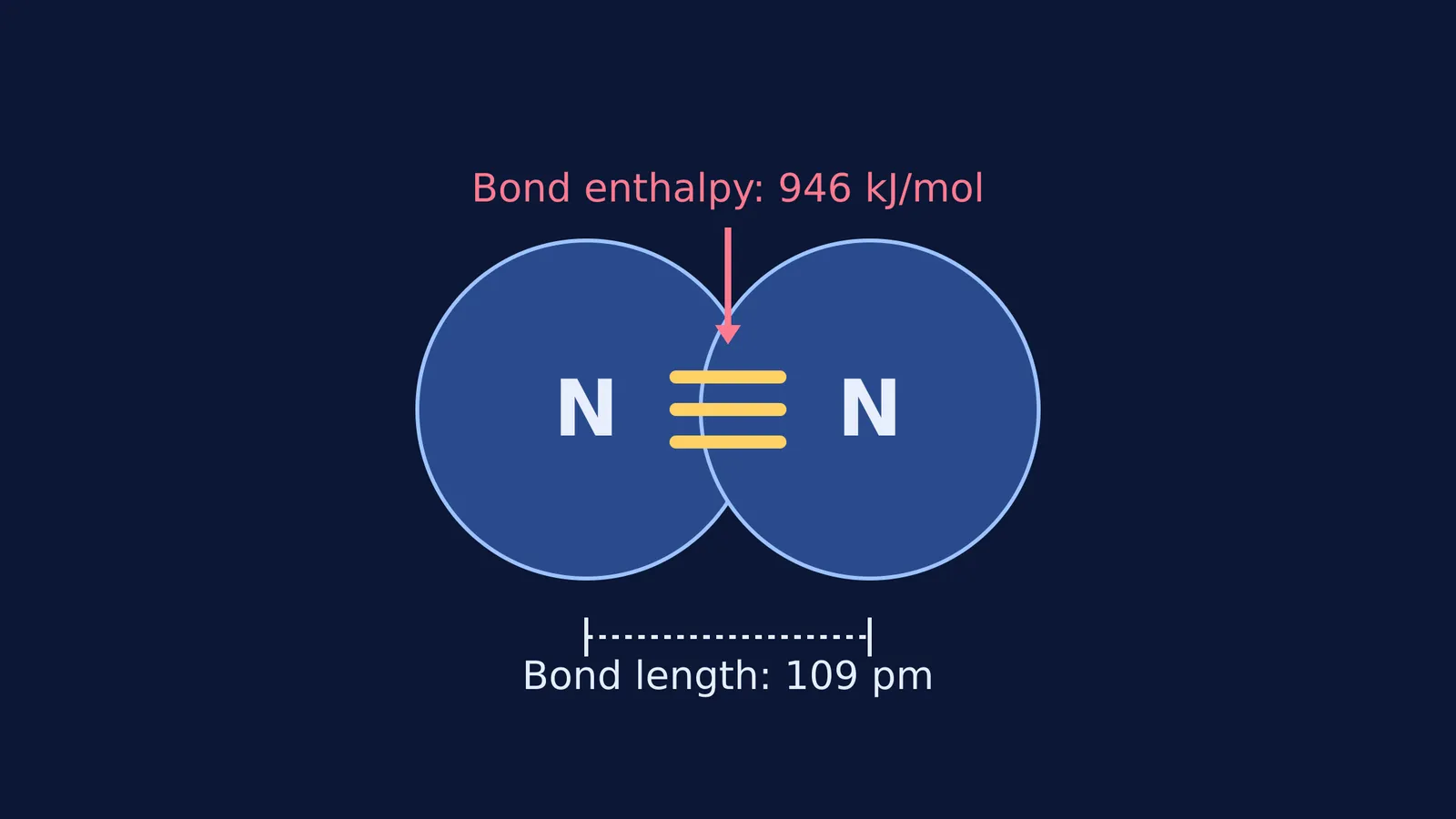
The short answer comes down to chemical bonding. A molecule of nitrogen gas (dinitrogen, or N₂) consists of two nitrogen atoms held together by a triple covalent bond (N≡N).
Each nitrogen atom has five valence electrons and needs three more to complete its octet. By sharing three pairs of electrons, the two atoms satisfy their outer shells perfectly, leaving one lone pair on each atom. This triple bond is incredibly strong. According to the OpenStax Chemistry textbook, breaking this bond requires a bond dissociation enthalpy of 946 kJ/mol, whereas a carbon-carbon single bond only takes 345 kJ/mol (OpenStax, 2023).
At room temperature, there is simply not enough thermal energy available in the environment to break the nitrogen atoms apart, which is why the gas remains chemically inert.
Because it is so reliably stable, chemists often use nitrogen to create an inert atmosphere in the laboratory. If you need a reaction to happen without moisture or oxygen interfering, you can pump nitrogen into the flask to push the reactive gases out. (You can read more about how this gas is collected in our guide to the laboratory preparation of nitrogen.)
How does bond length affect reactivity?
The strength of the nitrogen triple bond is directly tied to its extremely short bond length. Nitrogen atoms have a very small atomic radius compared to heavier elements. When two of them share six electrons to form a triple bond, their nuclei are pulled very close together.
In dinitrogen, the bond length is just 109 pm (NCERT, 2023). The shorter a bond is, the stronger the electrostatic attraction between the positive nuclei and the shared negative electrons sitting between them.
This tight, compact structure also makes the molecule perfectly non-polar, meaning it has no partial charges to attract other roaming molecules or ions. When studying these ideas, it helps to be careful with chemical bonding analogies that oversimplify how electron orbitals overlap in such tight, high-energy spaces.
By comparison, the oxygen gas (O₂) we breathe is held together by a double bond with a bond dissociation enthalpy of 498 kJ/mol (OpenStax, 2023). Because its bond is roughly half as strong as nitrogen's, oxygen is far more willing to break apart and react, which is why it readily supports combustion and respiration while nitrogen does not.
When does nitrogen actually react?
While dinitrogen is inert at room temperature, it is not invincible. If you supply enough energy to clear the high activation energy barrier, the triple bond will eventually break.
In nature, this extreme energy arrives during lightning strikes. The intense heat of a lightning bolt provides the activation energy needed to tear the N₂ molecules apart. The free nitrogen atoms immediately react with oxygen to form nitrogen oxides. These oxides eventually dissolve in rain to form dilute nitric acid, which falls to the ground and provides essential nitrates for the soil.
In industry, the Haber process forces nitrogen to react with hydrogen gas to manufacture ammonia for fertilisers. Because the N≡N bond is so resilient, this process requires extreme conditions: extreme heat and high pressure. Crucially, it also requires an iron catalyst, which provides a metal surface where the N₂ molecules can temporarily bind, weakening the triple bond just enough to let the hydrogen in.
Exam checklist: Nitrogen's reactivity
When you see an exam question asking why nitrogen acts like a noble gas or why its reactions require a catalyst, hit these three points in your answer to secure full marks:
Name the bond: Explicitly state that dinitrogen forms a triple covalent bond (N≡N).
Quote the enthalpy: Mention that the bond dissociation enthalpy is exceptionally high (946 kJ/mol).
Conclude the energy gap: State that room temperature does not provide enough thermal energy to overcome this activation barrier.
If you have concept gaps around periodic trends or molecular structure, search for nitrogen in the Fermi Concept Library to read its lesson and find its place in the map.


