

On this page
Nitrogen makes up 78% of the air around us, but isolating it purely in a flask requires specific chemical routes. The laboratory preparation of nitrogen gas relies on a controlled, stepwise breakdown of nitrogen-containing salts, a standard topic in the Class 12 chemistry syllabus.
How do you prepare nitrogen gas from ammonium nitrite?
The standard laboratory preparation of nitrogen begins with ammonium nitrite. However, pure ammonium nitrite is highly unstable and explosive, so we do not store it in a jar. Instead, we make it "in situ" — right in the reaction flask.
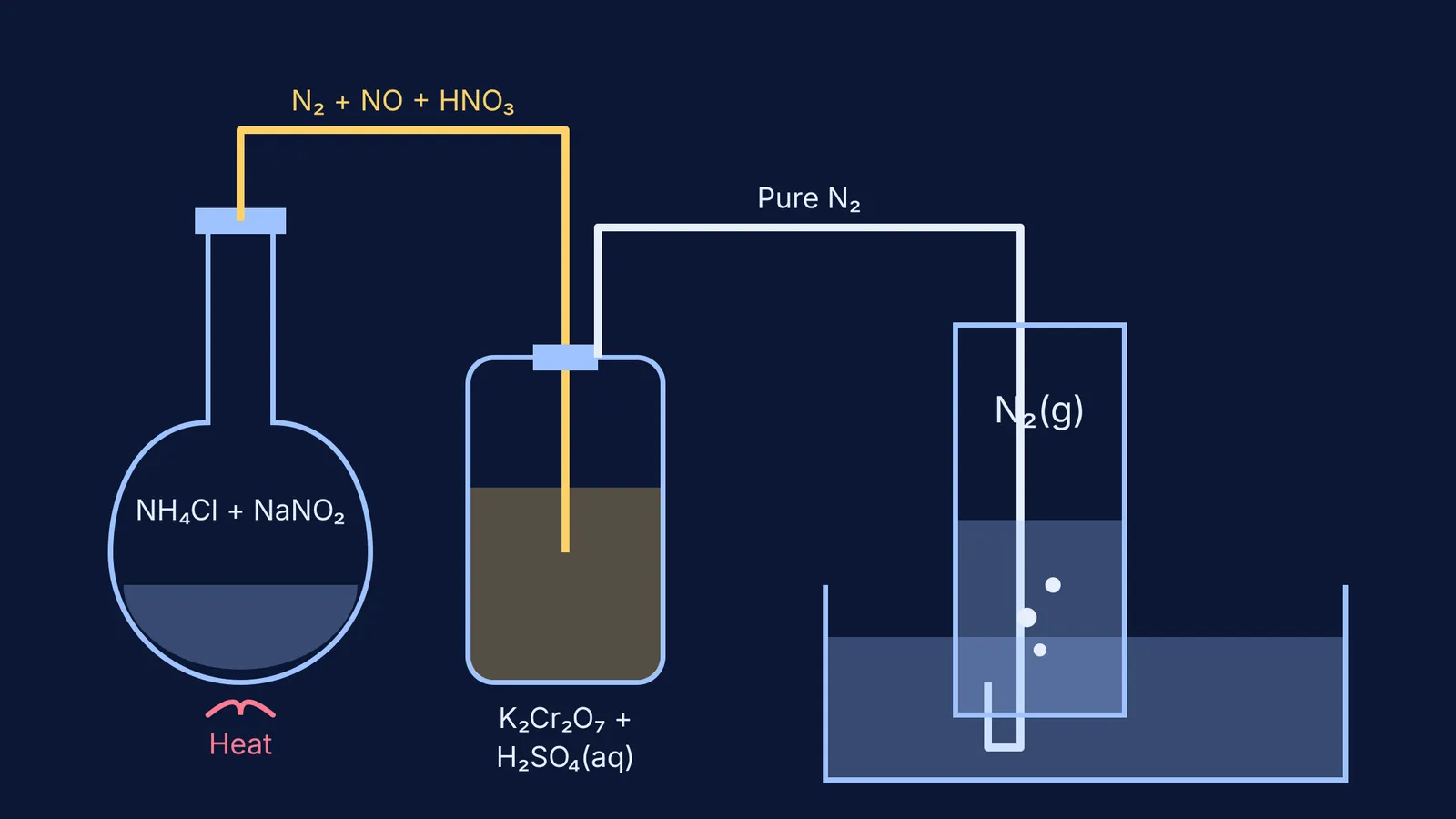
To do this, an aqueous mixture of ammonium chloride and sodium nitrite is gently heated. They undergo a double displacement reaction to form ammonium nitrite and sodium chloride. As the heating continues, the ammonium nitrite immediately undergoes thermal decomposition to release dinitrogen gas and liquid water.
The overall balanced equation is: NH₄Cl(aq) + NaNO₂(aq) → N₂(g) + 2H₂O(l) + NaCl(aq)
If you are curious about the properties of the nitrite ion itself, it is one of the classic ambident nucleophiles such as cyanide and nitrite. In this reaction, however, it simply acts as the nitrogen source pairing up with the ammonium ion.
Why do we use potassium dichromate to remove impurities?
In theory, the reaction above gives pure nitrogen. In practice, the real world is messier. The heating process causes side reactions, and trace amounts of nitric acid (HNO₃) vapour and nitric oxide (NO) gas emerge alongside the nitrogen. (Understanding the different structures of the oxides of nitrogen helps explain why NO forms under these conditions).
To clean the gas stream, the mixture is bubbled through a wash bottle. This bottle contains an aqueous solution of dilute sulphuric acid and potassium dichromate (K₂Cr₂O₇).
Potassium dichromate is a strong oxidising agent, and the manufacture of sulphuric acid reminds us of how useful acidic mediums are for such reactions. As the impure gas bubbles through, the dichromate oxidises the nitric oxide (NO) into nitric acid (HNO₃). Because nitric acid is highly soluble in water, it dissolves straight into the acidic wash liquid. The nitrogen gas, which is chemically inert and does not react with the dichromate, bubbles cleanly out of the other side and is collected over water.
If you are working through past papers and find questions on inorganic reactions hard to start, the step-by-step solver in the Fermi Problem Library explains the reasoning behind each reagent rather than just printing the final equation.
What is the thermal decomposition of ammonium dichromate?
There is a second common laboratory source of nitrogen gas: the thermal decomposition of ammonium dichromate.
Ammonium dichromate, (NH₄)₂Cr₂O₇, comes as bright orange-red crystals. When you heat them, they undergo a vigorous, self-sustaining decomposition. The reaction yields dinitrogen gas, water vapour, and a bulky green powder called chromium(III) oxide (Cr₂O₃).
(NH₄)₂Cr₂O₇ → N₂ + 4H₂O + Cr₂O₃
Teachers sometimes call this the "chemical volcano" demonstration because the green chromium(III) oxide fluffs up and shoots sparks, looking like a miniature eruption. This reaction is a perfect example of an intramolecular redox reaction, where the nitrogen in the ammonium ion is oxidised, and the chromium in the dichromate is reduced. You can explore the mechanism behind this and other p-block elements in the Fermi Concept Library.
How do we get very pure nitrogen gas?
While the ammonium nitrite and ammonium dichromate routes are great for standard laboratory work, they can still leave trace impurities. When a laboratory requires exceptionally pure dinitrogen gas, chemists turn to the thermal decomposition of metal azides.
By heating sodium azide (NaN₃) or barium azide (Ba(N₃)₂), the compound breaks down entirely into the pure metal and nitrogen gas.
Ba(N₃)₂ → Ba + 3N₂
Because the only other product is a solid metal, the nitrogen gas escaping the tube is of extremely high purity, free of water vapour or competing oxide gases.
The preparation checklist for exams
When studying the laboratory preparation of dinitrogen, organise your memory around the three routes:
The Standard Method: Heating NH₄Cl + NaNO₂. Remember that it produces N₂, H₂O, and NaCl. You must state that K₂Cr₂O₇ + H₂SO₄ is used to wash away NO and HNO₃ impurities.
The Volcano Method: Heating (NH₄)₂Cr₂O₇. Remember the products: N₂, H₂O, and the green solid Cr₂O₃.
The Purest Method: Heating Ba(N₃)₂ or NaN₃. Used exclusively when very high purity is requested.
Keeping these three distinct will guarantee you are ready for any p-block nitrogen question.


