On this page
Chapter 3 of NCERT's *Knowledge Traditions and Practices of India, Part I* (Reprint 2026-27) looks at three performing arts side by side: music, theatre and dance. Here is what it covers, how it fits the CBSE course, and how to turn it into a project.
Where does this chapter fit in the CBSE KTPI curriculum?
The CBSE KTPI curriculum for 2026-27 lists nine Class 11 chapters, and none of them is called "Performing Art Traditions in India". The closest is its Chapter 9, "Theatre and Drama in India", which the course structure table marks "For internal assessment only".
Written paper (70 marks): shared by five other curriculum chapters; theatre and drama has no share of it.
Internal assessment (30 marks): a research-based project of 2 × 10 marks (one per term), a portfolio worth 5 and a viva voce worth 5. Theatre and drama is one of four topics you can choose projects from.
Music and dance: the Class 11 curriculum has no separate chapter for them, so treat these sections as background for a theatre project. (The Class 12 list has "Dance: A Survey", also for internal assessment only.)
Topics not chosen for projects are covered through simpler formats such as a debate, role play or scrapbook.
What does the chapter say about music?
The NCERT chapter splits Indian music into three periods: ancient (2500 B.C. to A.D. 1200), medieval (A.D. 1201 to 1800) and modern (A.D. 1800 onwards).
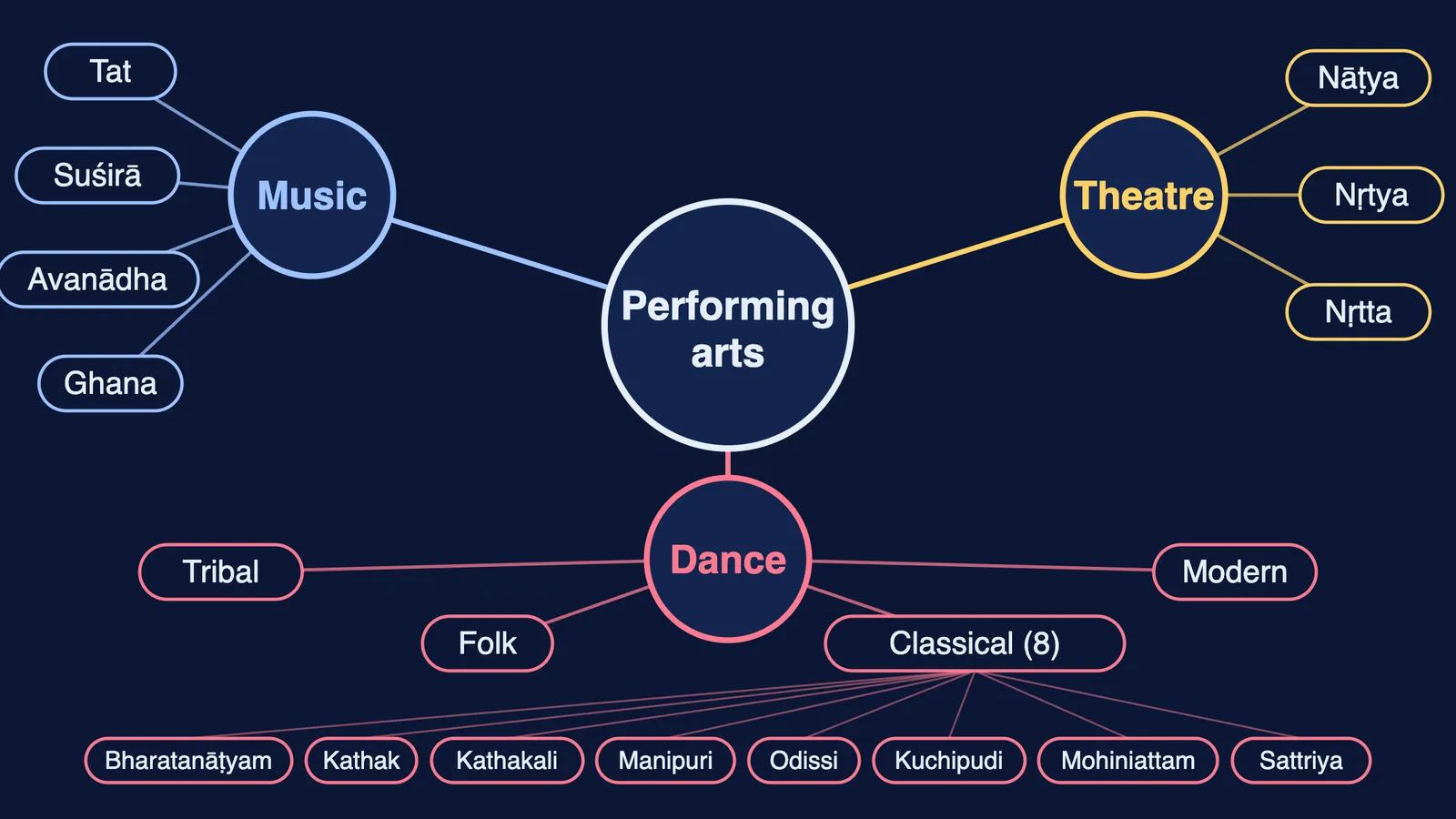
Ancient: Sāmagāna used just three pitches, Udātta, Anudātta and Svarita, from which the seven notes later grew. Bharata's Nāṭyaśāstra has 36 chapters, six of them (28 to 33) on music, and it is the first available text on classifying instruments. The chapter's four classes are Tat (strings), Suśirā (wind), Avanādha (percussion) and Ghana (brass or wood).
Medieval: Śāraṅgadeva (A.D. 1210 to 1247) wrote Saṅgīta Ratnākara, which treats music as Gīta, Vādya and Nṛtya together. Classical music took two paths, Hindustani in the north, east and west and Carnatic in the south. Forms such as Dhrupada and Khayāl developed, along with the sitār, tablā and the gharānā system.
Modern: Pt. V.N. Bhatkhande and V.D. Paluskar founded institutions and created notation systems, and music entered formal education.
The book also stresses the guru-śiṣya paramparā, the oral teacher-to-student chain.
How did Indian theatre develop?
The chapter calls the Nāṭyaśāstra the oldest treatise on dramaturgy and says systematic theorising about theatre began with it. Dramatic representation took three forms: Nāṭya (spoken, with song), Nṛtya (expressive mime) and Nṛtta (pure movement). Plays could be lokadharmi (popular) or nāṭyadharmi (conventional), and a Sūtradhāra linked the scenes.
Key names, in order:
Ashvaghosha's unfinished nine-act *Sāriputra Prakaraṇa*, the earliest known Sanskrit play, from the Kushan period of the first century A.D.
Kalidasa in the fifth-century Gupta period (*Abhijñāna-Śākuntalam*).
Vishakhadatta's *Mudrārākṣasam*, ninth century A.D.
A decline of Sanskrit drama from the ninth to twelfth centuries, while folk theatre in regional languages grew.
Bombay Parsi theatre, begun by Pestonji Framji's Original Theatrical Company around 1870, and later the Indian People's Theatre Association (IPTA).
The book ends with folk theatre: Bhavai, Tamasha, Bhand Pather, Jātrā, Nautanki, Swang, Rāslīlā and Kutiyattam, plus six shadow-puppet traditions.
Which dance forms does the chapter list?
The book sorts living dance into four groups: tribal, folk, classical and modern. Tribal and folk dances are participative, with no line between dancer and audience. It names eight classical forms: Bharatanāṭyam, Kathak, Kathakali, Manipuri, Odissi, Kuchipudi, Mohiniattam and Sattriya.
Bharatanāṭyam's name is read as Bhāva, Rāga, Tāla and Nāṭyam. Odissi's tribhangi pose bends the body in three places. Sattriya grew from the monasteries (sattras) of Assam and is linked to Srimanta Sankardev. For the basics of abhinaya and tāla, see our Class 9 guide to the components of dance.
What practice questions should you try?
Our own questions. Class 11 KTPI has no CBSE sample paper, so marks are our suggestion.
Name the chapter's four classes of Indian instruments and give one example of each from your region. (2 marks)
Distinguish Nāṭya, Nṛtya and Nṛtta, with an everyday example of each. (3 marks)
Why did Sanskrit drama lose ground after the ninth century, according to the chapter? (2 marks)
Compare one folk theatre form with one classical dance-drama on language, audience and setting. (5 marks)
A tablā student learns only by listening and copying. Using the guru-śiṣya paramparā, explain how such learning carried music across generations and what notation later added. (3 marks)
How should you plan a theatre and drama project?
Aim for something you can show in the portfolio and explain in the viva.
Pick a theatre form from the chapter performed near you.
Watch a performance or recording; note costume, music, narrator and audience.
Interview a performer or organiser about how they learned the form.
Link your notes to the book's terms: lokadharmi, Sūtradhāra, Nṛtya.
Present it as a role play or scrapbook.
If performing arts might become a career, read about BA and BPA degrees in dance.
Planning revision for the written chapters too? Fermi's AI tutor works out what you already know and builds a plan for the session.