On this page
Chapter 14 of the new Class 6 NCERT book asks how economic activities are grouped, what sets the groups apart and how they depend on one another.
The book is Exploring Society: India and Beyond (code fees1), first published in June 2024 and reprinted in February 2025 and February 2026 (NCERT prelims). Chapter 14 runs from page 195 to 208 and closes Theme E, "Economic Life Around Us" (NCERT Chapter 14). CBSE publishes no separate 2026-27 curriculum for Classes 6 to 8, which follow the NCERT book, so this chapter is assessed by the school.
What are the three economic sectors in Class 6?
Chapter 13 defined an economic activity as one that creates monetary value. Chapter 14 sorts these activities into broad groups called economic sectors (NCERT Chapter 14).
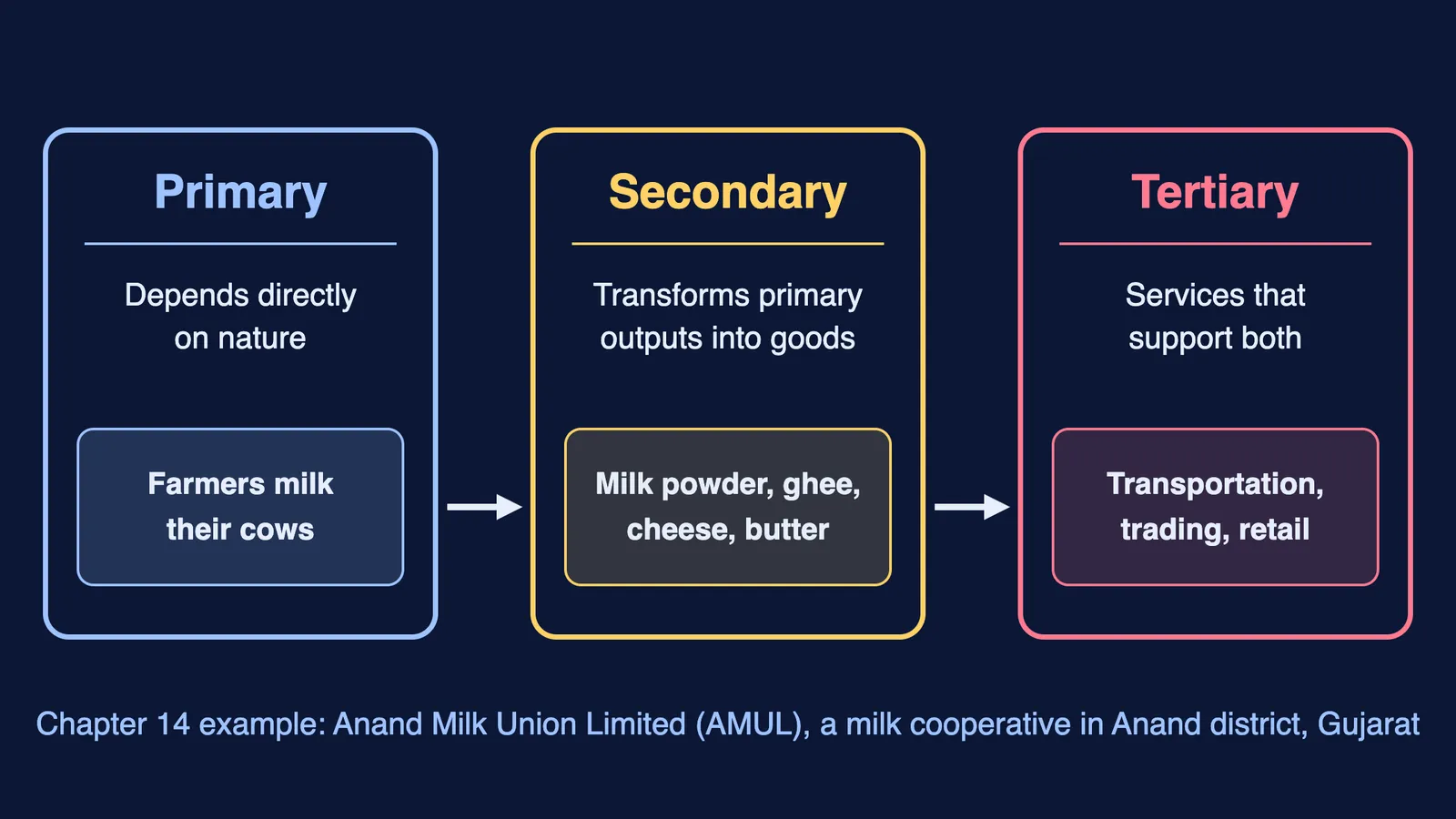
Primary sector: work that takes goods straight from nature. Farming, fishing, forestry, mining and rearing livestock are the usual examples.
Secondary sector: work that takes what the primary sector produces and turns it into new goods. Flour mills, groundnut oil extraction, furniture, cloth and car factories all count, and so do construction and utilities such as water, electricity and gas.
Tertiary sector: services that support the other two. Truck drivers, vendors, doctors, teachers, mechanics, banks, hotels, warehouses and software developers all belong here. The book also calls it the service sector.
Quick test: ask what the worker starts with. Nature means primary, a raw material being changed means secondary, and a service with no new good means tertiary.
How does the AMUL story show the sectors working together?
The chapter's main case study is a milk cooperative in Anand district, Gujarat, which the book names Anand Milk Union Limited (AMUL) (NCERT Chapter 14). In the early 1940s, farmers there walked or cycled to nearby villages to sell milk before it spoiled, and many sold through middlemen who paid them very little. On the advice of Sardar Vallabhbhai Patel they formed a cooperative, and AMUL was set up in 1946, led by Tribhuvandas Patel and Dr Varghese Kurien.
The book then maps the story onto the sectors:
Farmers milking their cows is primary work, because milk comes straight from livestock.
Turning milk into powder, ghee, cheese and butter in factories is secondary work.
Transporting the products by lorry, truck, railway, air and shipping services, then trading and retailing them, is tertiary work.
A second example in the chapter follows tree pulp into paper and then into the printed textbooks you study, and the book notes that none of it could happen without all three sectors. See also our explainer on the cooperative's village societies and milk tests.
Worked example: sorting one market lane
Imagine a market lane in a small town (our own made-up data). A student lists 20 economic activities there:
Primary (4): a dairy farmer, a poultry farm, a fishing boat, a mango orchard.
Secondary (5): a flour mill, a carpentry workshop, a tailoring unit, an oil mill, a brick-making unit.
Tertiary (11): a grocery shop, a bank branch, a school, a clinic, an auto-rickshaw driver, a mobile repair shop, a barber, a bus conductor, a post office, a pharmacy, a courier office.
Shares: primary 4 ÷ 20 = 20%, secondary 5 ÷ 20 = 25%, tertiary 11 ÷ 20 = 55%. The three add up to 100%.
Now trace one link. If the mill closed, wheat growers would lose a buyer, the grocery shop would lose a supplier of flour, and the auto-rickshaw driver who carries sacks would lose trips. One closure touches all three sectors, which is the chapter's point about interdependence.
How does this chapter connect to the rest of the book?
It builds directly on Chapter 13, The Value of Work, which separates economic from non-economic activities (NCERT prelims). Theme A, on land, oceans and landforms, describes the natural world that primary work draws on. In later classes the same three-sector idea returns in more detail, as in our Class 10 guide to sectors of the Indian economy. For how families earn a living in villages and cities, see our post on rural and urban livelihoods for Class 6.
Practice questions
Marks shown are our suggestion; your school sets its own paper.
Classify each as primary, secondary or tertiary: a salt pan worker, a bakery, a bus driver, a cotton farmer. (2 marks)
Name two secondary activities that start from a farm product, and give the raw material each one uses. (2 marks)
Why did the Anand farmers want to stop depending on middlemen? (3 marks)
A village has 30 economic activities: 6 primary, 9 secondary and the rest tertiary. Find each sector's share as a percentage. (3 marks; answer: 20%, 30%, 50%)
Put these steps for a jar of mango pickle in order and name each step's sector: a shop sells it; a grower picks mangoes; a truck carries jars to town; a unit pickles the mangoes. (5 marks)
Not sure which of these you can already answer? Fermi's AI tutor works out what you already know and builds a plan for the session.