On this page
Chapter 8 of the NCERT book Knowledge Traditions and Practices of India, Class XI, follows two threads: early chemical crafts (glass, dyes, cosmetics, ink, the idea of the atom) and metal working (copper, iron, zinc, gold and silver). Below: where it sits in the CBSE course, what to learn, a worked check and practice questions.
Is Chemistry and Metallurgy in India in the CBSE Class 11 KTPI written exam?
No. The CBSE KTPI curriculum for 2026-27 lists its own Class XI chapters, and they do not match the NCERT book's chapter numbers. The closest curriculum chapter is Chapter 2, "Chemistry in India", and the course-structure table marks it "For internal assessment only". The curriculum has no separate metallurgy chapter.
The 70 written marks go to five other chapters. Internal assessment carries 30 marks in the same curriculum: a research-based project (2 x 10 = 20), a portfolio (5) and a viva voce (5). Those 30 marks are shared across all the internal-assessment chapters (Chemistry in India, Environmental Conservation, Mathematics in India, Theatre and Drama), so no figure belongs to this chapter alone. You do two projects, one per term.
What does the chemistry half of the chapter cover?
The NCERT chapter (Reprint 2026-27) traces modern chemistry to alchemy and iatrochemistry, then turns to Indian traditions such as Rasāyana Śāstra. Main topics:
Harappan materials: baked bricks, gypsum cement, glazed pottery, and faience that Kenoyer found was refired at around 940 degrees Celsius.
Glass: texts such as the Arthaśāstra, finds at Maski and Taxila, and Harappan glass beads from about 1700 B.C.E.
Paints, dyes, perfumes and cosmetics: Varāhamihira's Bṛhatsaṁhitā, Gandhayukti, and Raja Serfoji's Dhanvantari Mahal at Thanjavur.
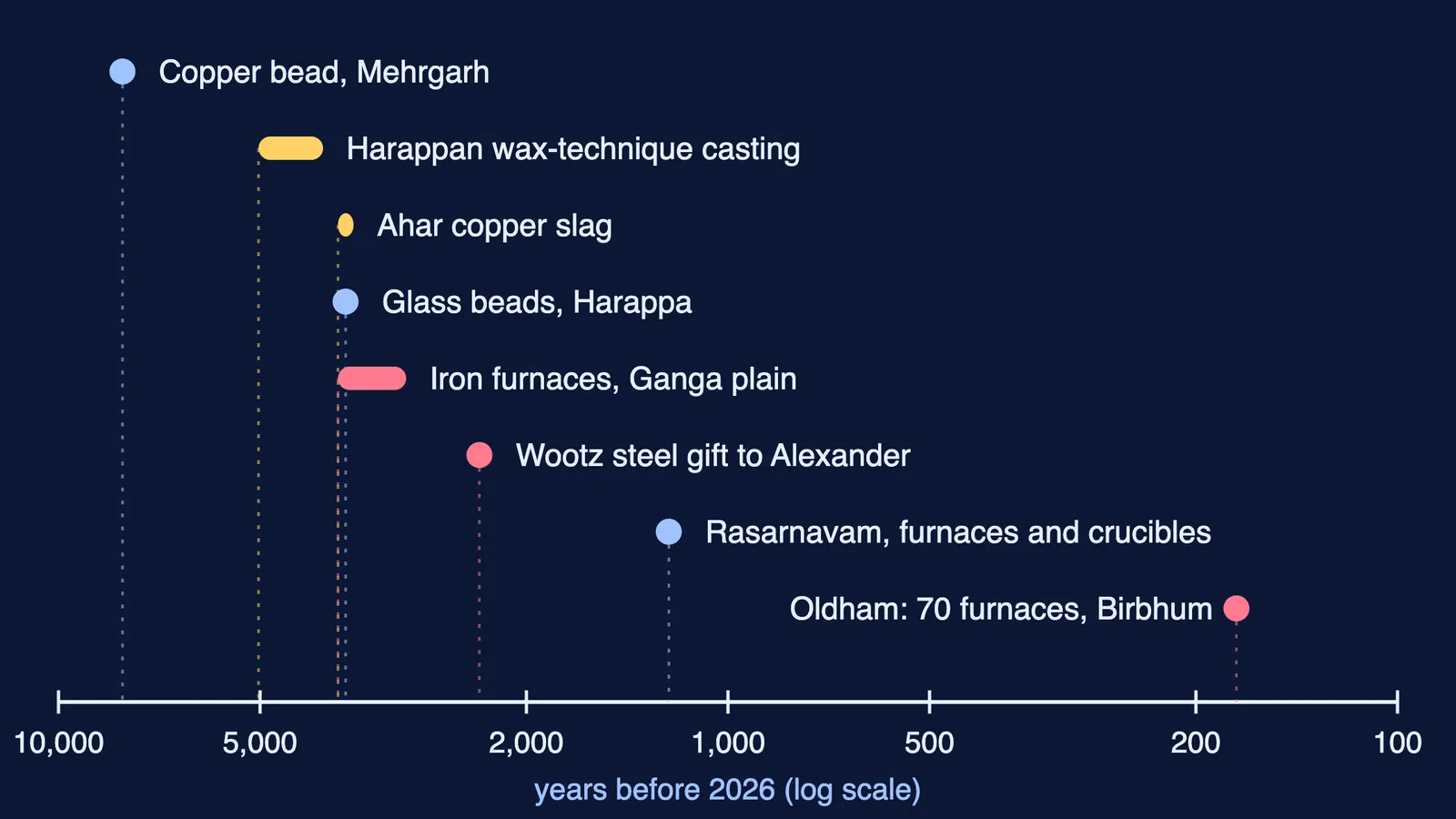
Chemicals and texts: Nagarjuna's Rasaratnākara on mercury compounds and extracting metals, and a separate book, the Rasārṇavam (around 800 C.E.), on furnaces, crucibles and identifying metals by flame colour.
Paper and ink: Gilgit manuscripts, I-tsing's account and a Taxila ink pot.
The atom: Kaṇāda's idea of tiny, indivisible paramāṇu, which the book compares with John Dalton's later atomic theory. Our Structure of Atom Class 11 guide covers the modern model.
What does the metallurgy half cover?
The same chapter makes its case mainly from archaeology:
Copper: a copper bead from Mehrgarh dated to about 6000 B.C.E., Aravalli ores carrying 4 to 8 per cent arsenic, an axe from Nal analysed at 94% copper and 5% nickel, and copper slag at Ahar dated 1800 to 1600 B.C.E.
Iron: furnaces in the Central Ganga Plain dated 1800 to 1000 B.C.E., the Agaria furnaces, wootz steel, and the Delhi iron pillar. Our post on why the Delhi iron pillar does not rust goes deeper.
Zinc: zinc boils at a low temperature and is lost as vapour, so it was made by downward distillation at Zawar. See how zinc was made at Zawar.
Gold and silver: Harappan ornaments, a silver sample from Mohenjodaro, the Maski gold mines, and the Arthaśāstra on mines.
Decline: learn the reasons the book gives for these skills fading.
A worked check: how pure is the Delhi iron pillar's iron?
The NCERT chapter lists the pillar's average non-iron elements: carbon 0.15%, silicon 0.05%, manganese 0.05%, phosphorus 0.25%, nickel 0.005%, copper 0.03%, nitrogen 0.02%. It also calls the metal over 99 per cent pure. Test that, treating these seven as the only non-iron elements.
Add the non-iron parts: 0.15 + 0.05 + 0.05 + 0.25 = 0.50; then 0.50 + 0.005 + 0.03 + 0.02 = 0.555%.
Iron left: 100 - 0.555 = 99.445%, consistent with the book's "over 99 per cent".
Share of phosphorus in the non-iron part: 0.25 / 0.555 = 0.45, so about 45%.
For our own example mass of 1,000 kg of this iron: phosphorus = 0.25% of 1,000 kg = 2.5 kg, and carbon = 1.5 kg.
Step 3 is a good viva point: phosphorus is the largest non-iron element, and the book cites Balasubramaniam's finding that a phosphate-containing layer protects the pillar.
Practice questions for Chemistry and Metallurgy in India
Class 11 KTPI has no CBSE sample paper, so the mark labels below are our suggestion.
(1 mark) Name the curriculum chapter that this NCERT chapter relates to, and state how it is assessed.
(2 marks) Why is copper slag at Ahar stronger evidence of local smelting than a finished copper tool?
(2 marks) An axe fragment is analysed as 94% copper and 5% nickel. What percentage is left for other elements, and from which pre-Harappan site does the chapter's example come?
(3 marks) Draw and label a two-chamber downward-distillation unit like those at Zawar. Mark where the fire is, where the retorts sit and where the zinc collects.
(5 marks) Plan a one-term project comparing the two kinds of evidence the chapter uses: archaeological finds (such as slag or retorts) and texts (such as the Arthaśāstra or the Rasārṇavam). Give two examples of each and say what each kind can and cannot tell a historian.
Not sure which half of the chapter to start with? Fermi's AI tutor works out what you already know and builds a plan for the session.