On this page
Family and Community is Chapter 9 of NCERT's new Class 6 Social Science book, Exploring Society: India and Beyond (code fees1, First Edition June 2024, reprinted February 2026). It opens Theme D, Governance and Democracy (NCERT, fees1 contents). CBSE publishes no separate 2026-27 curriculum for Classes 6 to 8; they follow the NCERT book, and the chapter is assessed by the school.
What does the Family and Community chapter cover?
Its two big questions: why does the family unit matter, and what is a community and its role? (NCERT Chapter 9 PDF).
Family: the book calls it the most basic and the oldest unit of any society.
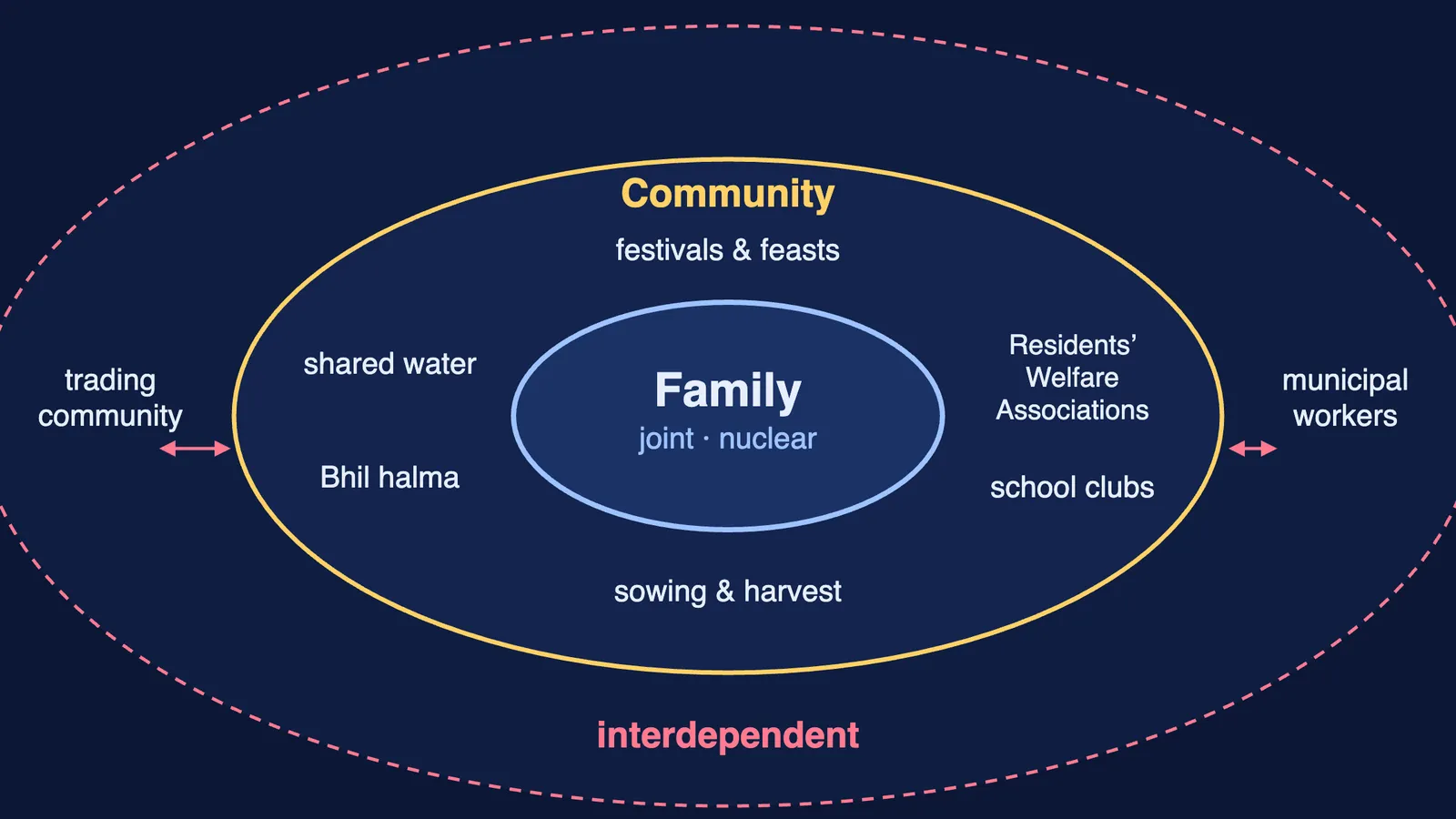
Joint family: several generations living together.
Nuclear family: a couple and their children, or sometimes one parent with children.
Kinship words: Indian languages have many exact relationship terms (bua, mausi in Hindi), and most have no word for "cousin": cousins are simply brothers and sisters.
Community: families linked to other families and to people nearby.
What are the roles and responsibilities in a family?
The book says family relationships rest on love, care, cooperation (working together) and interdependence (NCERT). The book describes following one's dharma, or doing one's duty, as an important principle of Indian culture, and calls the family a "school" where children learn values: sevā (service), tyāga (sacrifice), dāna (giving) and ahimsa.
In a Kerala town before Onam, Shalini's uncle has lost his job, so her parents buy festival clothes for his family as well, and Shalini accepts a cotton dress instead of silk. In a Meghalaya village, Tenzing's father shares the housework once Tenzing's mother becomes busy in a handicraft cooperative; his grandfather helps with homework and with neighbours in need.
What is a community, and what does it do?
Communities gather for festivals, feasts and weddings; in some villages people help each other sow and harvest (NCERT). Over time, many communities agreed on practices, rarely written down, for sharing water, grazing land and forest produce. The book says this holds for many tribal communities and, to some extent, villages today. Such rules secured access to resources but also gave every family duties.
The book's real-life examples:
Halma, Jhabua (Madhya Pradesh): facing a water crisis year after year and following its halma tradition of helping anyone in crisis, the Bhil community planted thousands of trees in hundreds of villages and dug trenches to hold rainwater, without pay. The book adds that in 2019 Mahesh Sharma of the Shivganga movement received the Padma Shri for his work with the Bhil communities.
Chennai floods, 2015: with almost all shops shut, many private groups, notably spiritual and religious organisations, cooked food and handed it out to people in need.
Ahmedabad: more than 20 years ago, workshop owner Kamal Parmar began evening tuition, with a free dinner, for underprivileged children he saw on the street. Soon 150 children attended regularly, and volunteers joined.
Residents' Welfare Associations: a newer kind of urban community, from the last 30 or 40 years, whose members make rules on waste, common areas and pets.
The book's closing points stress interdependence. An RWA depends on the trading community for supplies and municipal workers for waste. It also notes that "community" is a flexible word: a jāti, or a subdivision of one, is often called a community, as is a group sharing a religion, region, kind of work or interest, or a school group such as a club.
How does this chapter connect to the rest of the book?
Rules and duties in families and communities lead into local self-government in the next three chapters. Our Panchayati Raj Class 6 guide to Chapter 11 picks up the rural part; in Class 9, Governance and Public Policy takes these ideas further.
Worked example: how do you write up a lane survey?
The chapter asks you to count family types near your home. Made-up numbers:
Suppose you survey 24 households in your lane: 15 nuclear (3 of them with one parent) and 9 joint.
Nuclear share: 15 ÷ 24 = 0.625, or 62.5%.
Joint share: 9 ÷ 24 = 0.375, or 37.5%. Check: 62.5% + 37.5% = 100%.
Nuclear families are more frequent, by 15 − 9 = 6 households. Suggest reasons, then weigh each type's pros and cons.
Add one shared activity (a festival) and two outside groups the lane depends on (a vegetable seller, the waste collector).
Practice questions for Family and Community
Mark labels are our suggestion.
(1 mark) What is a nuclear family?
(2 marks) Why do most Indian languages have no separate word for "cousin"?
(2 marks) What did the Bhil community do about the water crisis around Jhabua, and why did they work without pay?
(3 marks) How does a Residents' Welfare Association show that communities depend on one another? Give two examples.
(5 marks) Using Shalini's or Tenzing's story, explain how members of a joint family share roles and support each other. Link your answer to one value the book says the family teaches.
Where to start revising? Fermi's AI tutor works out what you already know and builds a plan for the session.