On this page
If you are in Class 9 in 2026-27, Governance and Public Policy is Chapter 4 of Part 2 of NCERT's new Social Science book, Understanding Society: India and Beyond (NCERT, Part 2 contents). A note at the front of that file (Your Journey through this Book) says it takes the place of a chapter called Authority that had been planned earlier. It picks up where the Democracy and Elections chapters stop: voting forms a government, but democracy also needs open institutions and citizens who stay involved (NCERT Chapter 4).
What is the difference between government and governance?
Government is the institutions that hold political authority: the Legislature, the Executive and the Judiciary (NCERT Chapter 4). Governance is the process by which public decisions are made, carried out and monitored, involving citizens, the media, civil society and private organisations as well as government. Memory hook: government is who governs; governance is how governing is done.
The chapter names seven features of good governance: rule of law, accountability, participation, transparency, responsiveness, effectiveness and inclusiveness. It traces Indian ideas such as the Sabha and Samiti, Rajadharma and Gandhi's Ram Rajya through to the Constitution, and covers e-governance (DigiLocker, UMANG and others) with a limit: it works only when people have a device, reliable internet and the skills to use them.
What makes a policy "public"?
Families, schools and companies have policies too, but those apply to a limited group. In the chapter's terms, a policy is public when the government makes it for society as a whole, public institutions carry it out, and tax money often pays for it. Quick sort:
A cricket academy bans phones during practice: a policy, not a public policy.
A state government gives free bus passes to all school students: a public policy.
What are the stages of the policy cycle?
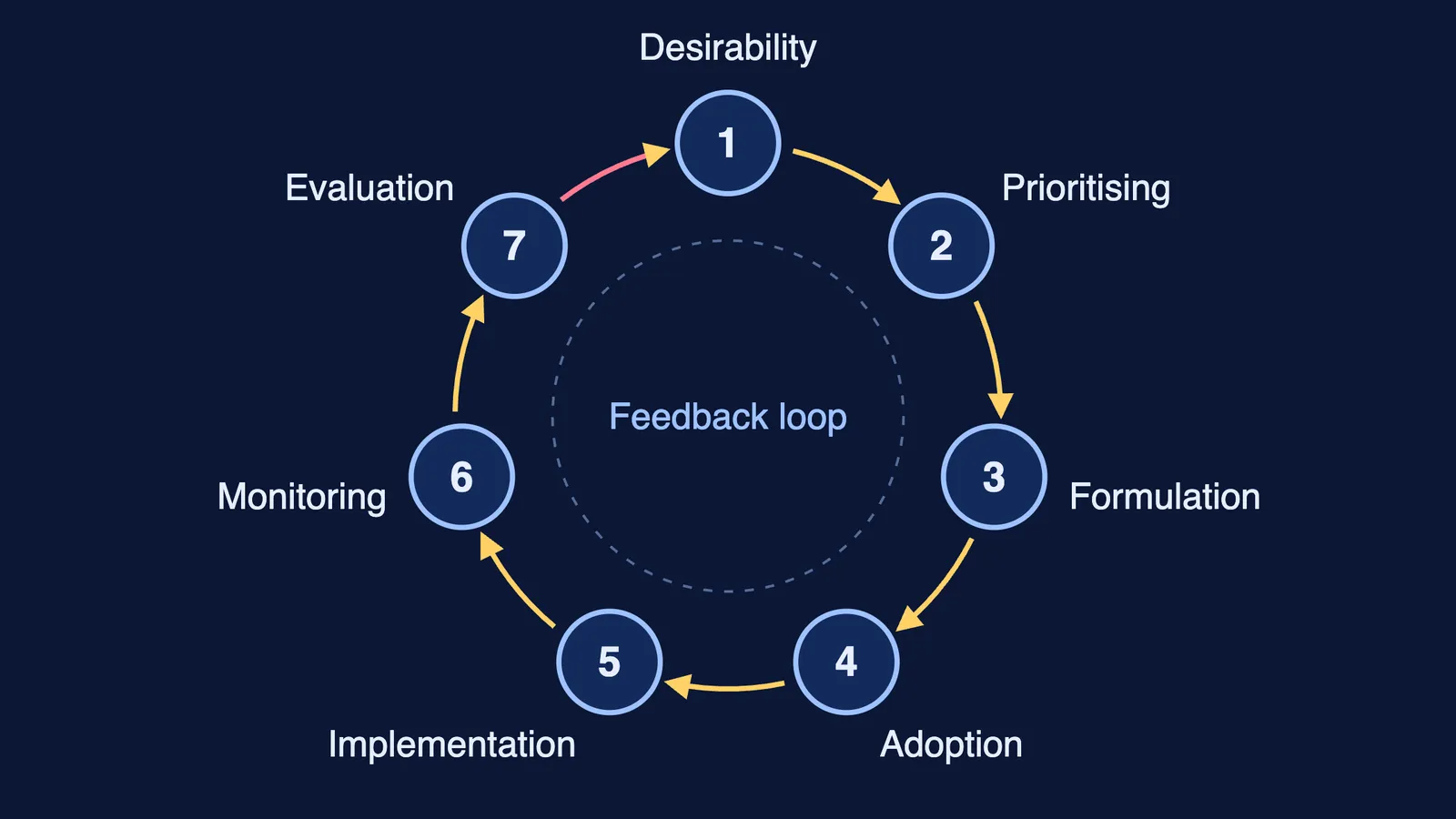
The chapter draws policy-making as a seven-stage cycle (the diagram above follows its order):
Desirability: what need or problem should be addressed?
Prioritising: which issues come first?
Formulation: consult stakeholders, draft the policy, check what it will cost.
Adoption: frame the law and the rules that go with it.
Implementation: officials, local bodies, civil society, private organisations and citizens put it into action.
Monitoring: track progress, keep people accountable, spot gaps.
Evaluation: judge results and impact, then feed that back into the cycle.
Our own example: a new colony at the edge of a town has no bus stop, so students walk along a busy road. Residents and their ward councillor raise it (desirability). The transport committee ranks it against other requests (prioritising). Officials consult residents and the school and cost a new stop (formulation). The committee approves the revised route (adoption). The transport department runs it (implementation), counts riders each month (monitoring) and, after a year, asks whether students reach school more safely (evaluation). If buses run empty at noon, timings change and the cycle turns again.
The chapter's real case is the National Education Policy 2020: the draft was opened to the public, about 2 lakh suggestions came in, and the Union Cabinet approved it in July 2020 (NCERT Chapter 4).
Policy, programme or scheme: what is the difference?
Policy sets the direction, a programme lays out the plan, and a scheme delivers a concrete benefit. The chapter's example is the National Health Policy 2017: its goals (such as universal access to good healthcare) lead to programmes (such as strengthening public healthcare), which run through schemes such as Ayushman Bharat PM-JAY, Janani Suraksha Yojana and Mission Indradhanush (NCERT Chapter 4).
On coordination, it uses Khelo Bharat Niti 2025: the Union Government sets the framework and funding, states build infrastructure and host games, blocks run regular events, and sponsors, families and citizens each play a part.
What will CBSE ask, and what mistakes cost marks?
CBSE's 2026-27 Class IX Social Science curriculum does not yet name this chapter. Its Part 2 still lists theme 5 as Authority (10 teaching hours), the chapter NCERT replaced, and says the course structure "will be provided shortly" (CBSE curriculum 2026-27). So hours and marks for this chapter are not yet published; study from the NCERT book and watch CBSE Academic for updates.
Common mistakes to avoid:
Using "government" and "governance" as if they mean the same thing.
Calling every rule a public policy, including a school or company rule.
Mixing up monitoring (tracking progress while the policy runs) and evaluation (judging the results).
Giving opinions instead of the chapter's terms and examples.
A 20-minute revision plan: redraw the cycle from memory (5 minutes), sort five everyday rules into policy or public policy (5 minutes), then walk one local problem through every stage in writing (10 minutes).
For background, read our guides to what democracy is and why it matters, how elections work in the new Class 9 book and who decides what inside government. Fermi is built for STEM, so for your maths and science revision, Fermi's AI tutor can work out what you already know and build a plan for the session.