On this page
Elections is Chapter 7 of the new NCERT Class 9 Social Science book, Understanding Society: India and Beyond Part 1, which schools use from the 2026-27 session. If your school still teaches the older book, our guide to electoral politics in the old Class 9 syllabus is the one you want.
What does the new Elections chapter cover?
The CBSE Class IX Social Science curriculum for 2026-27 gives Elections 9 instructional hours and lists its topics as the importance of elections, electoral systems, the Delimitation Commission, the Election Commission of India and its role, constituencies and electoral rolls, and the party system. The same document says the course structure, which sets marks per unit, will be provided later, so ask your teacher about the weighting.
The NCERT chapter works through five ideas:
Why elections matter. Regular elections keep representatives accountable.
Direct and indirect elections. You vote directly for the Lok Sabha, the Vidhan Sabha and local bodies; the President, the Vice President and the Rajya Sabha are chosen indirectly.
Laws and bodies. Two Representation of the People Acts (1950 and 1951), the Delimitation Commission and the Election Commission of India (ECI).
Political parties. Recognition by the ECI, coalitions and the Anti-Defection Law.
Challenges. Misinformation, fake news and intimidation.
How does an election in India work, step by step?
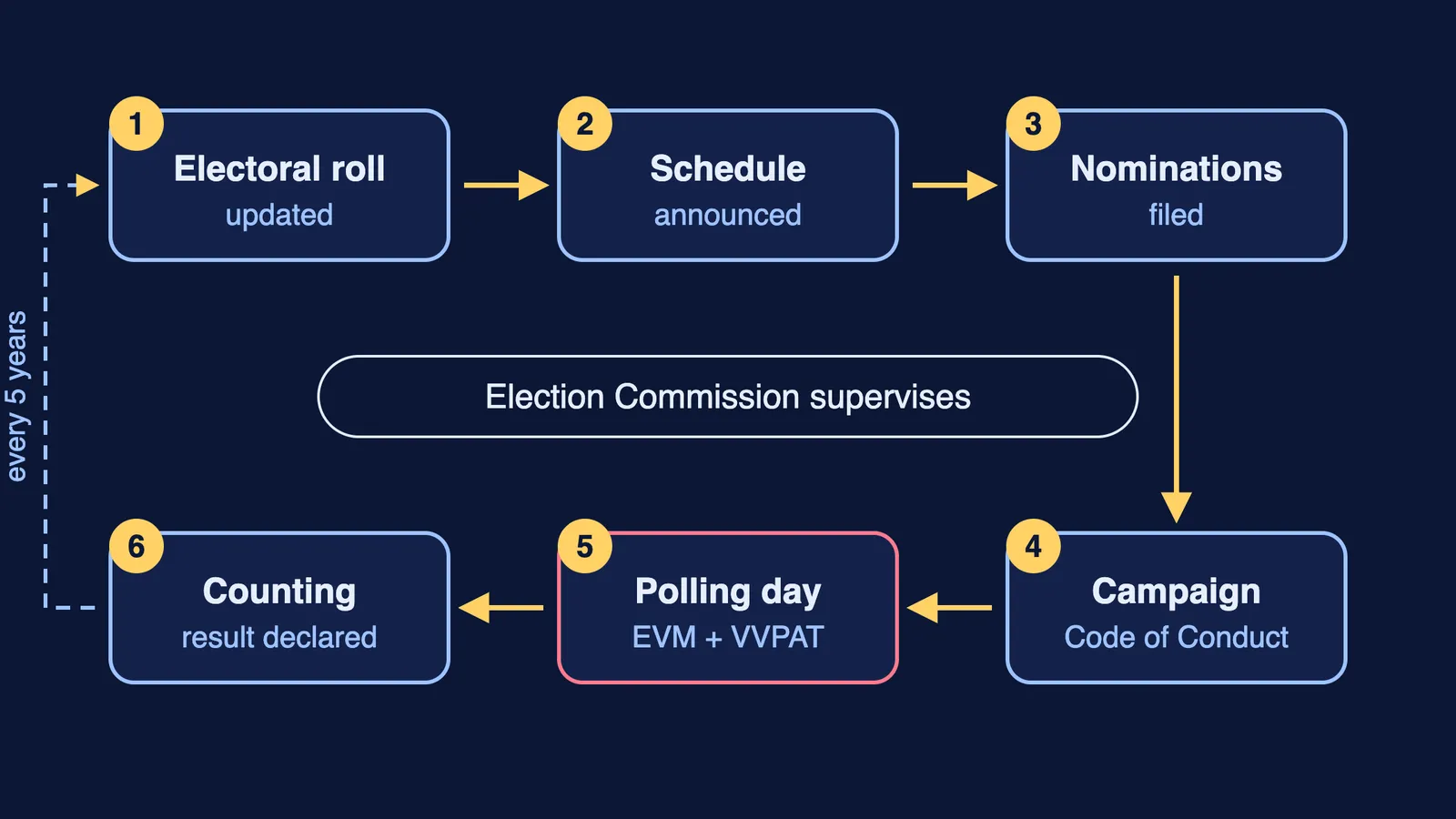
The diagram above follows one general election in six steps, using what the chapter says the ECI does.
Electoral roll updated. Enumerators collect details household by household, and only people whose names are on the roll can vote. A Special Intensive Revision adds missed voters, such as those who have just turned 18, and removes ineligible entries.
Schedule announced. The ECI weighs weather, harvests, exams and festivals.
Nominations filed. Candidates from registered parties, and independents, enter the contest under rules in the 1951 Act.
Campaign. Parties present their agendas while the Model Code of Conduct applies; voters can report violations through the cVIGIL app.
Polling day. Votes are cast on EVMs, and the VVPAT slip lets each voter check the vote.
Counting and result. Votes are counted and results declared; disputes are settled under the 1951 Act.
Delimitation sits outside this loop. It redraws constituency boundaries so each seat covers a similar population, and the chapter notes India has had four Delimitation Commissions, in 1952, 1963, 1973 and 2002.
What is the difference between FPTP and proportional representation?
India elects the Lok Sabha and Vidhan Sabhas by first-past-the-post (FPTP): the candidate with the most votes wins, even with less than half. The Rajya Sabha, the President and the Vice President are elected by proportional representation, according to the chapter.
Here is a worked example with made-up numbers. In one constituency, candidate P gets 42,000 votes, Q gets 38,000 and R gets 20,000, out of 1,00,000. Under FPTP, P wins with 42%. Under a majority (two-round) system, nobody crossed 50%, so P and Q would face a second round.
The chapter also explains the single transferable vote, used for the Vidhan Parishad, with a quota: total valid votes divided by (seats + 1), plus one. If 1,000 members vote to fill 3 seats, the quota is 1,000 / 4 + 1 = 251 votes. A candidate who reaches 251 first-preference votes is elected; otherwise the lowest candidate is eliminated and their ballots move to second preferences. For a deeper comparison, read our Class 11 guide to FPTP and proportional representation.
Which mistakes cost marks in this chapter?
Saying FPTP needs a majority. It needs only the highest number of votes.
Calling the Rajya Sabha directly elected. It is chosen indirectly.
Mixing up the two Acts. The 1950 Act covers seats, delimitation and electoral rolls; the 1951 Act covers how elections are run, offences and disputes.
Confusing delimitation (redrawing boundaries) with roll revision (updating the voter list).
Writing party names or opinions into a general answer. Keep answers about institutions and rules, and stay neutral.
How should you revise Elections for CBSE 2026-27?
Spread the work over three short sessions:
Day 1: redraw the six-step diagram from memory and add one line per step.
Day 2: make your own FPTP and STV examples with fresh numbers and solve them.
Day 3: list the laws and bodies (two Acts, Delimitation Commission, ECI, Anti-Defection Law of 1985) with one function each, then try the end-of-chapter activities without looking.
For when you turn 18, our guide on how to register as a first-time voter in India walks through it. If maths and science chapters are due the same week, Fermi's AI tutor can work out what you already know and build a plan for the session, so you start each sitting with a clear next step.