On this page
From 2026-27, Class 9 Social Science uses NCERT's new book, *Understanding Society: India and Beyond*. Part 2, Chapter 2, Life on Earth, asks how climate and landforms decide what lives where, and why conservation matters.
The CBSE 2026-27 Class IX curriculum gives this chapter 7 teaching hours. Marks per chapter are not out yet: the document says the course structure will be provided shortly. It also expects you to locate India's biosphere reserves on a map.
What is a biome, and how is it different from an ecosystem?
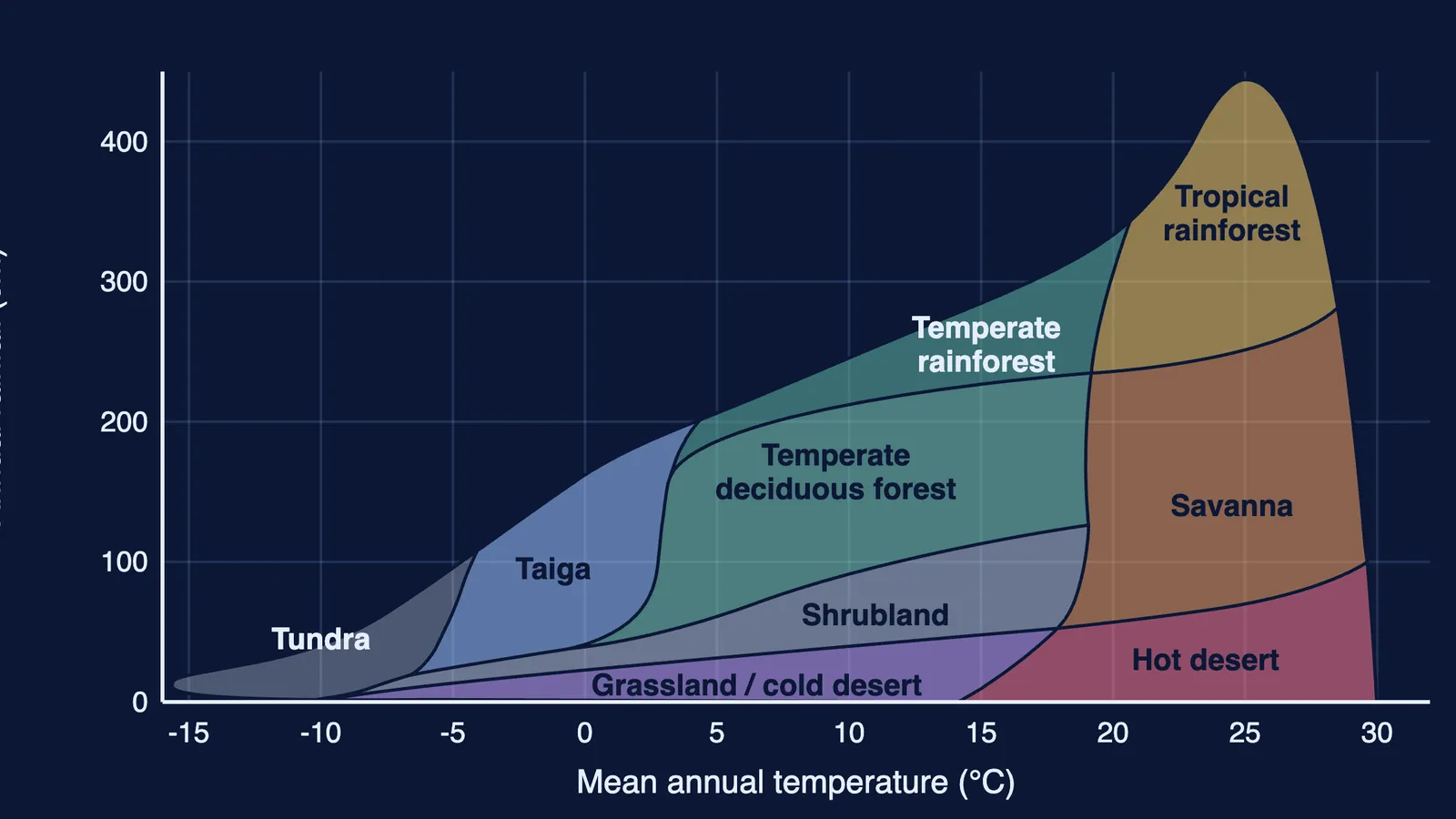
A biome is a large natural region where similar plants and animals live under similar climate, according to the NCERT chapter. An ecosystem is smaller: a neighbourhood inside a biome where living and non-living things interact closely. Biomes are terrestrial (forest, grassland, desert, tundra) or aquatic, and temperature, rainfall and the main plant types decide which one forms. Its world map (Fig. 2.2) also shows temperate deciduous forest and taiga (coniferous forest).
The diagram at the top shows this: read across for warmth, up for rain.
What are the main biomes and where are they found?
These profiles combine the chapter with NASA's Mission: Biomes pages:
Tropical rainforest: near the Equator, between 23.5° N and 23.5° S. NASA gives 2,000 to 10,000 mm of rain a year and daily averages of 20 to 25 °C. In India: the Andaman and Nicobar Islands and the Northeast.
Grassland: NASA's grassland page gives about 500 to 900 mm of rain a year, too little for dense forest. Tropical grasslands are savannas.
Desert: about 250 mm of rain a year, the least of any biome, per NASA's desert page. Hot (Sahara) or cold (Gobi). The Rann of Kutch is a salt desert that floods in the monsoon.
Tundra: the coldest biome, near the poles. NASA's tundra page gives 150 to 250 mm of precipitation and temperatures from -40 to 18 °C. Frozen ground (permafrost) stops trees, so mosses, lichens and shrubs grow.
Aquatic: the chapter says water biomes cover about three-fourths of the Earth's surface.
Why does energy shrink up the biome pyramid?
The chapter's biome pyramid puts producers (plants, algae) at the base, then herbivores, carnivores and top predators. Moving up, numbers, biomass and energy all fall, because each level loses energy as heat while living. The book's Fig. 2.10 instead arranges biomes from cold to hot and wet to dry, like the diagram at the top. If photosynthesis or food chains feel shaky, the Fermi Concept Library covers every concept in biology as well as physics, chemistry, mathematics and computing. For the Earth's spheres and the biosphere, see our guide to Earth as a System in Class 9.
How do forests and people depend on each other?
The second half of the chapter is about people. Forest communities get food, fuel, fodder, medicine and income from forests. The Gonds and Bhils honour forest deities before collecting, and communities protect sacred groves, which the chapter says number over 1,00,000 in India. It also covers ecotourism (Thenmala in Keralam was India's first planned site) and GI-tagged forest products.
Challenges include weak access to health care and schools, crop damage by wild animals, and fires. The chapter cites the Forest Survey of India: about 36 per cent of India's forest cover is fire-prone, and nearly 4 per cent extremely so. Government responses include the Forest Rights Act, 2006. Mendha Lekha in Gadchiroli, Maharashtra, was the first village to win rights over its forest under that Act, and manages 1,800 hectares through its Gram Sabha.
For how scientists sort living things, read Patterns in Life class 9; for why that variety is worth protecting, see why conserve biodiversity.
What mistakes do students make in this chapter?
Calling a biome an ecosystem. A biome is the broad region; ecosystems sit inside it.
Treating every desert as hot. The Gobi is cold.
Writing that energy increases up the pyramid. It decreases at every level.
Mixing up savanna (tropical, scattered trees) and temperate grassland.
How should you revise Life on Earth?
Make a biome card for each biome on the chapter's world map, plus aquatic, with the same lines every time: where, climate, life, one Indian example. A worked card:
Biome: tropical rainforest
Where: between 23.5° N and 23.5° S; Amazon, Congo, Southeast Asia
Climate: hot and wet all year, 2,000 to 10,000 mm of rain (NASA)
Life: layered forest and the richest store of biodiversity, called a "gene bank"
India: Andaman and Nicobar Islands, Northeastern states
Then test yourself without the cards (our questions, not the textbook's):
Two places each get under 250 mm of rain a year, one in the Sahara and one in Arctic Canada. Name each biome and the factor that separates them.
Why might a village protect its forest better than a distant office could? Use one example from the chapter.
Sketch a four-level pyramid for a grassland and label where energy is lost.
If you would rather have a plan made for you, Fermi's AI tutor works out what you already know and builds a plan for the session.