On this page
Chapter 13 is the last chapter of Exploration, the new NCERT Class 9 science textbook for 2026-27 (first edition, April 2026) (book prelims, NCERT). It pulls together ideas you met separately in Classes 6 to 8: sunlight, winds, the water cycle and climate change.
What is Chapter 13 of the new Class 9 science book about?
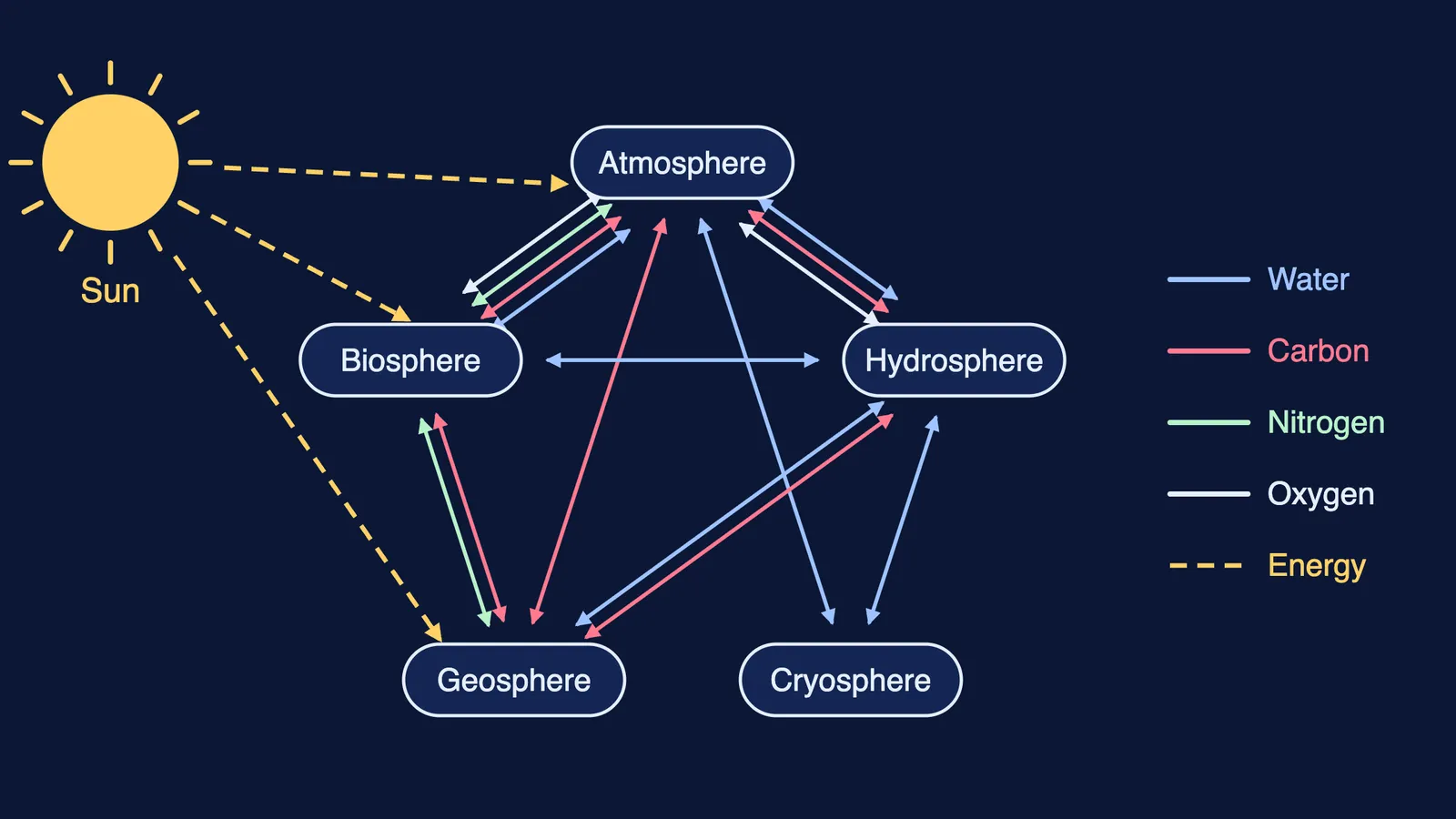
The chapter treats the Earth as one system made of five interacting spheres (NCERT Chapter 13):
Geosphere: rocks, soil and the Earth's interior.
Hydrosphere: oceans, rivers, lakes and groundwater.
Cryosphere: ice and snow, such as Himalayan glaciers.
Atmosphere: the air around us.
Biosphere: all living things and their habitats.
Solar energy flows through these spheres and matter cycles between them, so a change in one affects the others. For a refresher, see our guide to the major domains of the Earth.
How does uneven heating of the Earth make winds and currents?
The solar constant, the solar power arriving per square metre at the top of the atmosphere, is about 1.4 kW per square metre (NCERT Chapter 13). Insolation, the sunlight reaching the ground, peaks at about 1 kW per square metre on a clear day.
The Earth does not warm evenly, for three reasons:
Shape and latitude. At the equator sunlight is concentrated on a smaller area than at the poles.
Tilt. The tilted axis gives seasons and changing day length.
Albedo. Albedo is the fraction of sunlight a surface reflects: 0.80 to 0.90 for snow, much less for dark soil and ocean water.
Warm air rises, leaving low pressure, and air flows in from high pressure. Locally this gives valley breezes by day and mountain breezes at night. Globally it gives pressure belts and planetary winds, bent right in the Northern Hemisphere and left in the Southern by the Earth's rotation. Winds also drag surface water into ocean currents that carry heat towards the poles.
The atmosphere is mainly nitrogen (78%) and oxygen (21%). Almost all weather happens in the troposphere, about 12 km high on average, where temperature falls roughly 6.5 °C per kilometre. Our post on water in the atmosphere goes further into clouds and rain.
How do the water, carbon, nitrogen and oxygen cycles connect the spheres?
A biogeochemical cycle is the repeated movement of matter between living and non-living parts of the Earth (NCERT Chapter 13).
Water: evaporation, precipitation, run-off and infiltration link glaciers, rivers, air, soil and crops.
Carbon: photosynthesis removes CO2 from the air; respiration, decay and burning return it. Burial into fossil fuels takes millions of years.
Nitrogen: bacteria such as Rhizobium fix nitrogen gas into ammonia, nitrifying bacteria make nitrate, decomposers return ammonia, denitrifying bacteria release nitrogen gas.
Oxygen: respiration and burning use it; photosynthesis restores it.
Humans matter too: atmospheric CO2 rose from about 315 ppm to 420 ppm since 1960, about a one-third rise, which the chapter rounds to about 35% (NCERT Chapter 13). For the bigger climate picture, see our notes on world climate and climate change.
Worked example: how much solar energy does a rooftop get?
Take a 10 square metre roof receiving 1 kW per square metre (the chapter's clear-sky figure) steadily for 5 hours, a simplification since real sunlight rises and falls through the day.
Power falling on the roof = 1 kW per square metre × 10 square metres = 10 kW.
Energy in 5 hours = 10 kW × 5 h = 50 kWh.
In joules: 1 kWh = 3.6 × 10^6 J, so 50 kWh = 1.8 × 10^8 J.
If panels turned one-fifth of this into electricity (our assumption for practice), you would get 10 kWh, or 10 units on a bill.
The method is energy = intensity × area × time. Keep units matched: kW with hours gives kWh; W with seconds gives joules.
Common mistakes in Earth as a System answers
Mixing up the solar constant (top of the atmosphere) with insolation at the surface.
Swapping the breezes: valley breeze blows up the slope by day; mountain breeze blows down at night.
Calling the greenhouse effect harmful in itself. Without it the Earth would be too cold; extra CO2 strengthening it is the problem.
Writing "nitrogen fixation" when you mean nitrification. Fixation turns N2 into ammonia; nitrification turns ammonia into nitrate.
If one of these ideas keeps slipping, the Fermi Concept Library gives every concept in physics, chemistry, biology, mathematics and computing its own lesson, so you can fix the gap early.
How should you prepare Chapter 13 for CBSE 2026-27?
In the CBSE Class IX Science curriculum for 2026-27, Unit IV "Earth as a system" is Chapter 13 alone and carries 5 of the 80 theory marks, with 12 teaching periods suggested (CBSE curriculum 2026-27). The learning outcomes include drawing flow charts and concept maps for the cycles and for uneven heating.
A three-session plan:
Draw the five spheres from memory and add arrows for each cycle.
Practise one heating question and one energy calculation.
Trace one change, such as a cleared forest, through three spheres in writing.