

On this page
"Major domains of the Earth" is Chapter 5 of NCERT's older Class 6 geography book, The Earth Our Habitat (NCERT CIET). NCERT's Central Institute of Educational Technology also lists Exploring Society: India and Beyond as a Class 6 social science book (NCERT CIET), so check which book your school follows. The four domains are the same whichever book you use.
What are the four major domains of the Earth?
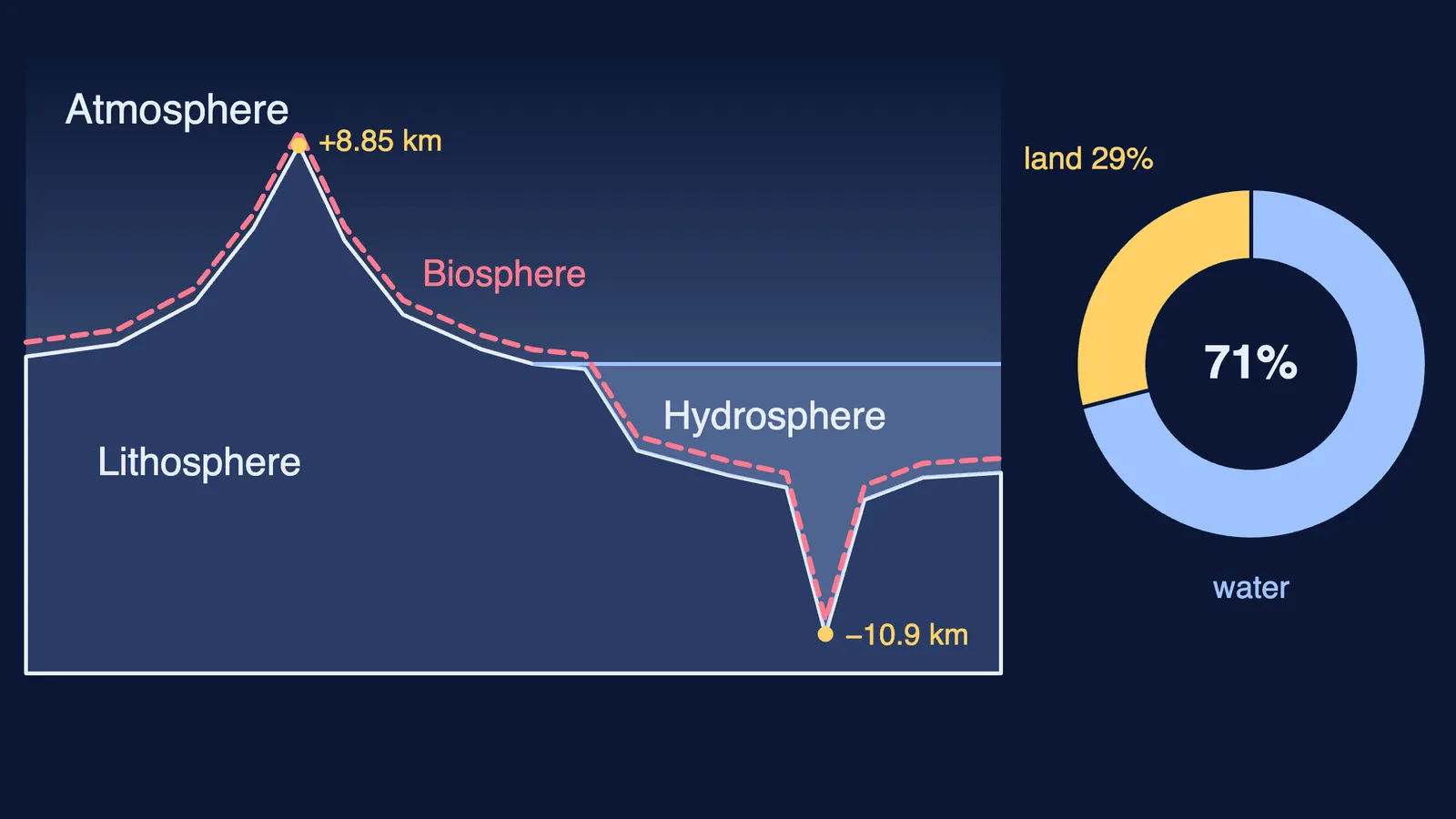
Lithosphere: the lithosphere is the rocky outer part of the Earth, made of the brittle crust and the top part of the upper mantle (National Geographic).
Hydrosphere: the hydrosphere is the sum of Earth's water, in the ocean, in the ground, on the surface and in the air (National Geographic).
Atmosphere: the atmosphere is the layer of gases around the planet, about 78% nitrogen, 21% oxygen, 0.9% argon and 0.1% other gases (National Geographic).
Biosphere: the biosphere is made up of the parts of the Earth where life exists, from the deepest roots of trees to ocean trenches and high mountaintops (National Geographic).
The first three are kinds of matter: rock, water and air. The fourth is the zone where the other three meet and life is found. Mountains, plateaus and plains are all shapes of the lithosphere, and our guide to major landforms of the Earth for Class 6 takes each one in turn.
How much of the Earth is covered by water?
Approximately 71% of the Earth's surface is covered in water, and only about 3% of all that water is freshwater (National Geographic). The ocean holds about 97% of the Earth's water; the rest is in glaciers and ice, under the ground, in rivers and lakes, and in the air (NOAA).
The lithosphere and the hydrosphere also give the Earth its highest and lowest points. Mount Everest's official height, announced jointly by Nepal and China in December 2020, is 8,848.86 metres (The Kathmandu Post). The deepest known point in the ocean is Challenger Deep in the Pacific Ocean's Mariana Trench, at 10,935 metres (NOAA Ocean Exploration).
What are the seven continents and five oceans?
The seven continents, from largest to smallest, are Asia, Africa, North America, South America, Antarctica, Europe and Australia (National Geographic). To remember the size order, try "All Animals Need Some Apples Every Afternoon": one word per continent, biggest first.
There is really one connected global ocean, divided into named regions (NOAA). Historically there were four: the Atlantic, Pacific, Indian and Arctic. Most countries now also recognise the Southern (Antarctic) Ocean as the fifth.
Before you label an outline map, read our guide to maps for Class 6: types, scale and symbols.
How do the four domains work together?
Pick one real place and sort what you see. Take a paddy field in Kerala during the monsoon:
Lithosphere: the soil and the rock beneath it.
Hydrosphere: the rain, the standing water and the well the farmer draws from.
Atmosphere: the air that carries the monsoon clouds and gives the rice plants carbon dioxide.
Biosphere: the rice plants, frogs, earthworms and the farmer.
Take away any of the first three and the fourth goes too. Now sort these yourself, then check the brackets: a cloud (hydrosphere), the Himalayas (lithosphere), the Ganga (hydrosphere), oxygen (atmosphere), a mangrove crab (biosphere), sand on a beach (lithosphere). Clouds are the usual trap: they float in the air, but they are water, and water in the air is part of the hydrosphere.
The biosphere is where geography meets biology. If ecosystems come up next in your science book, the Fermi Concept Library gives each biology concept its own lesson and shows its place in the map of ideas.
How should you revise this chapter for a test?
A short plan for the evening before:
Fold a page into four boxes and name one domain in each. Write each definition from memory, then check it against the list above.
Under hydrosphere and atmosphere, write the key numbers: 71% of the surface is water (National Geographic); air is 78% nitrogen and 21% oxygen (National Geographic).
On an outline world map, label the seven continents and five oceans, saying the size order aloud.
Write two lines on why the biosphere depends on the other three.
Ask someone at home to call out a river, a mountain, the wind, a tree and a lake; sort each one into its domain.
If your child has a worksheet on this chapter and does not know where to begin, Fermi's AI tutor can take a topic or a scanned assignment, work out what they already know and build a plan for the session, checking understanding as it goes.
The atmosphere has layers of its own, and our guide to the layers of the atmosphere for Class 7 is the natural next read.


