

On this page
The air above you is not one even blanket. Scientists split it into five layers, and each one behaves differently: in some, the air gets colder as you climb; in others, it gets warmer. If you know where each layer starts and ends, which way the temperature goes, and one thing that happens there, you can answer most Class 7 questions on this topic and draw the chart from memory.
What are the five layers of the atmosphere?
NCERT's Class 7 geography book, Our Environment, names them from the ground up in chapter 4, Air. Use these heights in your answers:
Troposphere: average height 13 km. This is where the air we breathe is found, and where almost all weather (rain, fog, hailstorms) happens.
Stratosphere: from the top of the troposphere up to 50 km. It is almost free of clouds, which makes it good for flying aeroplanes, and it holds the ozone layer.
Mesosphere: up to 80 km. Meteorites burn up here when they enter from space.
Thermosphere: from 80 km to 400 km. Temperature rises very fast with height, and the ionosphere in this layer reflects radio waves back to Earth.
Exosphere: the topmost layer, with very thin air, where light gases such as helium and hydrogen float off into space.
The ozone in the stratosphere matters for life on the ground too; our post on why the ozone layer matters for living things explains what it blocks.
How does temperature change in each layer?
This is the part most students mix up, because the temperature does not simply fall as you go higher. The US weather and oceans agency NOAA describes the pattern on its layers of the atmosphere page:
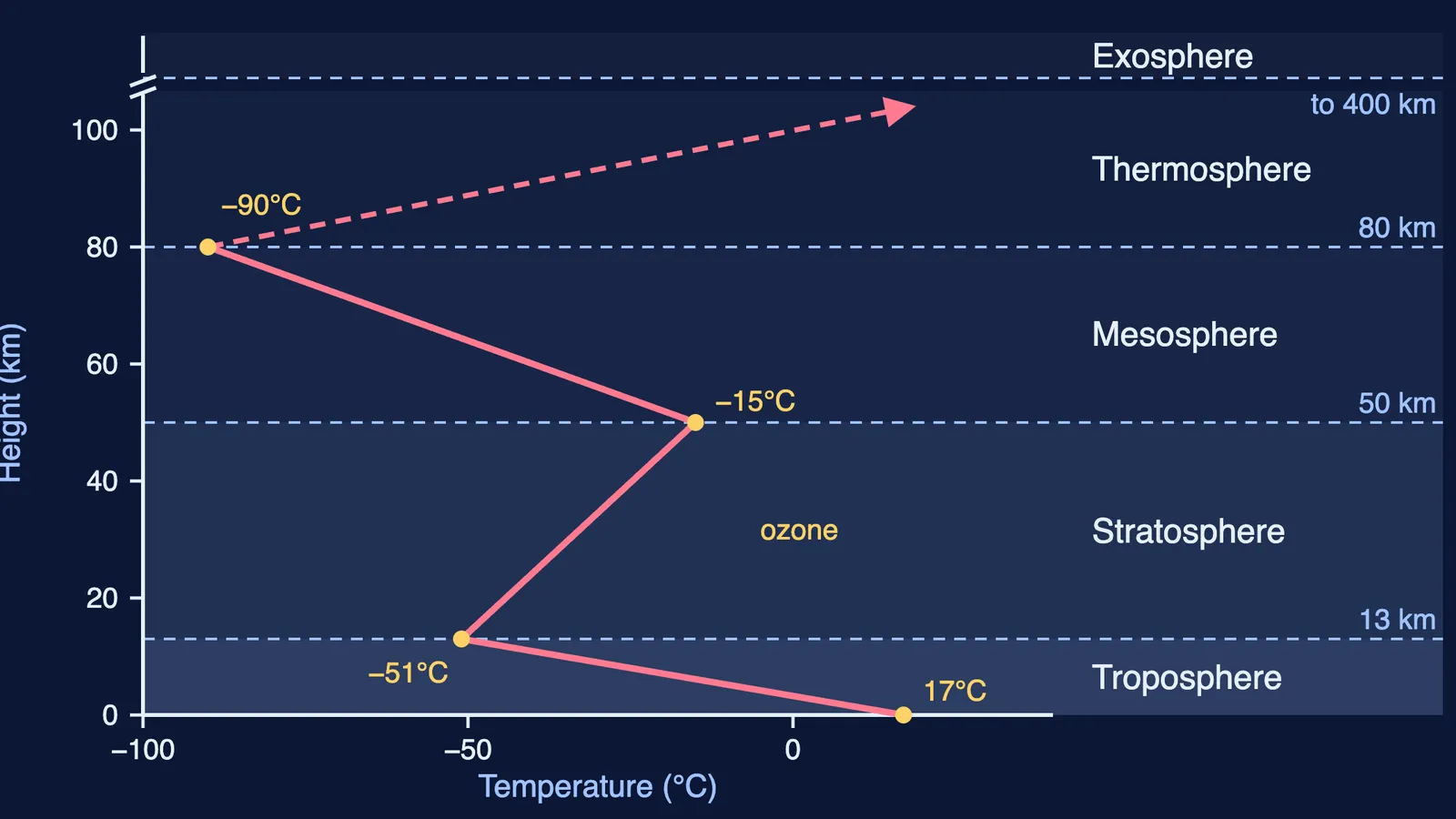
Troposphere: falls with height. NOAA gives an average of about 17°C at the ground dropping to about -51°C at the top.
Stratosphere: rises with height. Heat is produced when ozone forms, so it warms to a maximum of about -15°C at the top.
Mesosphere: falls with height again. It is warmest near its bottom, about -15°C.
Thermosphere: rises with height. It absorbs high-energy ultraviolet and X-ray radiation from the Sun, and NOAA says it can reach about 2,000°C near the top.
The coldest air in the whole atmosphere, about -90°C, is near the top of the mesosphere, according to the UCAR Center for Science Education. The same page notes that auroras occur in the thermosphere and that many satellites orbit within it.
Why do different books give different heights?
Because the layers are not fixed shells. NOAA says the troposphere is 18-20 km high at the equator but only about 6 km high at the poles (NOAA). The 13 km in the NCERT chapter is an average. NOAA also puts the top of the mesosphere near 85 km and the top of the thermosphere near 600 km, while NCERT uses 80 km and 400 km.
For your school exam, write the NCERT figures, since your paper is marked against the textbook. If your school uses a newer NCERT book or a state board text, check that book's numbers first. Knowing why the numbers differ is still useful: if a question asks where the troposphere is thickest, the answer is near the equator.
How do you draw the labelled chart in three minutes?
Here is a method that works in an exam, using the NCERT heights:
Draw a vertical axis for height (0 to 100 km) and a horizontal axis for temperature.
Mark dashed lines at 13 km, 50 km and 80 km. Label the bands Troposphere, Stratosphere, Mesosphere and Thermosphere, and write Exosphere at the top.
Draw the temperature line: start at the bottom right, slope left to 13 km, slope right to 50 km, slope left to 80 km, then up and to the right.
Add one feature per band: weather, ozone and aeroplanes, meteorites, radio waves.
To remember the order, try Tall Students Make Tall Excuses: Troposphere, Stratosphere, Mesosphere, Thermosphere, Exosphere.
A worked example answer
Question: Name the layer in which meteorites burn up, and the layer that helps in radio transmission. (2 marks)
Answer: Meteorites burn up in the mesosphere, which extends up to a height of 80 km. The thermosphere, which extends between 80 and 400 km and contains the ionosphere, helps in radio transmission by reflecting radio waves back to Earth.
Each answer names the layer, gives its height from the NCERT chapter and states the feature. That habit covers what a short answer usually asks for.
If you want to know why the Moon has no such layers, read why the Moon has no atmosphere. And for how satellites help forecast the weather that forms in the troposphere, see how INSAT satellites help forecast weather.
If you understand ideas better when you can see them, the Fermi Simulation Lab has interactive simulations for ideas that are easier to see than read. And when you revise, Fermi's AI tutor checks your understanding as it goes, so you find the layer you mix up before the exam does.


