On this page
Water in the atmosphere is Chapter 10 of the NCERT Class 11 book Fundamentals of Physical Geography, and it is still on the syllabus. The CBSE Geography curriculum for 2026-27 lists it under Unit IV, Climate, whose five chapters carry 8 marks together, with these topics: humidity, evaporation and condensation, forms of condensation, precipitation, and the types and world distribution of rainfall. Here is each, with a worked example.
What is the difference between absolute and relative humidity?
The NCERT chapter calls the water vapour in the air humidity, and says vapour makes up zero to four per cent of the atmosphere by volume.
Absolute humidity: the actual mass of vapour in a volume of air, in grams per cubic metre.
Relative humidity: the moisture in the air as a percentage of what it could hold at that temperature.
Saturated air: air holding all the moisture it can at its temperature.
Dew point: the temperature at which a sample of air becomes saturated.
Warm air can hold more vapour than cold air. So when temperature changes and the vapour does not, relative humidity changes while absolute humidity stays put.
Worked example: why a muggy evening ends in dew
The HyperPhysics table for water vapour gives the most vapour air can hold: 30.4 g/m³ at 30 °C, 17.3 g/m³ at 20 °C and 12.83 g/m³ at 15 °C.
At 4 pm the air is 30 °C and holds 17.3 g/m³. Relative humidity = 17.3 ÷ 30.4 × 100 ≈ 57%.
At night it cools to 20 °C. Same vapour, but now 17.3 ÷ 17.3 = 100%. The air is saturated, so its dew point is 20 °C.
Near dawn the grass cools to 15 °C. Air touching it can hold only 12.83 g/m³, so about 4.5 g of vapour from each cubic metre of air cooled that far can condense as dew.
How does condensation happen, and what are its forms?
Evaporation turns water into vapour, driven by heat; moving air speeds it up by replacing the saturated layer. Condensation is the reverse, caused by loss of heat. In free air it needs tiny particles of dust, smoke or sea salt, called hygroscopic condensation nuclei (NCERT). The same chapter describes the forms:
Dew: droplets on cool surfaces like grass, when the dew point is above freezing.
Frost: ice crystals instead, when the dew point is at or below 0 °C.
Fog: a cloud at or near the ground that cuts visibility below 1 km.
Mist: wetter than fog, with visibility between 1 and 2 km.
Clouds: tiny droplets or ice crystals condensed high up in free air.
What are the four basic types of clouds?
By height, spread, density and transparency, NCERT names four types:
Cirrus: thin, feathery and white, at 8,000-12,000 m.
Cumulus: cotton-wool patches with flat bases, at 4,000-7,000 m.
Stratus: layered sheets covering much of the sky.
Nimbus: dark grey, dense and shapeless, at middle levels or near the ground.
What are the three types of rainfall?
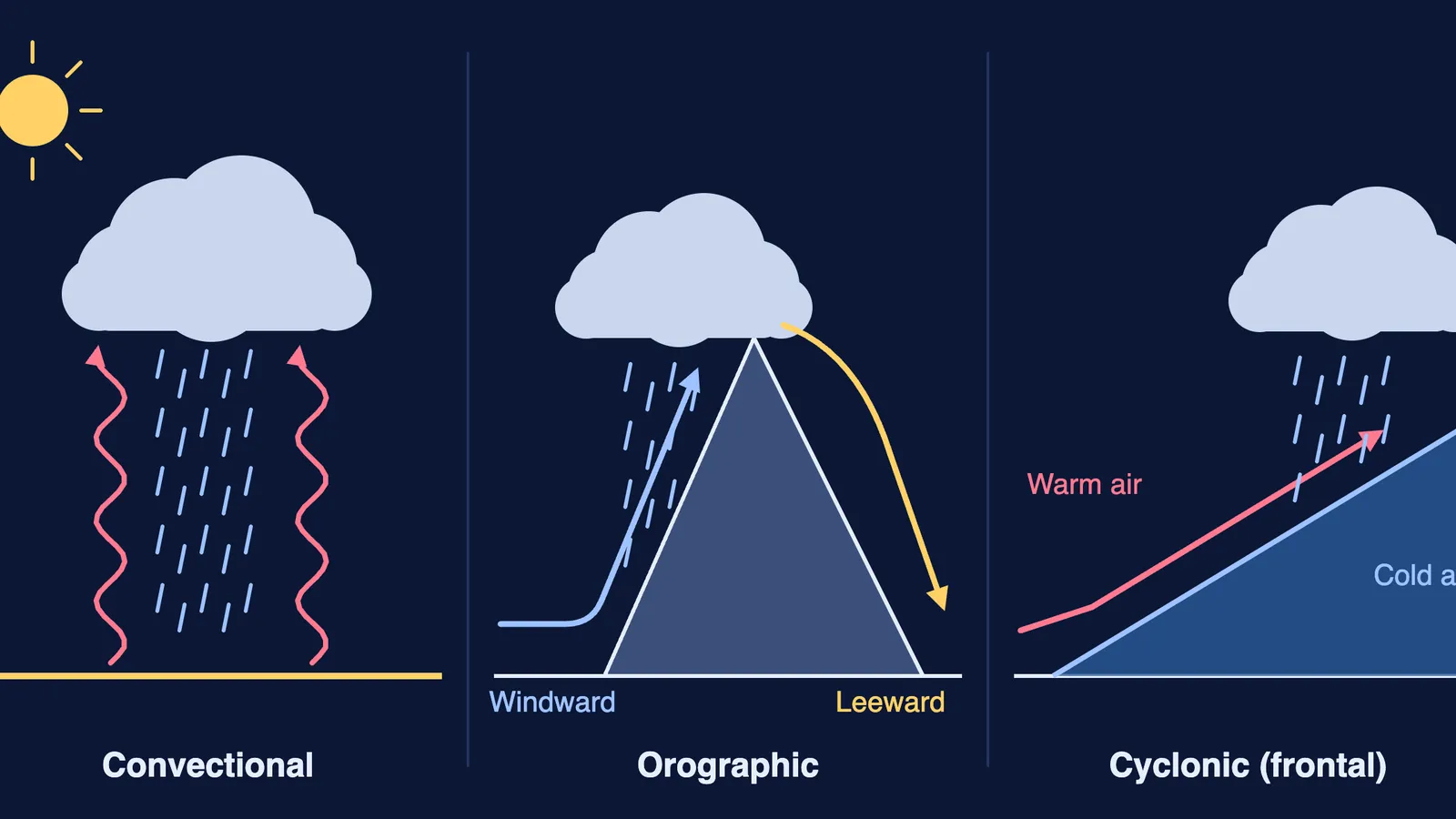
When droplets grow too heavy for the air to hold, they fall as rain, snow, sleet or hail. By origin, rainfall has three types:
Convectional: heated air rises, expands and cools, and cumulus clouds give short, heavy rain with thunder. Common in summer and in the hotter part of the day, especially in equatorial regions and continental interiors.
Orographic (relief): moist wind is forced up a mountain and rains on the windward slope, then descends, warms and dries, leaving a rain-shadow area.
Cyclonic (frontal): NCERT refers you to Chapter 9, where warm air glides over the cold air along a front, rising to form clouds and rain.
India has the textbook orographic case. The NCERT India: Physical Environment climate chapter says the Arabian Sea monsoon branch climbs the Western Ghats and gives the windward side 250-400 cm of rain, leaving little to the east.
How is rainfall distributed across the world?
The NCERT chapter gives four bands:
Over 200 cm a year: the equatorial belt, windward western coasts of the cool temperate zone, and monsoon coasts.
100-200 cm: interior continental areas.
50-100 cm: central tropical lands and eastern and interior temperate lands.
Under 50 cm: rain-shadow interiors and high latitudes.
Rainfall generally decreases from the equator towards the poles and is higher on coasts than inland.
A 30-minute revision plan
Write the four humidity definitions from memory (5 minutes).
Redo the worked example at 25 °C, where saturation is 23 g/m³ (5 minutes).
Sketch the three rainfall types with arrows (10 minutes).
Answer NCERT's question on dew and frost formation in 150 words (10 minutes).
If the physics underneath, such as evaporation or saturation, stays shaky, the Fermi Concept Library covers every concept in physics, chemistry, biology, mathematics and computing, each with its own lesson. Next, read about the layers of the atmosphere, how INSAT satellites help forecast weather, or an earlier chapter of the same book, interior of the Earth for Class 11.