On this page
How can anyone describe a place nobody has visited? This guide follows Chapter 3 of NCERT's Fundamentals of Physical Geography with the numbers you need, a diagram to draw from memory and a revision plan. For a refresher, see our Class 7 guide to the Earth's layers and the rock cycle.
What are the direct and indirect sources of information about the Earth's interior?
The Earth's radius is about 6,378 km, and most of what we know about its interior is based on estimates and inferences, according to the NCERT Class 11 chapter Interior of the Earth.
Direct sources give real material to analyse:
Mining: gold mines in South Africa are 3 to 4 km deep; deeper is too hot.
Deep drilling: the deepest drill, at Kola in the Arctic, has reached 12 km.
Volcanic eruptions: magma can be analysed in a laboratory, though the depth it came from is hard to know.
Indirect sources are inferred:
Temperature, pressure and density, which all increase with depth.
Meteors, made of material similar to the Earth's.
Gravity, greater near the poles than at the equator; a difference from the expected value is a gravity anomaly, which shows how mass is spread in the crust.
Magnetic surveys of the crust.
Seismic activity, one of the most important indirect sources.
What are P-waves, S-waves and surface waves?
An earthquake is the shaking caused when energy is released along a fault, a sharp break in the crustal rocks, the NCERT chapter explains. The energy is released at the focus (hypocentre); the point on the surface above it is the epicentre.
P-waves (primary): fastest and first to arrive; they pass through solids, liquids and gases and vibrate parallel to the wave's direction, like sound.
S-waves (secondary): arrive later and travel only through solids; they vibrate perpendicular to the wave's direction.
Surface waves: the last to be recorded and the most destructive.
Waves travel faster through denser material and reflect or refract at a change in density. That bending makes the shadow zone.
Why is there a shadow zone for earthquake waves?
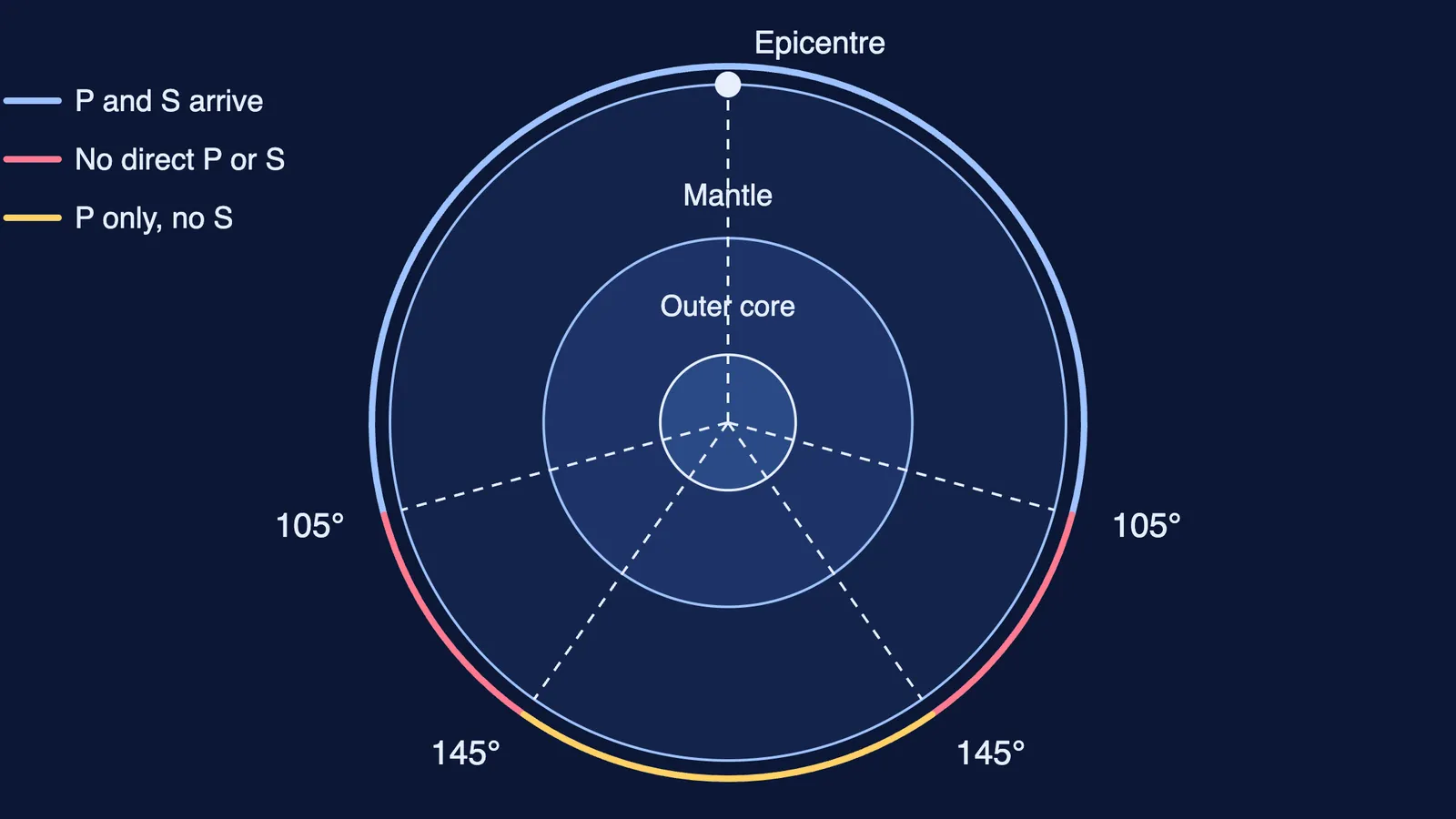
Seismographs within 105° of the epicentre record both P and S waves, while those beyond 145° record P-waves but not S-waves, according to NCERT. The band between 105° and 145° receives neither, so it is the shadow zone for both types. The whole area beyond 105° gets no S-waves, so the S-wave shadow zone is much larger than the P-wave band.
S-waves cannot pass through liquid, so a large S-wave shadow means a liquid layer inside: the outer core. P-waves cross the core but bend as they enter and leave it, leaving the 105° to 145° band empty.
Draw it in four steps:
A circle for the Earth, a smaller one for the core.
The epicentre at the top.
105° and 145° on both sides, measured at the Earth's centre.
Shade 105° to 145° "no P, no S" and beyond 145° "P only".
What are the layers of the Earth's interior?
The NCERT chapter gives these figures:
Crust: brittle and outermost; oceanic crust averages 5 km thick, continental crust around 30 km, and up to 70 km in the Himalayan region.
Mantle: from the Moho discontinuity to 2,900 km. Its upper part, the asthenosphere, extends to about 400 km and is the main source of magma.
Lithosphere: the crust plus the uppermost mantle, 10 to 200 km thick.
Core: from 2,900 km; the outer core is liquid and the inner core solid, made mostly of nickel and iron, which is why it is called the nife layer.
What are the types of volcanoes in Class 11?
NCERT sorts volcanoes by eruption and form:
Shield volcanoes: apart from basalt flows, the largest on Earth; fluid basalt keeps their slopes gentle, as in Hawaii.
Composite volcanoes: cooler, more viscous lava; explosive eruptions pile up layers of ash and pyroclastic material.
Calderas: the most explosive; they collapse on themselves, leaving a hollow.
Flood basalt provinces: very fluid lava spreading far, some flows more than 50 m thick. The Deccan Traps, covering most of the Maharashtra plateau, are one; see the Deccan Traps and the dinosaurs.
Mid-ocean ridge volcanoes: along a ridge system more than 70,000 km long through all the ocean basins.
A 30-minute revision plan for this chapter
Five minutes: both lists of sources from memory.
Ten minutes: the shadow zone diagram, without looking.
Five minutes: P, S and surface waves by speed, medium and vibration.
Five minutes: the NCERT layer numbers: 5, 30, 70, 400 and 2,900 km.
Five minutes: each volcano type with one feature and one example.
Why waves bend at a boundary is physics as much as geography; the Fermi Concept Library has a lesson for every concept in physics if refraction needs a second look. Unsure where to start? Fermi's AI tutor can work out what you already know and build a plan for the session.
Next, read why scientists can't predict earthquakes.