On this page
The Deccan Traps are a vast pile of lava flows in western India, and they were erupting when the dinosaurs died out. Here is how they formed, why the rock breaks into neat columns, and why scientists still argue about the volcanoes' part in the extinction.
What are the Deccan Traps?
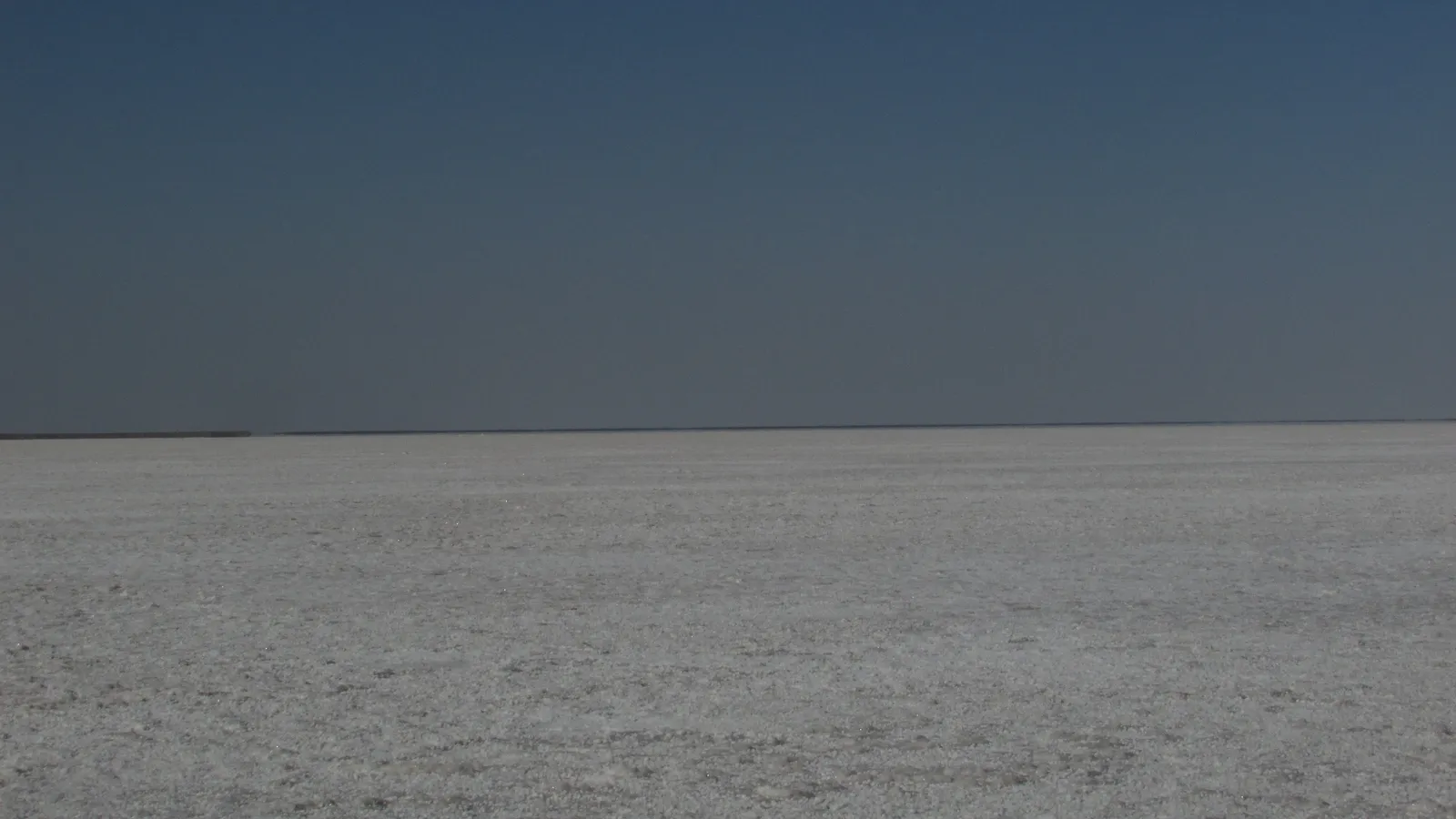
The Deccan Traps are flood basalts: lava that poured mostly from cracks and vents in valleys and plains, not from cone-shaped volcanoes, and cooled into the dark rock called basalt (Rebecca Teed, Wright State University, via SERC).
The Deccan Traps still cover about 500,000 square kilometres of India (Teed, SERC). At least half a million cubic kilometres of the basalt remain after 66 million years of erosion (same source).
The name describes the landscape. Trap comes from an old Germanic word for stairs, because weathering carves the stacked flows into giant steps (same source).
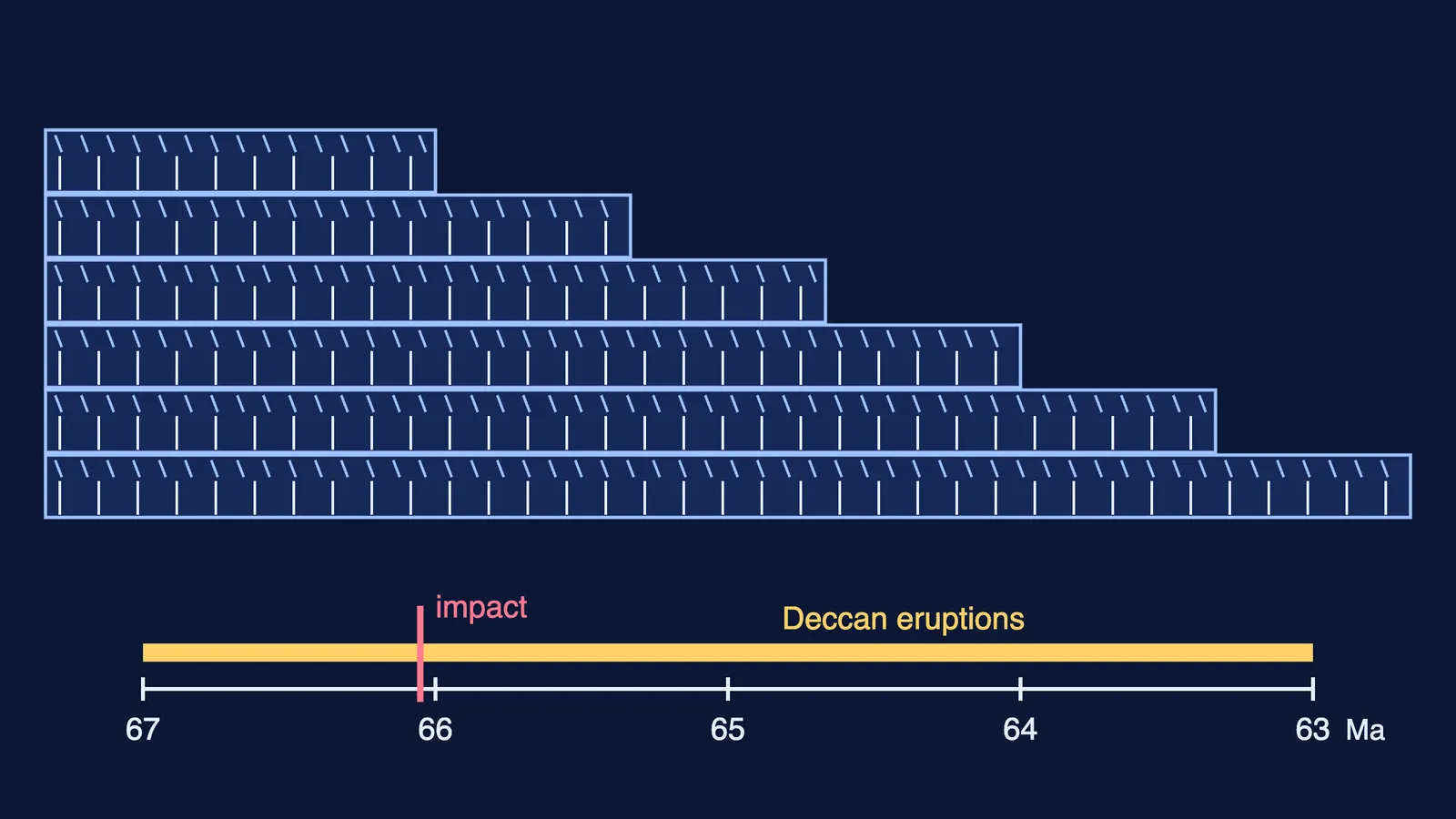
The traps were built by many eruptions between about 67 and 63 million years ago, when India was an island continent in the southern hemisphere, not yet joined to Asia (same source).
Why does basalt crack into columns?
Lava shrinks as it cools. The US National Park Service puts the chain simply: cooling causes contraction, contraction causes fracturing, and the cracks grow from the top and bottom of a flow towards its centre (NPS). The columns stand perpendicular to the main cooling surfaces, so a flat lava flow gives upright columns (same source). Most columns are hexagonal, but they can have three to seven sides (same source).
You can see Deccan columns in Mumbai. Gilbert Hill has columnar jointing more than 50 metres high and has been designated a National Geological Monument by the Geological Survey of India (Current Science, 2001, via India Environment Portal). Argon dating gave its basalt an age of about 60.5 million years, which the authors argue is about 6 million years younger than the lower Western Ghats lavas (same source).
Did the Deccan Traps kill the dinosaurs?
Start with the other suspect. In 1980 the Alvarez team reported iridium about 30, 160 and 20 times above background in deep-sea limestones at the boundary in Italy, Denmark and New Zealand, and proposed an asteroid about 10 kilometres across (Alvarez et al., Science 1980). That impact is now dated to 66,052,000 years ago, give or take 8,000 years (Berkeley News).
The Deccan question is about timing. In February 2019 two teams published dates in the same issue of Science:
A Princeton-led team dated zircon crystals in ash layers between flows. Of 141 sample sites, 24 gave usable zircons, and the team concluded the traps erupted in four pulses, the second starting only tens of thousands of years before the impact (Princeton release; Schoene et al.).
A Berkeley-led team used argon-argon dating on the lavas and found that about three-quarters of the lava erupted after the impact (Berkeley News; Sprain et al.).
In 2020 a Yale-led team compared ocean temperature and carbon records with climate models and concluded that most Deccan gas release came well before the impact. The volcanic activity caused gradual warming of about two degrees, the team said, but not the mass extinction (Hull et al., Science 2020; Yale release via Phys.org).
How can you judge a new dinosaur-extinction study?
Ask four questions:
What was dated: the lava, ash between flows, or gas inferred from climate records? Each answers a different question.
Which clock? Berkeley researchers note that zircons in sediment between flows give only a maximum age for the lava, while their argon-argon method dated crystals from the lava flows themselves (Berkeley News).
Is the gap bigger than the error bars? See the worked example.
Does the killer fit the speed? About 75% of marine species died out, and the loss of shelled plankton looks sudden in many records (Teed, SERC).
Worked example, with made-up error bars: a study puts an eruption pulse 30,000 years before the impact, with its own uncertainty of 20,000 years, and the impact date carries 8,000. Independent errors add as the square root of the sum of squares, so the combined error is the square root of (20,000 squared plus 8,000 squared), about 21,500 years. The 30,000-year gap is only about 1.4 times that combined error, so the pulse probably came first, but the data cannot rule out the reverse. Halve the gap and nobody can say which came first.
These clocks rest on radioactive decay. If half-lives feel shaky, the Fermi Concept Library has a lesson for every concept in physics, chemistry, biology, mathematics and computing.
Where to go next
To feel what an impact does to the ground, try the flour tray experiment on drop height and crater size. For how dinosaur science began, read about William Buckland and Megalosaurus, the first named dinosaur. And if rocks like these pull you in, see BSc geology career options in India.