On this page
With a baking tray, a packet of flour, one marble and a ruler, a Class 9 or 10 student can run a real physics investigation in an hour, with a parent as the second pair of hands. You will be testing what researchers found with steel balls and glass beads: more energy gives a bigger crater, but each extra bit of energy buys less extra width.
What do you need for the flour tray experiment?
A tray of plain flour, deep enough that the marble never hits the bottom
One marble, a metre ruler and a 30 cm ruler (or vernier callipers)
A kitchen scale (optional; see below)
A spoon of cocoa sifted over the top, so the crater rim shows clearly
How do you make it a fair test?
A fair test changes one thing and keeps everything else the same. You change the drop height (the independent variable) and measure crater width (the dependent variable); everything else is a control. Our explainer on why experiments need a control group covers the idea.
The control that matters most is packing. In a 2003 glass-bead study, Walsh and colleagues reported that with their finest beads, lightly shaking the container even once dramatically reduced how far the ball sank, so they poured the beads fresh before each run and only smoothed the surface with a straight edge. Copy that:
Fluff the flour with a fork and level it with a ruler before every drop. Never tap the tray.
Measure height from the flour surface to the bottom of the marble.
Let go; do not throw.
Drop three times at each height and average.
Measure each crater rim to rim in two directions at right angles and take the mean.
Same marble, same flour, same tray throughout.
How does drop height affect crater size?
Ignoring air resistance, a falling marble's energy at impact is E = mgh, with mass m, g about 9.8 m/s² and drop height h (OpenStax University Physics shows mgh = ½mv²). If mgh feels shaky, practise with these gravitational potential energy problems first.
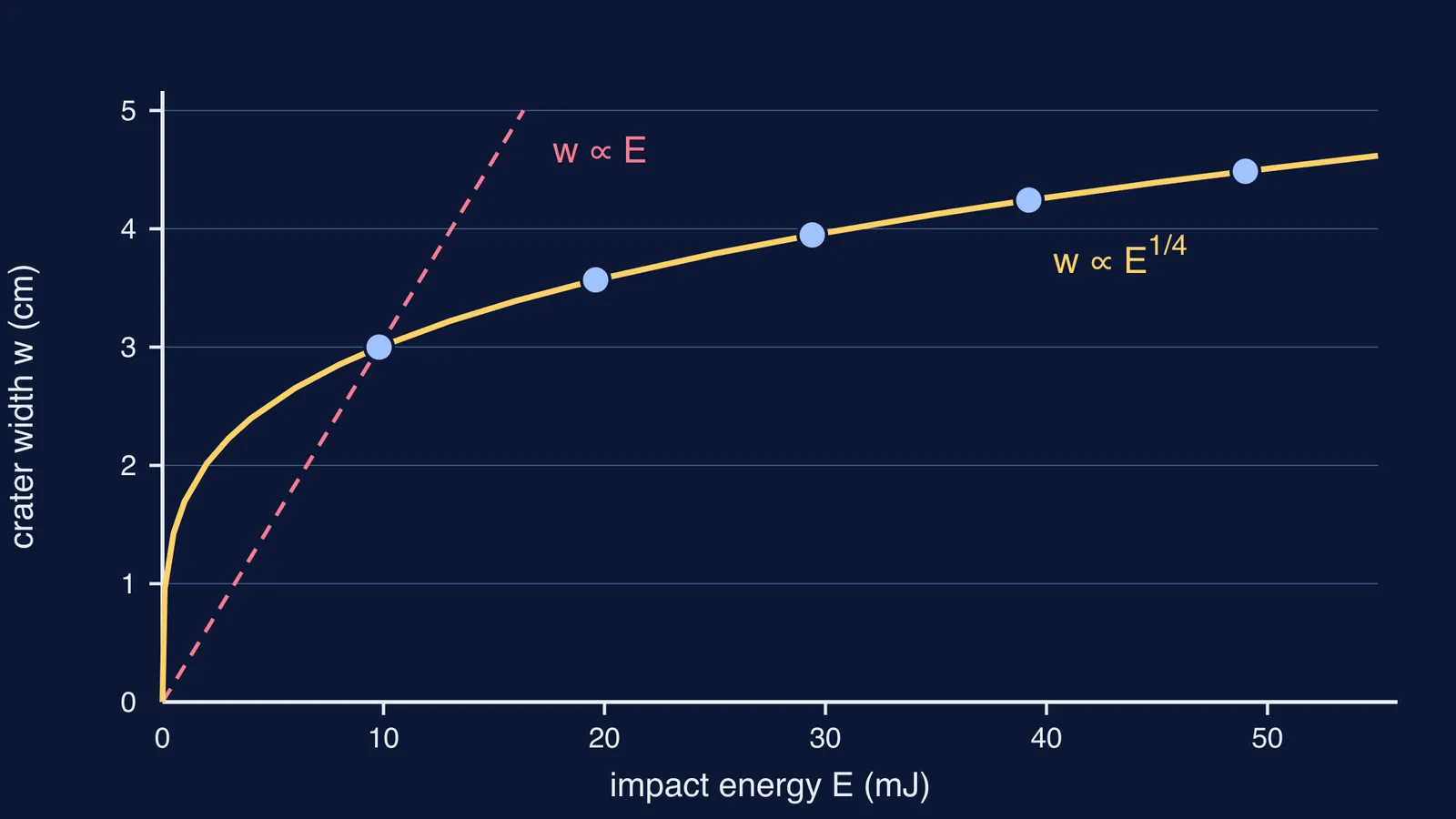
So doubling the height doubles the energy. It does not double the crater. In the Walsh et al. study in Physical Review Letters, a 66 g steel ball dropped from 2 to 90 cm into glass beads gave crater diameters proportional to the 1/4 power of impact energy for the four larger bead sizes, with a fitted slope of 0.251 ± 0.005 on a log-log plot. A sand version was published as an introductory lab on error analysis (Amato and Williams, American Journal of Physics).
What crater widths should you expect?
Suppose your marble is 5 g (0.005 kg). The energies for five heights are:
20 cm: E = 0.005 × 9.8 × 0.20 = 9.8 mJ
40 cm: 19.6 mJ
60 cm: 29.4 mJ
80 cm: 39.2 mJ
100 cm: 49.0 mJ
If the 1/4 law from the Walsh study holds and your 20 cm crater is 3.0 cm wide, expect about 3.6, 3.9, 4.2 and 4.5 cm for the higher drops. Five times the energy gives only about 1.5 times the width. These are predictions, not measurements; your numbers are the experiment.
Why does the crater-width graph curve?
The Walsh paper explains why. When gravity controls the crater, the marble's energy goes into lifting flour out of the hole. That work grows with volume dug out times height lifted. If depth grows in step with width w, volume grows like w³ and lift like w, so the energy needed grows like w⁴. Turn that round and w grows like E to the power 1/4: equal steps in energy give shrinking steps in width.
Test this with your own data:
Plot log w against log E. A power law becomes a straight line whose slope is the exponent. Our guide to choosing the right graph for your data explains why the axes matter.
Plot w⁴ against E. If the 1/4 law holds, the points fall on a straight line through the origin.
For ideas that are easier to see than to read, the Fermi Simulation Lab has interactive simulations you can explore alongside your tray.
What should you write in your conclusion?
Use this four-line frame:
Pattern: "As drop height rose from 20 to 100 cm, crater width rose from __ to __ cm."
Shape: "The graph curved; equal energy steps gave smaller width steps."
Number: "My log-log slope was __, against 0.25 in the published glass-bead study."
Limits: "Flour packing and reading the rim add uncertainty; my repeats differed by up to __ cm."
If turning mgh into numbers trips you up, the Fermi Problem Library has worked problems with a step-by-step solver that explains the reasoning rather than printing an answer.
Next, try a heavier marble: the energy changes, and the 1/4 law says what to expect.