

On this page
Your Class 7 geography chapter Inside Our Earth packs three ideas into a few pages: the planet's layers, the three families of rock, and the cycle linking them. Here is each, with a worked example and a revision plan.
What is inside our Earth?
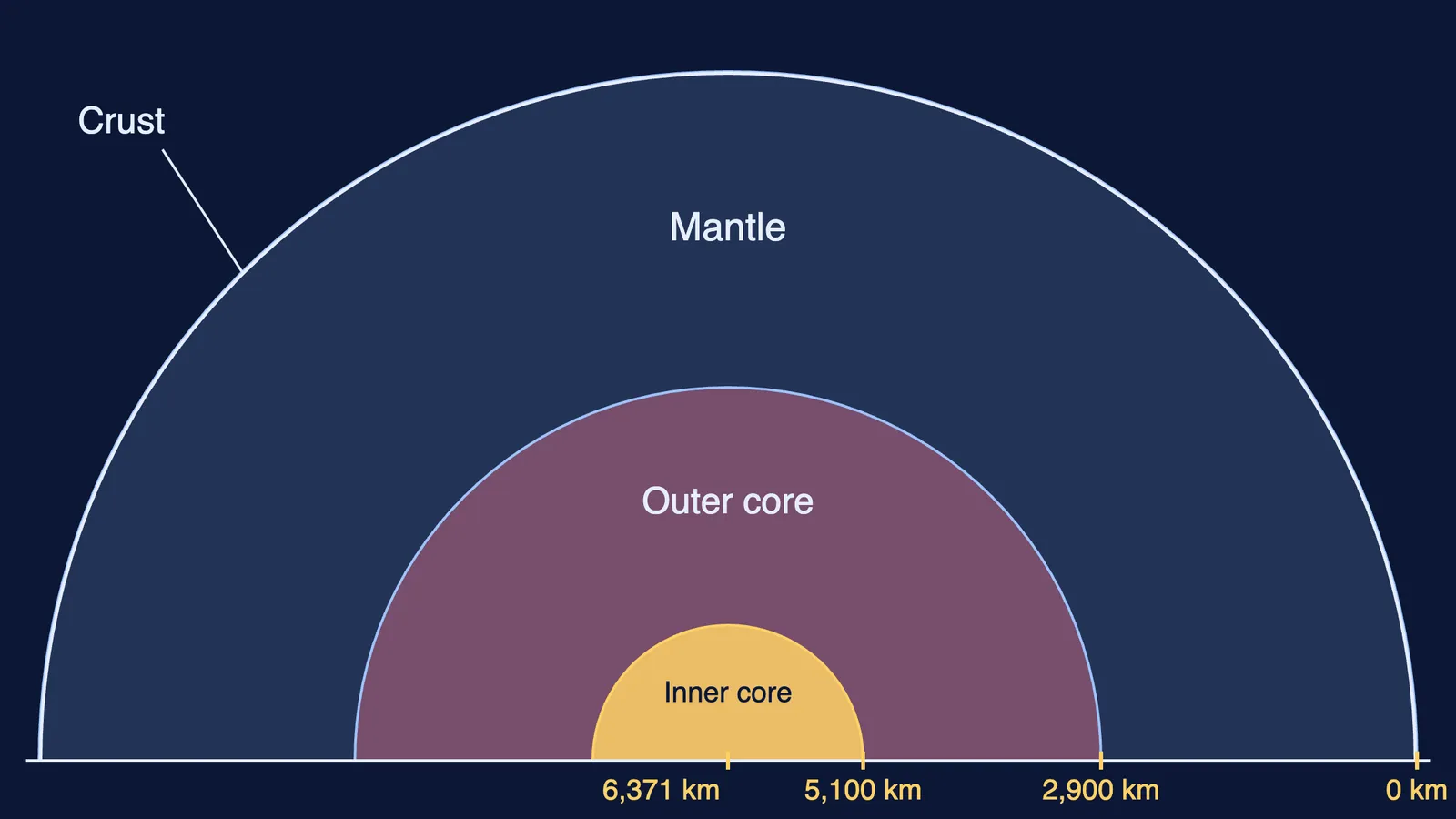
The NCERT chapter Inside Our Earth in Our Environment compares the Earth to an onion: concentric layers, one inside another.
Crust: the thinnest layer, about 35 km thick under the continents and only 5 km under the ocean floor. Continental crust is mostly silica and alumina (sial); oceanic crust is mostly silica and magnesium (sima).
Mantle: lies just beneath the crust and extends to a depth of 2,900 km below the crust.
Core: the innermost layer, with a radius of about 3,500 km, made mainly of nickel and iron (nife), at very high temperature and pressure.
According to the NCERT chapter, the crust is only 1% of the Earth's volume, the mantle 84% and the core 15%, and the Earth's radius is 6,371 km.
The US Geological Survey's Inside the Earth adds that the core has two parts: a liquid outer core about 2,200 km thick and a solid inner core about 1,250 km thick. USGS puts average continental crust at about 30 km; in a school answer, use the NCERT figure.
What are the three types of rocks?
NCERT defines a rock as any natural mass of mineral matter that makes up the Earth's crust (NCERT Class 7, Inside Our Earth). Minerals are naturally occurring substances with certain physical properties and a definite chemical composition.
Igneous (primary) rocks form when molten magma cools. Lava that cools quickly on the surface gives fine-grained extrusive rock such as basalt, which makes up the Deccan plateau. Magma that cools slowly deep inside the crust gives large-grained intrusive rock such as granite, the stone of kitchen grinding stones.
Sedimentary rocks form when broken fragments, called sediments, are carried by wind and water, laid down in layers, then compressed and hardened. Sandstone is made from grains of sand, and these rocks may contain fossils. The Red Fort is built of red sandstone.
Metamorphic rocks form when igneous or sedimentary rocks change under great heat and pressure: clay becomes slate and limestone becomes marble. The Taj Mahal is white marble.
The names help: igneous comes from the Latin ignis (fire), sedimentary from sedimentum (settle down), and metamorphic from the Greek for change of form. To see sedimentary layering in real landscapes, read our explainer on why rocks on hillsides show layers.
How does the rock cycle work?
The rock cycle is the process by which one type of rock changes into another in a cyclic manner (NCERT). To remember it, follow one rock round the loop: a lump of Deccan basalt.
Cooling: lava reaches the surface and cools quickly into basalt, an extrusive igneous rock.
Breaking down: over a long time the basalt cracks into small fragments, which rivers and wind carry away as sediments.
Settling and hardening: the sediments settle in layers and are pressed into sedimentary rock.
Heat and pressure: buried deep, it changes into metamorphic rock.
Melting: still under great heat and pressure, the metamorphic rock melts into magma.
Back to the start: the magma cools and solidifies into igneous rock again.
The cycle need not run in one fixed order: the textbook figure has extra arrows, for example between sedimentary rock and sediments. Forces inside the Earth also cause volcanoes and earthquakes, which come next in our guide to Our Changing Earth: earthquakes and volcanoes.
How should you revise Inside Our Earth for a test?
A short plan for the evening before:
Draw half the Earth from memory with each layer's textbook number, then check.
Say the three short forms aloud: sial, sima and nife, and what each stands for.
For each rock type, write how it forms, one example and one Indian landmark.
Draw the rock cycle with five boxes (magma, igneous rock, sediments, sedimentary rock, metamorphic rock) and label every arrow with its process: cooling, breaking and carrying, compressing, heat and pressure, melting.
Answer the chapter's Give reasons questions out loud, such as why limestone changes into marble.
Mix-ups that cost marks:
The crust is the thinnest layer; the core is the innermost.
Intrusive means slow cooling inside, large grains; extrusive means fast cooling outside, fine grains.
Fossils go with sedimentary rocks.
In the NCERT exercise, gold, petroleum and coal are minerals, not rocks.
If a word such as magma, pressure or mineral is still fuzzy, the Fermi Concept Library covers every concept in physics, chemistry, biology, mathematics and computing. If you are not sure where to begin, Fermi's AI tutor can work out what you already know and build a plan for the session.


