

On this page
Our Changing Earth is Chapter 3 of the NCERT Class 7 geography book, Our Environment. The chapter's exercises ask you to tie each term, such as focus, meander, stack, moraine or loess, to the force or agent that made it. This guide follows the NCERT chapter (PDF) section by section and ends with a 30-minute revision plan.
Before you start, check which Class 7 book your school uses with our guide on how to check the rationalised NCERT syllabus.
Why do the plates move, and what are endogenic and exogenic forces?
The NCERT chapter defines lithospheric plates as several large and some small, rigid, irregularly shaped slabs of the earth's crust that carry continents and the ocean floor. The plates move because molten magma inside the earth moves in a circular way.
Endogenic forces act inside the earth, and exogenic forces act on its surface, according to the same chapter. Endo means inside, exo means outside and genic means origin.
Endogenic forces, sudden: earthquakes, volcanoes, landslides.
Endogenic forces, slow (diastrophic): building mountains.
Exogenic forces (erosion and deposition): rivers, wind, sea waves, glaciers.
NCERT says the plates move just a few millimetres each year. A seismology FAQ from IRIS, now run by EarthScope, puts the speed at several centimetres a year, about the rate your fingernails grow (why do tectonic plates move).
What is the difference between focus and epicentre?
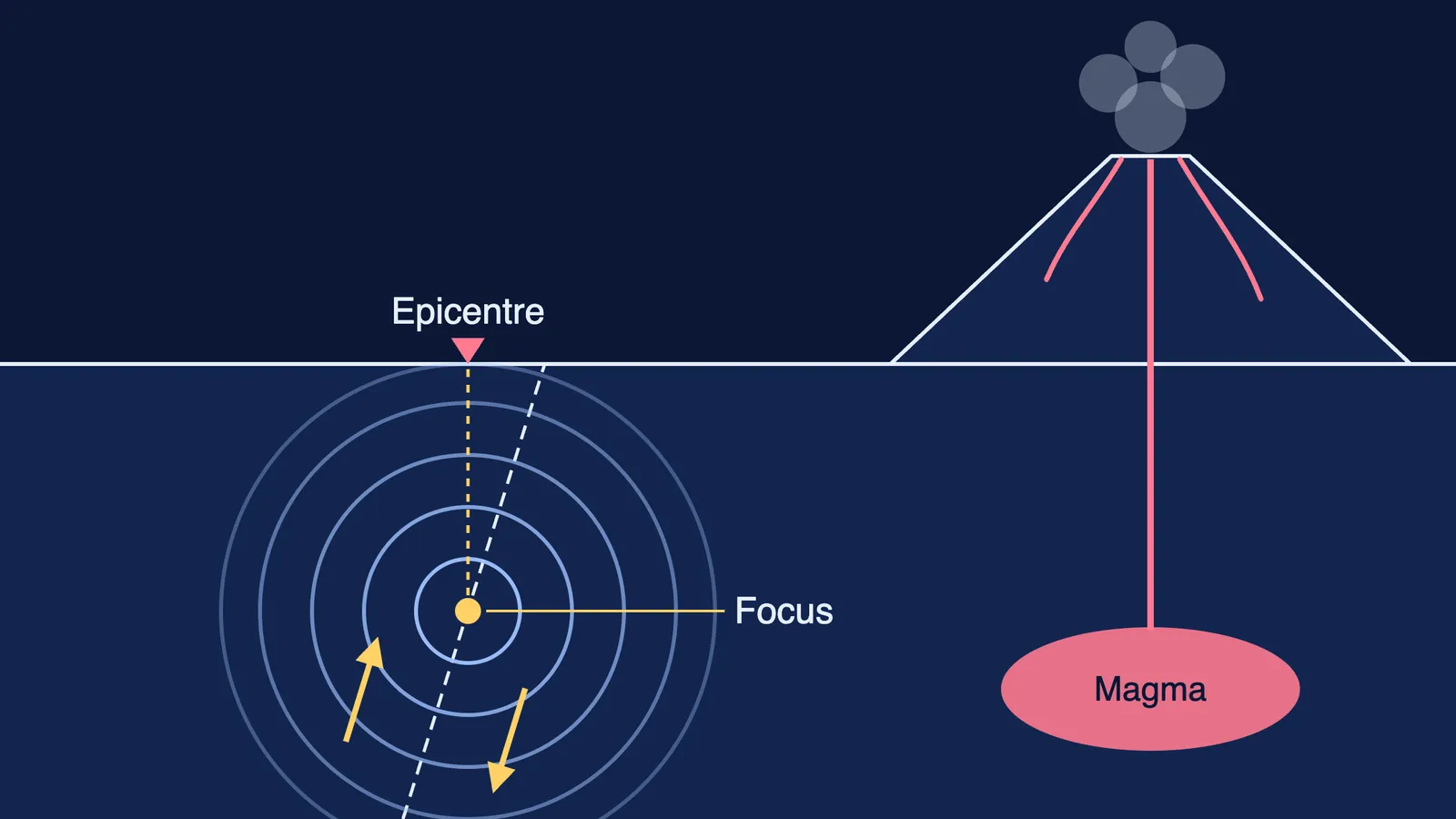
The NCERT chapter defines an earthquake as the vibration of the earth's surface when lithospheric plates move. The focus is the place in the crust where the movement starts. The epicentre is the place on the surface directly above the focus. Damage is usually greatest closest to the epicentre.
A volcano is a vent, or opening, in the earth's crust through which molten material erupts suddenly. In your diagram, label the crater, vent, lava and magma chamber.
The textbook says earthquakes are measured with a seismograph and their magnitude on the Richter scale. Its benchmarks are:
2.0 or less: felt only a little.
Over 5.0: can cause damage from things falling.
6.0 or higher: very strong.
7.0: a major earthquake.
The chapter's case study is the earthquake of 26 January 2001, which it describes as measuring 6.9 on the Richter scale. It hit Bhuj in Gujarat, and the textbook's headlines report that at least 971 students and 31 teachers were feared to have died when school buildings collapsed. Earthquakes cannot be predicted, the chapter says, but being prepared limits the harm. Its safe spots are under a table or desk, or against an inside wall, away from chimneys, windows and mirrors.
For the engineering lesson, read how earthquake-resistant buildings are made. For an Indian plate boundary, see why the Andaman Islands have earthquakes.
How do rivers, sea waves, glaciers and wind shape the land?
The NCERT chapter defines weathering as the breaking up of rocks on the earth's surface. Erosion is the wearing away of the landscape by agents such as water, wind and ice. What erosion removes gets carried away and deposited somewhere else, and that deposition builds new landforms. So learn each agent twice: what it wears away and what it builds.
River. Wears away: a waterfall, where water drops over very hard rock (the highest is Angel Falls in Venezuela). Builds: meanders, ox-bow lakes (meander loops that get cut off), floodplains, levees (raised banks), distributaries and a delta.
Sea waves. Wears away: sea caves, then sea arches, then stacks, plus the sea cliff. Builds: beaches.
Glacier, a 'river of ice'. Wears away: deep hollows that later fill up as mountain lakes. Builds: glacial moraines, made of rocks, sand and silt.
Wind. Wears away: mushroom rocks, which are narrow at the base because the wind erodes the lower part more than the upper part. Builds: sand dunes, and loess where very fine sand settles over large areas (large deposits are found in China).
How should you revise Our Changing Earth in 30 minutes?
Minutes 0 to 5: from memory, draw the tree of earth movements (endogenic forces, sudden and slow, and the four exogenic agents). Then check it against Fig. 3.1.
Minutes 5 to 12: draw and label the earthquake diagram (focus, epicentre, waves) and the volcano (crater, vent, lava, magma chamber).
Minutes 12 to 22: rewrite the four-agent list above without looking. Every gap is a word to look at again.
Minutes 22 to 30: answer the textbook's 'Give reasons' questions out loud. Why are floodplains fertile? Floods leave fine soil and sediment on them.
Three mix-ups are easy to make: putting the epicentre underground, calling a beach erosional, or listing a volcano as a slow movement. The chapter's own exercises test the last two.
If a diagram still feels flat on the page, Fermi's AI tutor can draw the figure with you and check your understanding as it goes. It works out what you already know and builds a plan for the session.


