

On this page
You have probably seen them from a bus on a ghat road: a hillside cut open for the highway, the rock inside striped like a layer cake. Those stripes are a record of time, written in sand and mud.
What makes the stripes in a rock?
Most striped rock is sedimentary rock. The US Geological Survey defines sedimentary rocks as rocks formed from pre-existing rocks or pieces of once-living organisms. Rivers carry broken-down grains into lakes and seas. When that sediment is buried deeply, the USGS explains, it loses water and becomes cemented into rock.
The stripes themselves are called beds. The geological survey of Newfoundland and Labrador defines bedding as layers in sedimentary rocks caused by changes in composition or grain size. A flood dumps sand; quiet years let only mud settle; a shallow sea piles up shells. Each change leaves a band of different rock. Common ones, per the USGS:
Sandstone: sand-sized grains cemented together.
Shale and siltstone: hardened mud made of the finest grains, clay and silt.
Limestone: often built from the remains of living things, or from minerals that came straight out of the water.
Conglomerate: pebble-sized pieces, larger than 2 millimetres.
Why is the oldest layer at the bottom?
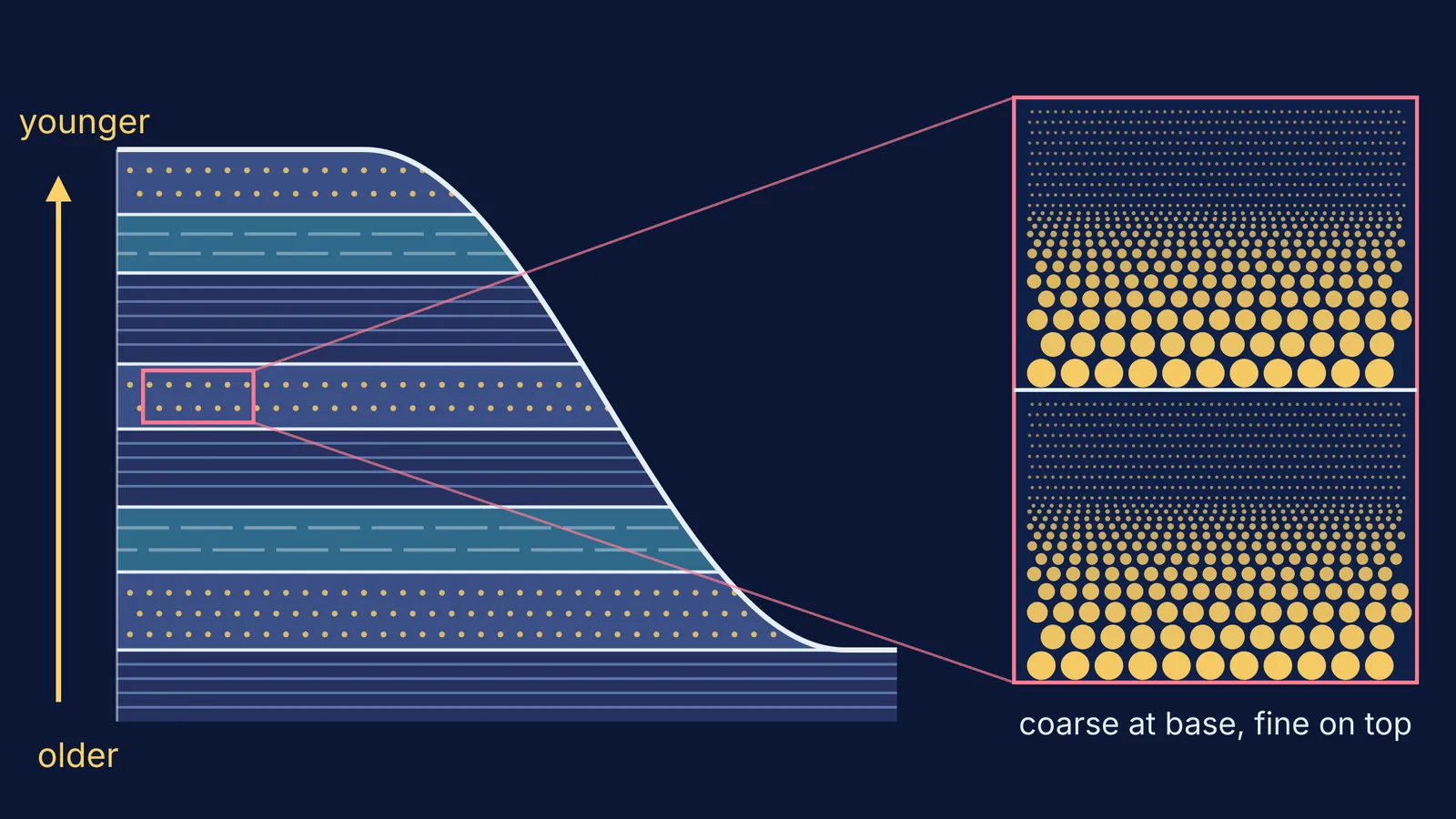
Each new bed lands on top of the last. National Geographic states the law of superposition: where there has been no later disturbance, sedimentary strata were deposited in ascending order with younger beds successively overlying older beds. Folding and other disturbances can scramble that order.
The Grand Canyon is the textbook case. The US National Park Service says the rocks of the inner gorge formed almost two billion years ago, while the Kaibab Formation near the rim is 270 million years old, with layer upon layer of sedimentary rock between.
Layers also order the fossils inside them: see how fossils and radioactive dating reveal the age of rocks and the story of William Smith and his geological map.
Why do sand and mud settle into separate layers?
This part is physics. A small grain sinking in still water reaches a steady speed given by Stokes' law, w = (ρs − ρw) g D² / 18μ, where D is grain diameter and μ is water's viscosity; it applies to very fine sand and smaller grains.
The key is D². Worked example: take quartz grains with a density of about 2.65 g/cm³ (soil science lab manual/05%3A_Soil_Physics_and_Water_Relations/5.04%3A_Particle_Density)) in water at 20 °C, whose viscosity is 1.0016 mPa·s (HyperPhysics). On the Wentworth scale used by the USGS, sand runs from 62.5 µm to 2 mm, silt from 4 to 62.5 µm, and clay is below 4 µm.
Very fine sand, 0.1 mm across: about 9 mm per second, so it falls 10 cm in roughly 11 seconds.
Silt, 0.01 mm: about 0.09 mm per second, so 10 cm takes roughly 19 minutes.
Clay, 0.002 mm: about 0.0036 mm per second, so 10 cm takes nearly 8 hours.
The clay grain is 50 times smaller, so it settles 50², or 2,500, times more slowly. Real grains are not perfect spheres, so treat these as estimates. The pattern holds: after a flood, sand lands first and mud drifts down on top. This is graded bedding, caused by differential settling by size and weight of suspended particles in water.
For ideas that are easier to see than to read, the Fermi Simulation Lab has interactive simulations.
How can you make rock layers in a jar?
First, use the numbers above to predict what you will see after 10 seconds, 20 minutes and the next morning.
Fill a tall, clear bottle one-third full of garden soil mixed with sand and small pebbles.
Top up with water, close the lid tightly and shake for a minute.
Set it down. Pebbles and coarse sand drop almost at once; fine sand follows within seconds.
Mark the top of each band on the outside and note the time.
Check after 20 minutes for silt, then next morning, when the clay has mostly settled and the water clears.
Add a spoonful of soil and swirl gently. A new bed forms on top, younger than the one below.
If your times differ from the predictions, ask why: grain shape, cold water, or clumps of clay. For more hands-on ideas, try starting a rock and shell collection with kids.
How do you read layers on a real hillside?
At the next road cut, run this checklist from a safe spot, away from traffic and loose slopes:
Are the stripes flat, tilted or bent? Tilted or folded bands were moved by later earth movements.
Gritty bands are probably sandstone; smooth, flaky ones are probably shale.
Does one band grade from coarse at its base to fine at its top? That is one settling event, like your jar.
Shells or fossil shapes suggest the layer formed under water.
Unless the rock has been overturned, the lowest band is the oldest page in the book.
Try the jar tonight, and see whether your clay settles as slowly as Stokes' law predicts.


