

On this page
Children are natural collectors. A walk on the beach or a hike in the hills usually ends with pockets full of smooth pebbles, chipped shells, and sparkling stones. Instead of leaving them in a forgotten pile, you can use these finds to introduce the basics of geology.
Taking abstract science out of the textbook and putting it into a child's hands has a measurable effect. A UK government-backed study, the Natural Connections Demonstration Project, tracked 125 schools over four years and found that 92% of teachers reported that outdoor learning improved pupils’ engagement with learning. When children handle the physical evidence of natural processes, the ideas stick.
What are the three families of rocks?
Geologists group rocks by how they were made. By looking closely at a stone's texture, children can often guess its family and the environment that created it.
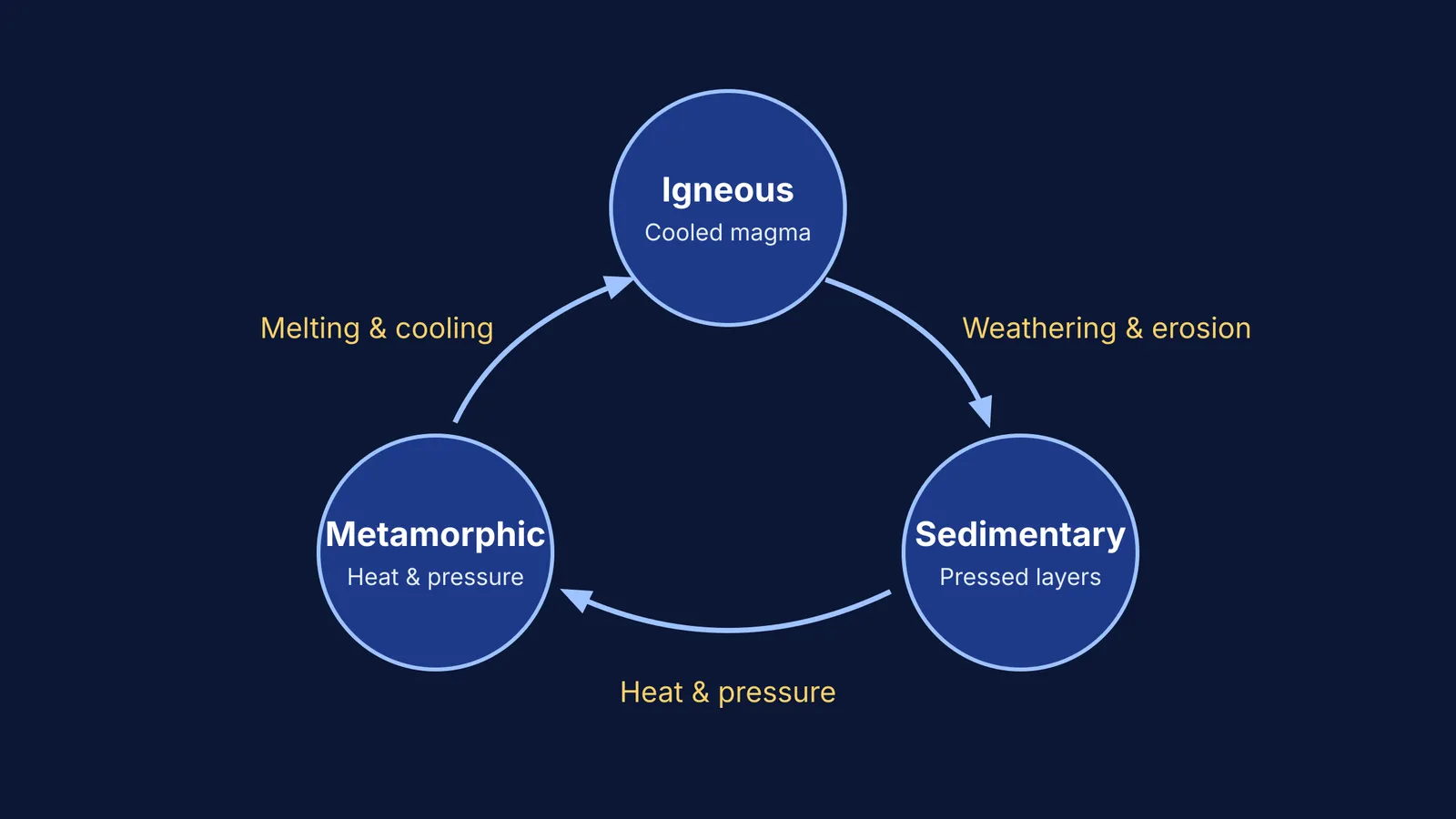
Igneous: These are the "fire" rocks, born from cooling magma or lava. If a rock cooled slowly deep underground, it will have large, visible crystals, like granite. If it erupted from a volcano and cooled quickly on the surface, it might have tiny crystals or even gas bubbles trapped inside, like pumice. This connects directly to the deep heat of the planet, driven by Arthur Holmes and the convection currents inside the Earth.
Sedimentary: These are the "layer" rocks. Over vast spans of time, sand, mud, and bits of shell settle at the bottom of lakes and oceans. The weight of the water squashes them into rock, often trapping fossils between the layers. Sandstone and limestone belong to this family. If your child finds a rock with a fossilised shell, it is almost certainly sedimentary.
Metamorphic: These are "changed" rocks. When igneous or sedimentary rocks are pushed deep underground, intense heat and pressure bake and squeeze them into completely new forms. This pressure often creates wavy bands of colour or a sparkly, sugary texture, as seen in marble or slate.
How can children read a rock?
You do not need a geology degree to guide a collecting session. You just need to ask the right questions to prompt active observation. Bring a simple magnifying glass and ask your child to inspect their best finds.
Are there flat layers? If it looks like a stack of hard pancakes or has stripes that run straight across, it is likely sedimentary.
Does it have shiny, interlocking crystals? Randomly scattered crystals point to an igneous rock.
Are there wavy bands? If the stripes look squashed, folded, or warped, the rock has been metamorphosed by pressure.
What is the shape of the stone? Ask your child why some rocks are jagged and others are perfectly round. Smooth, rounded stones usually mean they have been tumbled and worn down by a river or the sea over a long time.
How do you build a structured session from pebbles?
Once the collection is brought home, sorting the rocks is a scientific exercise in itself. Have your child sort them by texture (rough versus smooth), colour, or weight. This mirrors the classification systems that real scientists use.
You can take it a step further by setting up a simple display. Empty egg cartons or shallow boxes work well for keeping specimens separated. Encourage your child to keep a small notebook, recording where and when each stone was found. This habit of keeping field notes is exactly how working geologists build a record of an area.
A physical collection gives you an anchor for harder questions. When a child asks how an entire island of rock can form from a volcano, you can read together about J. Tuzo Wilson and the hotspots that build island chains.
When their questions stretch beyond what you can see in the stone, you can turn to Fermi's AI tutor. If a child wants to know exactly how a shell gets its spiral shape or why some rocks break into perfectly flat sheets, the tutor will build a plan for the session and explain the reasoning step by step, rather than just printing an answer. If they are struggling to picture how flat layers of mud slowly fold into wavy metamorphic rock, the Fermi Simulation Lab provides interactive simulations for the ideas that are easier to see than to read.


