

On this page
Biology and geography textbooks both say that fossils help us date rocks, and that lower layers are usually older. Those ideas feel obvious now, but someone had to turn them into a working method. One of the first to do it on a large scale was William Smith, an English land surveyor. This post covers what he noticed, how his 1815 map was made, a short strata exercise and what to take from his way of working.
Who was William Smith?
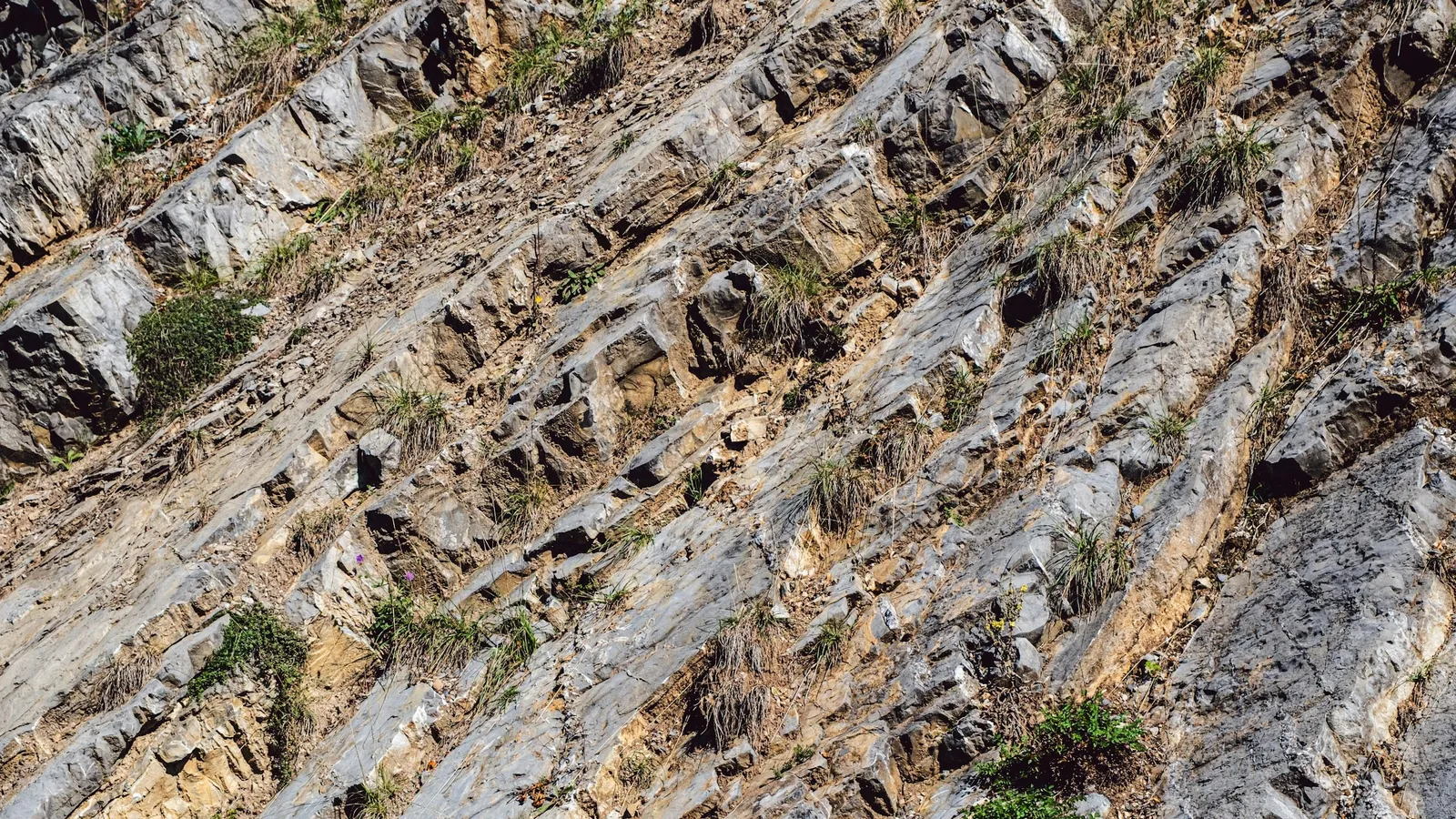
The Oxford University Museum of Natural History, which holds his archive, gives his dates as 1769 to 1839 and calls him "the father of English geology". He began as a land surveyor's assistant in his home village of Churchill, Oxfordshire, and then travelled the country working on mining, canal construction and irrigation projects. That work kept him looking at freshly cut rock, and he kept detailed notes on the layers and the fossils in them.
What did Smith notice about fossils?
Smith explained his idea in his 1816 book Strata Identified by Organized Fossils. "Organized fossils" meant fossils of living things. He wrote that it was "a previous discovery of regularity in the direction and dip of the various Strata in the hills around Bath" that led him to "the discovery of organic remains peculiar to each Stratum".
The point is practical. Two grey limestones can look identical. If each layer has its own set of fossils, you can tell them apart and recognise the same layer miles away, even when it looks different. Smith called fossils "the antiquities of Nature".
The order of the layers matters too. Because each layer kept its own fossils along its whole course, Smith could follow it across the country and draw it on a map.
How was the 1815 map made and published?
The museum says Smith published A Delineation of the Strata of England and Wales in 1815, the first geological map of England and Wales, and that he achieved it on his own. It also notes that publishing the work would ultimately bankrupt him.
How many copies exist? A survey by Tom Sharpe in Earth Sciences History (2016) located about seventy surviving copies with confidence and the likely location of at least thirty more. Sharpe suggests 130 to 150 survive from a probable print run of about 330 to 350. That means somewhere between 130/350 ≈ 37 percent and 150/330 ≈ 45 percent of the original copies may still exist.
Recognition came late. The Geological Society's Wollaston Medal page records that the first recipient, in 1831, was William Smith. His nephew and ward John Phillips became a professor of geology at Oxford and left Smith's archive to the museum in 1874.
Worked example: reading strata like Smith
Here is a short exercise with sample sections, invented for practice.
Section A, at a canal cutting, from top to bottom: sandstone with fossil shells of type X; clay with fossils of type Y; limestone with fossils of type Z.
Section B, 20 km away, from top to bottom: clay with fossils of type Y; limestone with fossils of type Z; a red mudstone with no fossils.
Match the layers by fossils, not appearance. The clay with Y and the limestone with Z appear in both, so they are the same strata.
Order them. Undisturbed layers are laid down bottom first, so the full sequence from oldest to youngest is: red mudstone, limestone (Z), clay (Y), sandstone (X).
Explain the gap. The sandstone is missing at B. Either it was never deposited there, or it has been worn away.
Now a dip calculation, again with sample numbers. Suppose the top of the limestone is at the surface at one point, and a well 2 km due east meets it 100 m down. Its dip is about tan⁻¹(100/2,000) = tan⁻¹(0.05) ≈ 2.9° towards the east. Gentle dips like this let a layer that is deep in one place reach the surface far away.
What mistakes do students make?
Matching layers by colour or rock type alone. Similar-looking rocks can be very different in age.
Assuming the top layer is always youngest. It usually is, but folding can overturn layers; check for clues before concluding.
Forgetting units in the dip. Convert km to m before dividing, or the angle comes out wrong by a factor of 1,000 in the ratio.
For another early fossil hunter, read our post on Mary Anning and her fossil finds, and the Fermi Concept Library has every concept in physics, chemistry, biology, mathematics and computing for revising the basics.
What can students learn from Smith's way of working?
Smith learned from his job. His geology grew out of surveying work: he noticed patterns while doing something else, wrote them down carefully for years, and then tested them across a whole country. He combined two kinds of evidence, order and fossils, so each could check the other.
Start a small notebook for one topic you find confusing, and write down every pattern you notice for two weeks before you try to explain it.


