On this page
Chapter 8 of the new 2026-27 NCERT Class 9 Social Science book, *Understanding Society: India and Beyond* Part 1, introduces the basic ideas of economics. Every idea in it comes back to one tension: wants are unlimited, resources are not.
What does the chapter say economics is about?
You can read the chapter free on the NCERT textbook site. Its argument runs in three steps.
Needs and wants. Food, water and shelter are needs; gadgets and holidays are wants, and wants keep growing.
Scarcity. Land, labour, capital and technology are limited, and each has many uses. The same steel can become an aircraft or a fridge, not both.
Choice and opportunity cost. Picking one use means giving up another; the chapter calls the value of what is given up the opportunity cost. OpenStax Principles of Economics makes this precise: opportunity cost is the value of the next best alternative.
The chapter traces the word to the Greek *oikonomia*, managing a household, and points to the Economic Survey, presented in Parliament before the Union Budget each year. Our explainer on where each rupee of the Union Budget comes from and goes shows the government making exactly these choices.
How does a production possibility curve show opportunity cost?
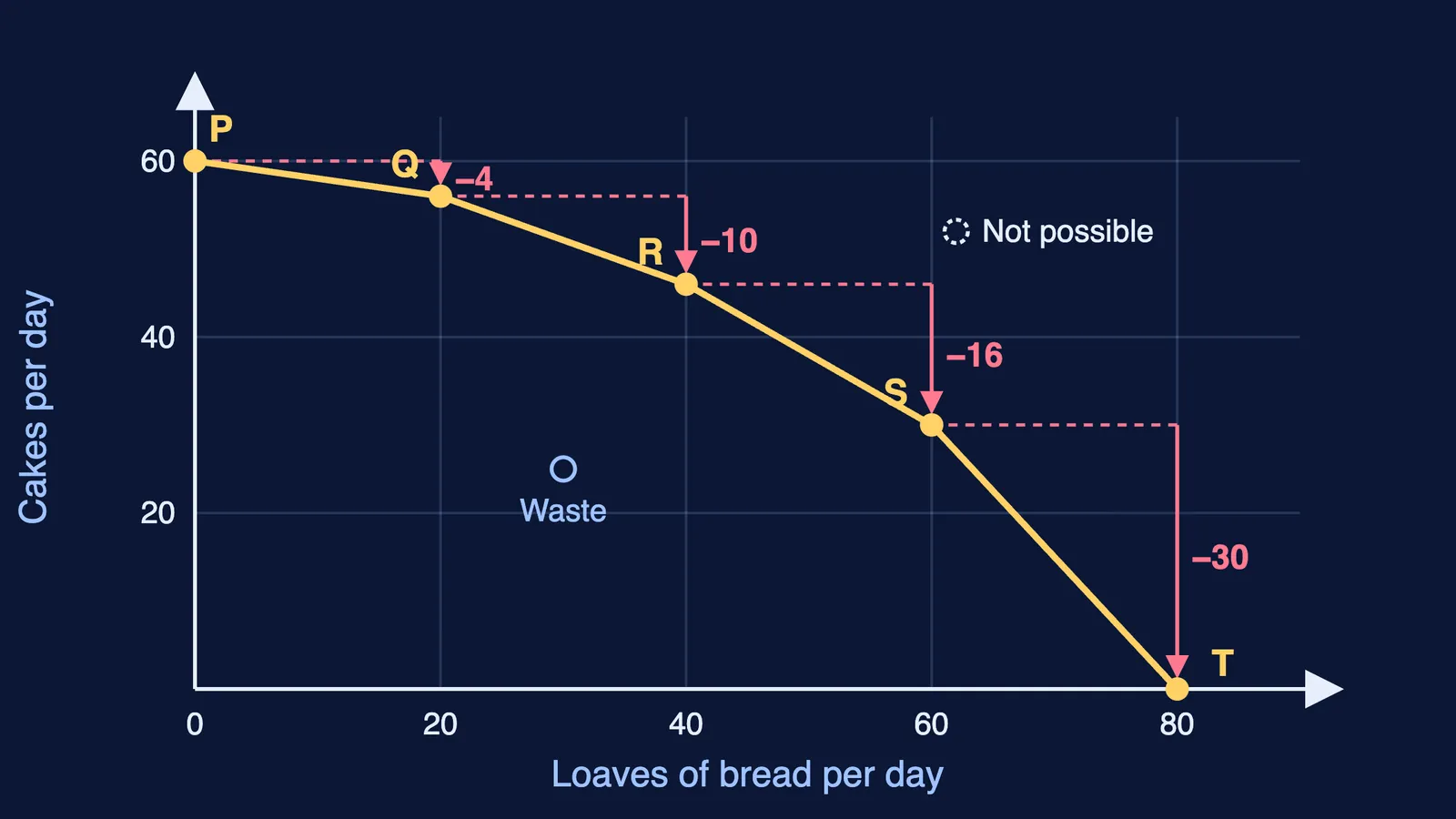
The chapter draws a production possibility curve (PPC) for a farmer choosing between barley and wheat. Every point on it uses resources fully, without waste. Let us build a fresh one. A small bakery has one oven, fixed flour and two bakers. In a day it can make:
P: 0 loaves of bread, 60 cakes
Q: 20 loaves, 56 cakes
R: 40 loaves, 46 cakes
S: 60 loaves, 30 cakes
T: 80 loaves, 0 cakes
Each extra batch of 20 loaves costs:
P to Q: 60 − 56 = 4 cakes, or 0.2 cake per loaf
Q to R: 56 − 46 = 10 cakes, or 0.5 cake per loaf
R to S: 46 − 30 = 16 cakes, or 0.8 cake per loaf
S to T: 30 − 0 = 30 cakes, or 1.5 cakes per loaf
Beyond the chapter: the cost rises because the bakery first moves resources that are poor at cakes, and later the ones best at cakes. OpenStax calls this the law of increasing opportunity cost, and notes that a point inside the curve is wasteful while a point outside cannot be reached with the resources available. In our diagram, 30 loaves and 25 cakes sits inside (an idle oven); 62 loaves and 52 cakes sits outside.
Each red drop over a 20-loaf step gives the slope of that piece of the curve. If reading slope from a graph feels shaky, the Fermi Concept Library covers every concept in mathematics, each with its own lesson.
What are the three central questions of an economy?
Scarcity forces every economy to answer three questions:
What to produce? Water-hungry sugarcane and paddy, or millets and pulses that save water and soil?
How to produce? Labour-intensive (more workers) or capital-intensive (more machines), depending on costs, technology, the product and the law.
For whom to produce? School, office and sports shoes are made for different buyers and budgets.
Planned, market or mixed: how do economic systems differ?
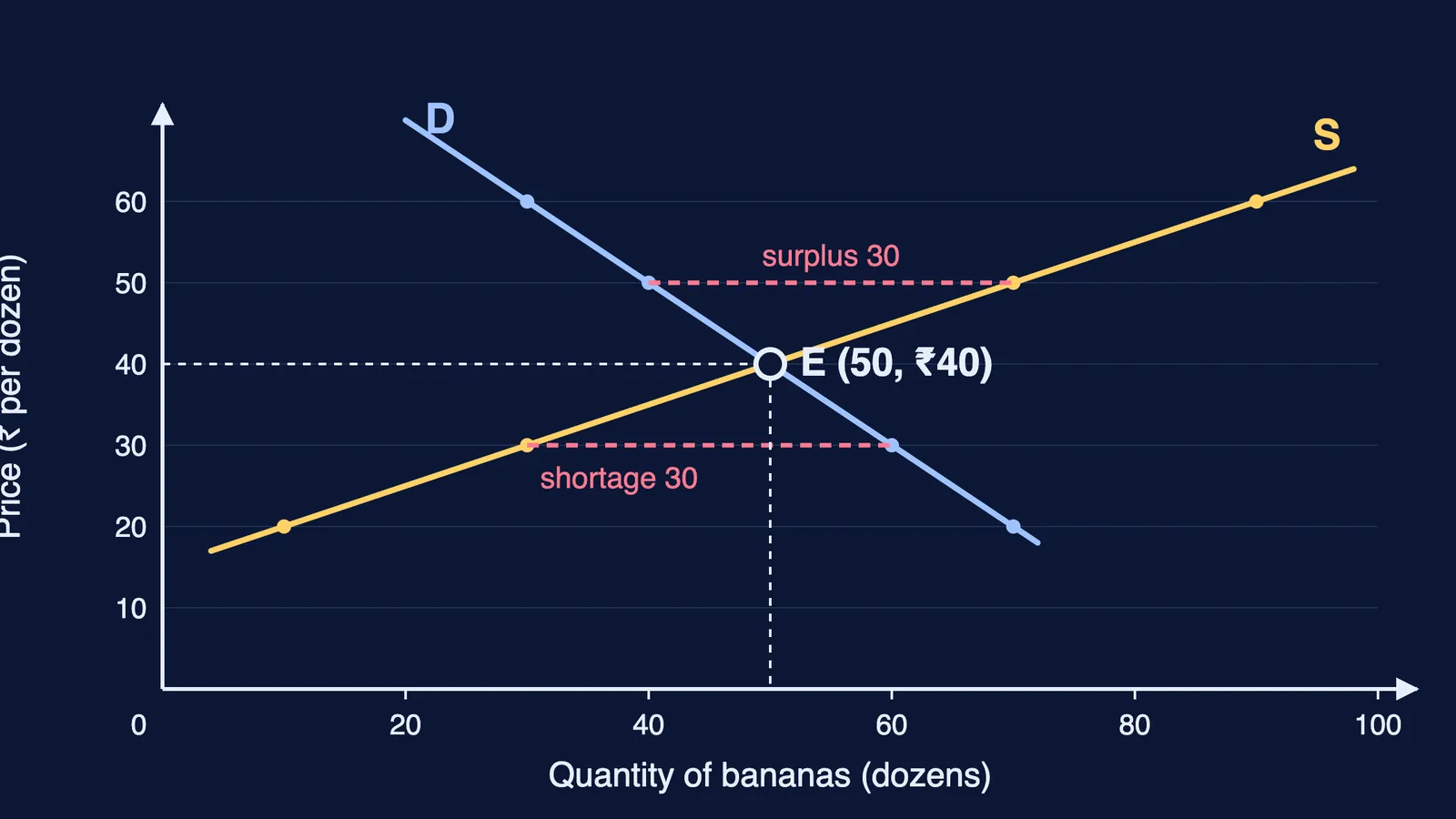
In a planned economy a central authority decides what is made, how, for whom and at what price; the chapter's examples are the former Soviet Union, North Korea and Cuba. In a market economy demand and supply decide (how they settle a price), with the government as referee: the USA, Japan and Hong Kong. A mixed economy combines both, as in India after 1991, China after 1978, Germany and Sweden.
Which mistakes cost marks in this chapter?
Calling opportunity cost the money you spent. It is the next best option you gave up.
Calling a point inside the PPC impossible. Points on the curve use resources fully, so inside means waste. (Outside, meaning unreachable for now, goes beyond the chapter.)
Writing that India is a pure market economy. The chapter places it among mixed economies.
Mixing up "how to produce" (method) with "for whom" (buyers).
How should you prepare for CBSE 2026-27?
The CBSE Class IX Social Science curriculum for 2026-27 gives this theme 7 instructional hours and lists 20 marks of internal assessment for the subject. It says the course structure will be provided later, so trust your school's circular for marks per unit. It also names welfare economy and social safety nets under this theme, which the chapter covers only through a passing mention of welfare programmes; ask your teacher how deeply they will be tested.
Practise with questions you set yourself:
Draw a PPC for two of your own choices, such as study hours and sport hours, and compute each step's cost.
Your class has ₹2,000 left after a fair. Rank three uses and name the opportunity cost of the first.
For a product sold near you, say who decides what, how and for whom.
Pocket money is where most of you meet scarcity first; see our guide on how much pocket money a teenager in India should get.