On this page
The Price Puzzle: What Drives the Market is Chapter 9 of the new NCERT Class 9 Social Science book *Understanding Society: India and Beyond* Part I, introduced for 2026-27. It is the second of the two Economics chapters in Part I, after Building Blocks in Economics (NCERT contents page).
What is The Price Puzzle chapter about?
The chapter asks why prices move, such as why mangoes get cheaper as the season goes on. It covers four ideas:
Demand and what moves it: substitutes and complements, income, tastes, population, seasons and expected prices.
Supply and what moves it: other goods a producer could make, number of sellers, technology and expectations.
Market equilibrium, and why real markets keep moving towards a new one instead of settling.
Government's role: price ceilings and floors, monopolies, public goods, and the costs of too much regulation.
What do the laws of demand and supply say?
The law of demand: when a product's price rises, the quantity demanded falls, and when the price falls, it rises, other things staying the same (NCERT Chapter 9). Demand means willingness backed by the ability to pay.
The law of supply: when the price rises, sellers offer more, because higher prices mean more profit and draw in new sellers (same chapter). So the demand curve slopes down and the supply curve slopes up, with price on the y-axis and quantity on the x-axis.
Market demand (or supply) is the total of every buyer's (or seller's) quantity at each price. You will meet these again in Class 11; our guide to the law of demand with its schedule and curve goes a step further.
How do you find the equilibrium price? A worked example
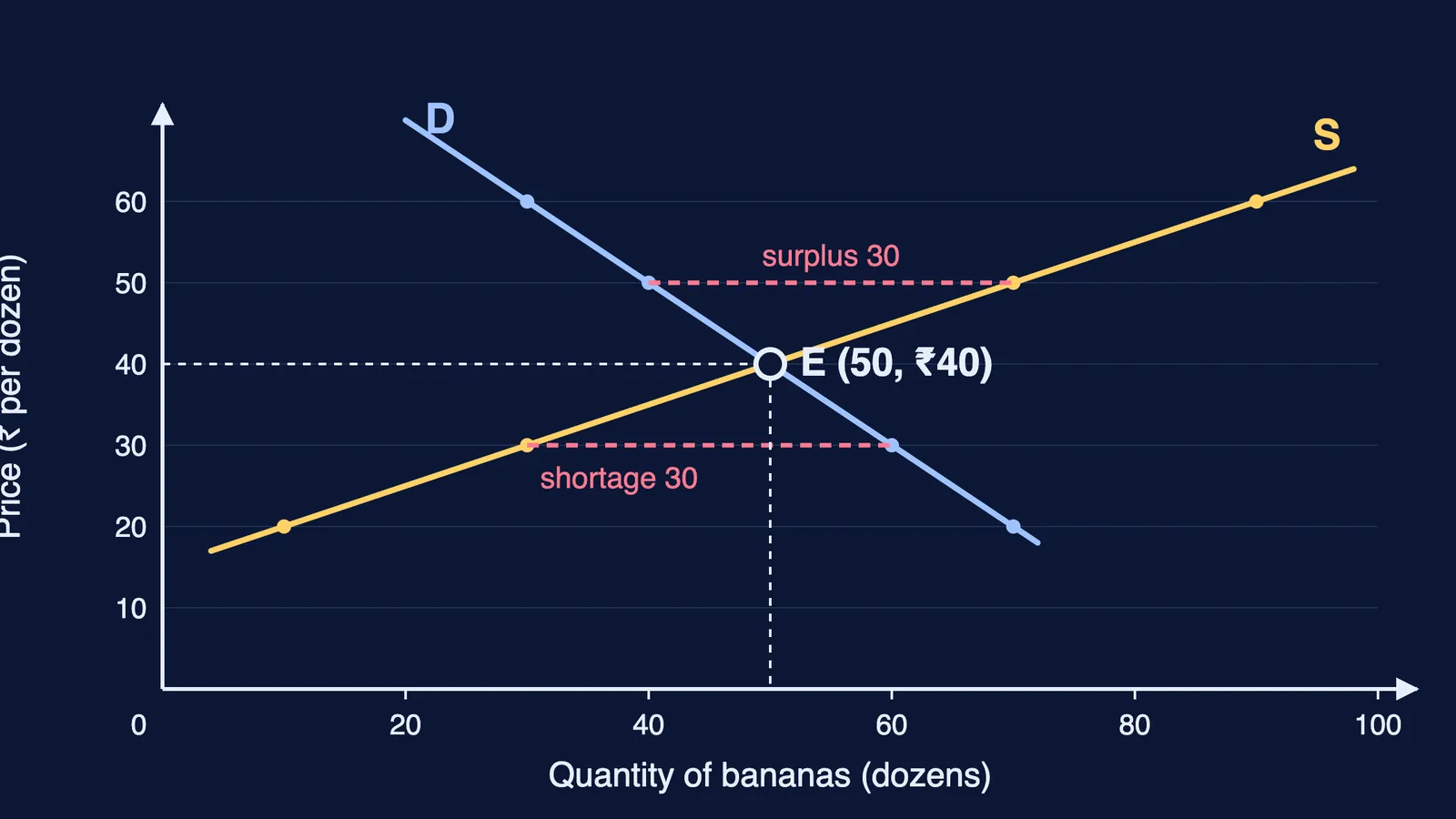
A made-up banana market at a weekly haat (our numbers), in dozens:
₹20: demanded 70, supplied 10, so a shortage of 60
₹30: demanded 60, supplied 30, so a shortage of 30
₹40: demanded 50, supplied 50, so the market clears
₹50: demanded 40, supplied 70, so a surplus of 30
₹60: demanded 30, supplied 90, so a surplus of 60
Equilibrium is the price at which quantity demanded equals quantity supplied: here ₹40 a dozen and 50 dozen sold. Below ₹40, buyers chase too few bananas and the price rises; above it, unsold bananas pile up and sellers cut the price.
What happens when demand changes or the government caps the price?
Say a festival week arrives and buyers want 15 dozen more at every price. The demand curve shifts right. At the old price of ₹40, buyers now want 65 dozen but sellers still offer 50, a shortage of 15. The price rises until the two match again: at ₹45, buyers want 60 and sellers offer 60. The new equilibrium is ₹45 and 60 dozen.
Now go back to the original market and suppose a rule says bananas cannot sell above ₹30. Buyers want 60 dozen, sellers offer 30, so 30 dozen are short. This is why the CBSE curriculum asks you to explain how price ceilings can lead to shortages or black markets (CBSE Class IX Social Science curriculum 2026-27). The chapter's real example: during COVID-19 the government capped sanitiser prices under the Essential Commodities Act, 1955 (NCERT Chapter 9).
What mistakes do students make in this chapter?
Mixing up a movement and a shift. A change in the good's own price moves you along the curve; a change in anything else, such as income or a related good's price, shifts the whole curve (NCERT Introductory Microeconomics, Chapter 2).
Swapping the axes. Price goes on the y-axis, quantity on the x-axis.
Adding prices instead of quantities when building market demand or supply.
Getting substitutes and complements backwards. Tea and coffee replace each other; a car and petrol are used together.
Calling a ceiling above the equilibrium price a cause of shortage. A ceiling only bites below equilibrium; a price floor only bites above it.
If drawing a line from a table and reading where two lines cross still feels shaky, the Fermi Concept Library has every concept in physics, chemistry, biology, mathematics and computing, each with its own lesson.
How should you prepare for CBSE 2026-27?
The CBSE curriculum gives this chapter 8 instructional hours and lists its outcomes: explain both laws with real examples, find equilibrium price and quantity, analyse surplus and shortage, explain price ceilings, and understand market failures and public goods (CBSE curriculum 2026-27). It says the course structure will be provided shortly, so it gives no chapter-wise marks; check the CBSE curriculum page before your exams.
Try this one yourself. Price ₹10, ₹15, ₹20, ₹25; quantity demanded 40, 30, 20, 10; quantity supplied 10, 15, 20, 25. Find the equilibrium, then the gap at ₹15. (Answer: ₹20 and 20 units; at ₹15 there is a shortage of 15 units.)
Then pick one price you see this week and name the force that moved it. Our post on the law of supply and market equilibrium is the next step when you reach Class 11.