On this page
If you are in Class 9 in 2026-27, your science book is the new NCERT textbook Exploration (first edition, April 2026), and Chapter 12 is "Patterns in Life: Diversity and Classification" (NCERT contents and imprint page). Here is how the new chapter is built, a worked example and the mistakes that cost marks.
What is in Patterns in Life class 9?
The chapter runs from page 228 to page 251 and moves in five steps:
Biodiversity and India (12.1-12.2). Endemic species such as the Nilgiri tahr and Neelakurinji, and hotspots like the Western Ghats and the Himalayas.
Why and how we classify (12.3-12.4). Seven criteria, from external features and mode of nutrition to cell structure and DNA, plus a case study of four hornbill species in Pakke Tiger Reserve, Arunachal Pradesh.
Systems over time (12.5). Aristotle grouped animals by habitat; Linnaeus used two kingdoms (1758), Haeckel added Protista (1866), Copeland made four (1938) and Whittaker five (1969).
The five kingdoms (12.6). Monera, Protista, Fungi, Plantae and Animalia, with five plant groups and the animal phyla.
Hierarchy, names and fossils (12.7-12.10). Kingdom down to species, binomial names, Carl Woese's three domains (1977), fossils and threats to biodiversity.
How many marks is Chapter 12 in CBSE 2026-27?
CBSE does not give marks per chapter. The CBSE Class IX Science curriculum for 2026-27 puts Chapter 12 in Unit I, World of Living, with Chapters 2, 3 and 11; that unit carries 27 of the 80 theory marks. The same document gives "Diversity" 12 teaching periods and lists viruses (acellular entities) as a key concept and recognising the three domains of classification as a learning outcome. Practical 8 asks you to identify specimens or slides, including Spirogyra, mushroom, moss, fern, pine cone, Amoeba, Hydra, earthworm and starfish.
How does the five kingdom classification work?
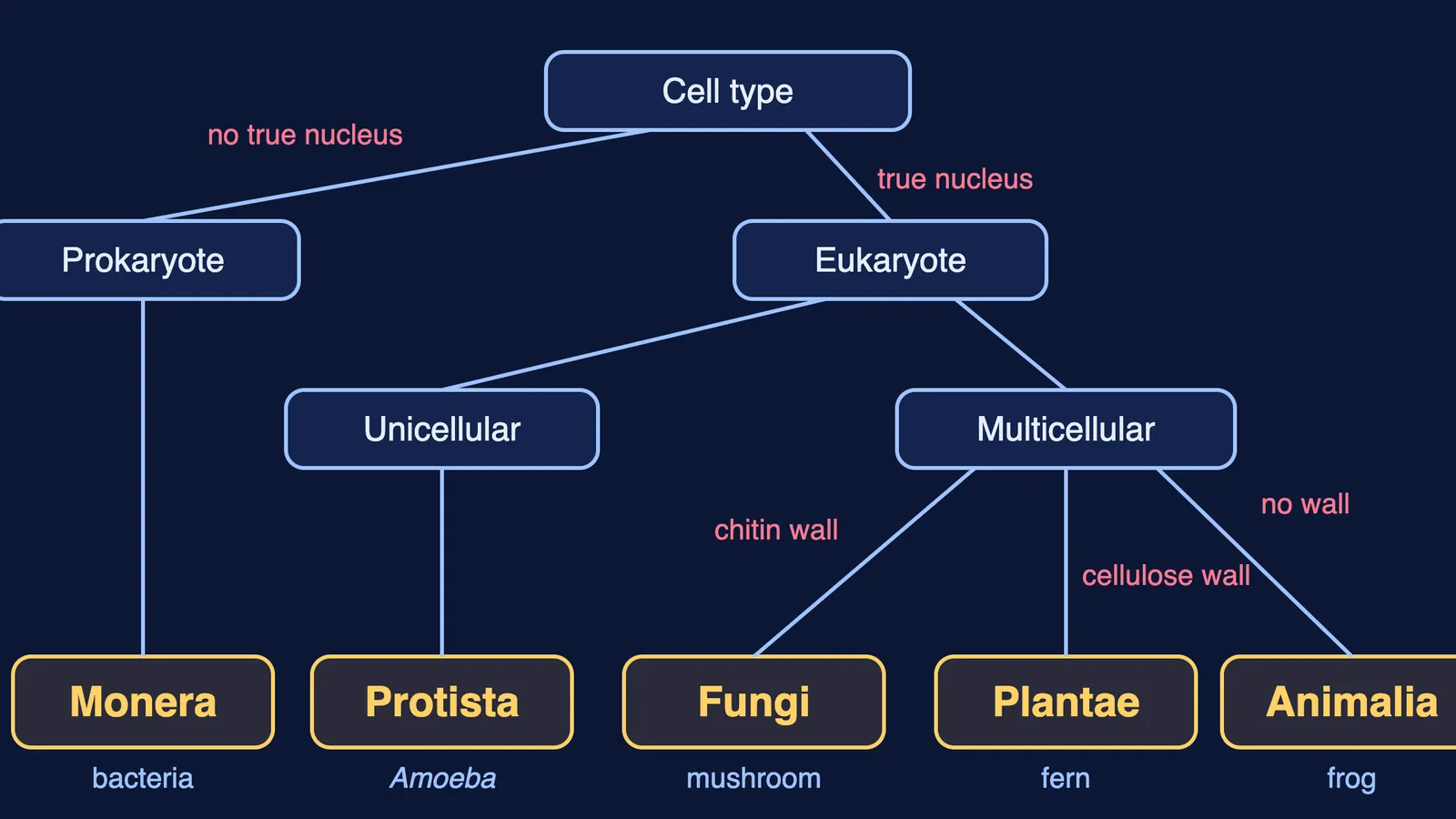
The chapter's concept map (Fig. 12.5 in the chapter) sorts organisms by cell type, number of cells, cell wall and mode of nutrition. As questions (the diagram above draws the first three):
Does the cell have a true, membrane-bound nucleus? No: Monera (bacteria, archaea, cyanobacteria).
One cell or many? A single eukaryotic cell with no wall or a cellulose wall: Protista (Amoeba, Paramecium, Euglena).
Is there a cell wall? None: Animalia.
What is the wall made of? Chitin, with food absorbed from dead matter: Fungi. Cellulose, with photosynthesis: Plantae.
Worked example. Sort five organisms the way a case-based question expects:
*Lactobacillus*: no true nucleus, so Monera.
*Paramecium*: one eukaryotic cell, no wall, so Protista.
Yeast: one cell, but its wall is chitin, so Fungi. The book notes this exception.
Fern: many cells, cellulose wall, photosynthesis, so Plantae.
Starfish: many cells, no wall, eats other organisms, so Animalia.
Inside the plant kingdom, the order follows life on land: thallophytes (Spirogyra), bryophytes (moss, Marchantia) with no vascular tissue, pteridophytes (ferns) with xylem and phloem but no seeds, gymnosperms (pine) with naked seeds, and angiosperms with seeds in fruits. Animals split first on the notochord, then into eight non-chordate phyla, protochordates and five vertebrate groups. Our explainer on unicellular vs multicellular organisms helps with step 2.
If a term such as notochord or chitin is still only a word, the Fermi Concept Library gives every biology concept its own lesson and its place in the map, so you can see where it sits among the others.
How do you write a scientific name correctly?
The chapter gives the hierarchy as kingdom, phylum, class, order, family, genus, species, and each lower level holds fewer organisms that share more features. Its tiger example reads Animalia, Chordata, Mammalia, Carnivora, Felidae, Panthera, tigris (with Vertebrata as a sub-phylum).
Binomial nomenclature, introduced by Carolus Linnaeus in the 18th century, gives every organism a two-part Latin name: genus first, then species. The chapter's rules:
Genus starts with a capital letter; species is all lower case: *Mangifera indica*, not Mangifera Indica.
Print it in italics; underline it when you write by hand.
The genus groups close relatives: *Panthera tigris* (tiger) and *Panthera leo* (lion).
Why species is the unit everything else rests on is in our post on species as the basic unit of classification, and our chapter-wise list of scientific names in NCERT biology is useful for practice.
What mistakes cost marks in this chapter?
Putting yeast in Protista because it is unicellular. Its chitin wall places it in Fungi.
Giving bryophytes xylem and phloem. Pteridophytes are the first group with vascular tissue; neither group has seeds.
Saying a class has more features in common than a genus. It is the other way round: lower levels share more.
Calling the three domains (Bacteria, Archaea, Eukarya) kingdoms. Woese's domains are a separate, DNA-based system; in the five kingdom map, archaea sit inside Monera.
Placing viruses in Monera. They have no cells, so they fit none of the five kingdoms.