On this page
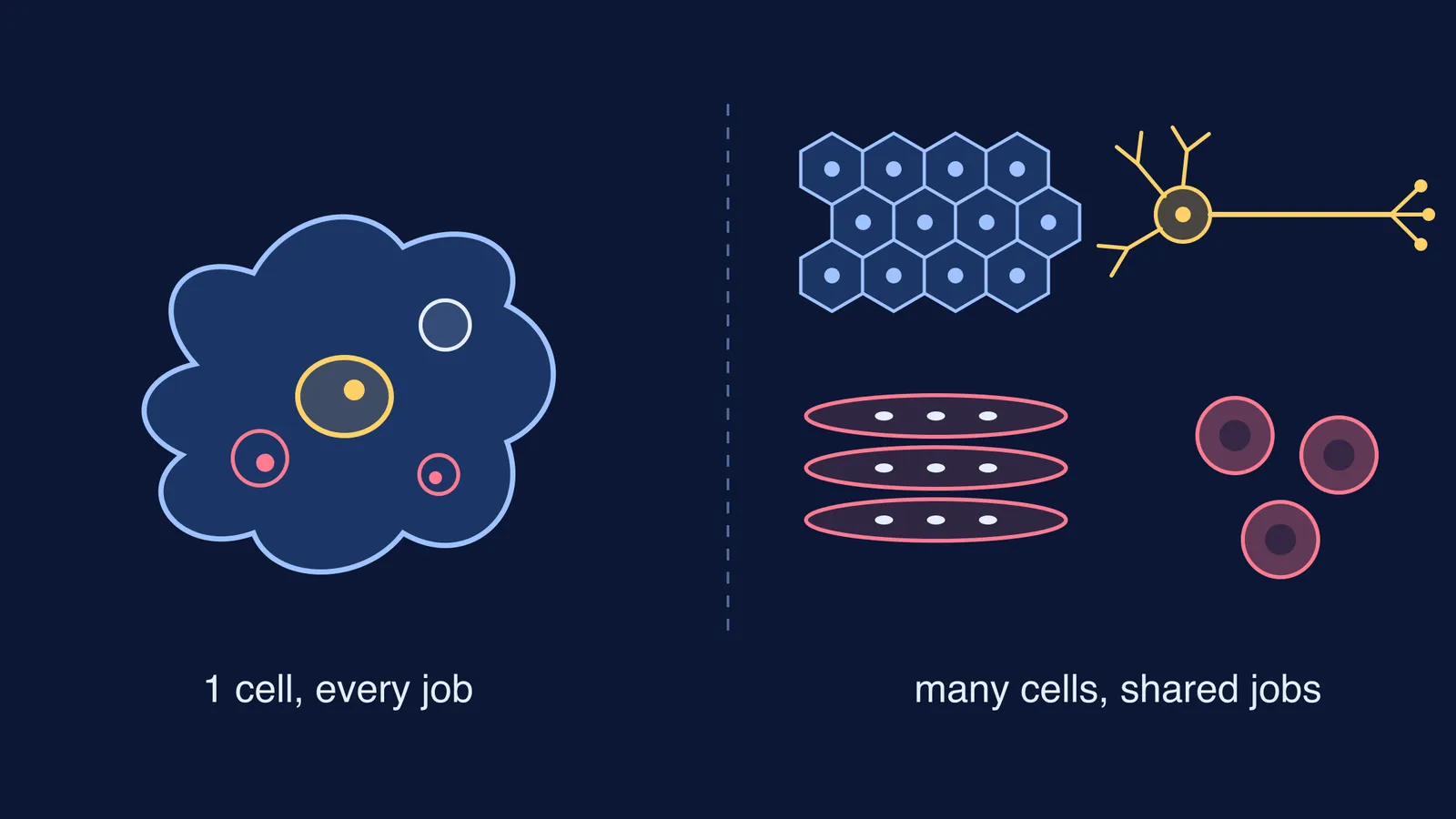
Every living thing has to do the same few jobs: take in food, get rid of waste, keep its water balanced and make more of itself. The difference between unicellular and multicellular organisms is who does those jobs. In Amoeba, one cell does all of them. In you, trillions of cells each take a share. Below is the idea, with a worked comparison you can turn into a 3-mark answer.
What is the difference between unicellular and multicellular organisms?
NCERT's Class 11 chapter Cell: The Unit of Life puts it in one line: organisms made of a single cell are unicellular, while those "like us, composed of many cells, are called multicellular organisms."
The same chapter says unicellular organisms are capable of "independent existence" and of "performing the essential functions of life" (NCERT Class 11 Biology, Chapter 8).
A multicellular organism hands those functions out. Its cells specialise, and most of them cannot live on their own as a separate organism.
How does Amoeba do every job with one cell?
Amoeba has no mouth, gut or kidney, yet it manages every one of these jobs with parts of one cell. According to the summary of the genus Amoeba):
Moving and feeding: it pushes out temporary extensions called pseudopodia and engulfs food by phagocytosis.
Digesting: the swallowed food is held in food vacuoles, which are digestive organelles.
Water balance: Amoeba proteus has one contractile vacuole that fills with water and then squeezes it out of the cell.
Reproducing: it divides by mitosis and cytokinesis, so one cell becomes two.
We cover the feeding step in more detail in how an Amoeba takes in food using pseudopodia.
How is Paramecium different from Amoeba?
Paramecium is also a single cell, but it is more organised. Species range from 0.06 mm to 0.3 mm in length, according to the overview of Paramecium.
It swims using tightly spaced rows of cilia, not pseudopodia.
A deep oral groove draws food into the cell, where it is packed into food vacuoles.
Contractile vacuoles push out the extra water that enters by osmosis.
It has two kinds of nuclei: a large macronucleus and one or more micronuclei.
Besides splitting in two, it can exchange micronuclei with a partner during conjugation.
So even inside one cell, different organelles do different jobs. For labelled structures, see Paramecium structure: cilia, oral groove and two nuclei, and for the water pump in both organisms, how the contractile vacuole works.
Why do multicellular organisms divide the labour?
Some jobs clash when one cell tries to do them all at once. A mathematical model by Ispolatov, Ackermann and Doebeli in Proceedings of the Royal Society B (published online in 2011, in print in 2012) showed that a multicellular form can emerge from genetically identical single-celled ancestors when splitting "poorly compatible physiological processes" into different cells gives a fitness advantage.
Your body is the extreme version. A 2023 study in PNAS, which drew on more than 1,500 published sources, estimated about 36 trillion cells in a 70 kg man, 28 trillion in a 60 kg woman and 17 trillion in a 10-year-old child.
Those cells are not copies of an Amoeba. A neuron carries signals, a muscle cell contracts, a red blood cell carries oxygen, and each relies on other cells for much of what it needs.
Worked example: one job, three organisms
Trace each job through all three. This side-by-side comparison is the heart of the topic.
Taking in food: Amoeba uses pseudopodia; Paramecium uses cilia and the oral groove; humans use a digestive system of organs.
Digestion: Amoeba and Paramecium use food vacuoles inside the cell; humans digest food mainly in the gut, outside cells.
Water balance: Amoeba and Paramecium use contractile vacuoles; humans use kidneys.
Movement: Amoeba uses pseudopodia; Paramecium uses cilia; humans use muscle cells.
Reproduction: Amoeba and Paramecium divide the whole cell; humans make special reproductive cells.
For a 3-mark answer, make three moves: define both terms in a line each, give one example of each, then name one job and say who does it in each case. That last step shows you understand the difference rather than just reciting definitions.
If an organelle keeps tripping you up, the Fermi Concept Library gives every concept in biology its own lesson and its place in the map. For practice, the Fermi Problem Library has worked problems with a step-by-step solver that explains the reasoning.
Tonight, draw Amoeba and Paramecium side by side from memory and label one job on each.