

On this page
For a single-celled organism living in fresh water, the environment is a constant threat. Because the water outside the cell has a lower concentration of solutes than the cytoplasm inside, water constantly pushes its way in through the cell membrane by osmosis.
If this water were allowed to accumulate, the internal pressure would build until the cell burst. To survive, freshwater protists like Amoeba and Paramecium rely on a specialized organelle called the contractile vacuole. This structure acts as a microscopic sump pump, continuously collecting excess water and expelling it back into the environment.
Why do freshwater protists need osmoregulation?
Osmoregulation is the biological process of maintaining a stable internal balance of water and dissolved salts. In a freshwater (hypotonic) environment, the osmotic gradient forces water into the cell. The contractile vacuole solves this problem by actively gathering and pumping water out.
This is an energy-intensive process. Mitochondria are frequently clustered around the contractile vacuole to supply the massive amounts of ATP needed for its operation. The discovery of proton pumps in the vacuole membrane revealed that the cell actively pumps ions to create the necessary gradients for water movement. While its primary role is managing water volume, the vacuole also helps excrete dissolved metabolic wastes, such as ammonia—a process that distinguishes ammonotelic, ureotelic and uricotelic animals—which are flushed out along with the water.
For students tackling biology reasoning questions about osmosis, the Fermi Concept Library breaks down exactly how osmotic pressure and concentration gradients drive these cellular processes.
How does the contractile vacuole fill and empty?
The contractile vacuole operates in a continuous, rhythmic cycle that takes several seconds to complete, depending on the species and the temperature of the water. The cycle consists of two main phases:
Diastole (filling): The vacuole collects water from the cytoplasm. It expands steadily as it fills, often by the fusion of smaller vesicles that shuttle water from deeper within the cell.
Systole (contraction): The vacuole contracts sharply, driven by cytoskeletal elements that squeeze the structure, expelling its contents out of the cell.
In a typical Paramecium, one full cycle takes several seconds in fresh water, according to Wikipedia. If the organism is placed in a more saline solution, the rate of contraction slows down dramatically because less water enters the cell. Similarly, because the pumping mechanism is driven by enzymes and active transport, a drop in temperature will slow the rate of contraction, while warming the water will speed it up.
What is the contractile vacuole function in Amoeba and Paramecium?
While the end goal is exactly the same, Amoeba and Paramecium have evolved different anatomical approaches to osmoregulation.
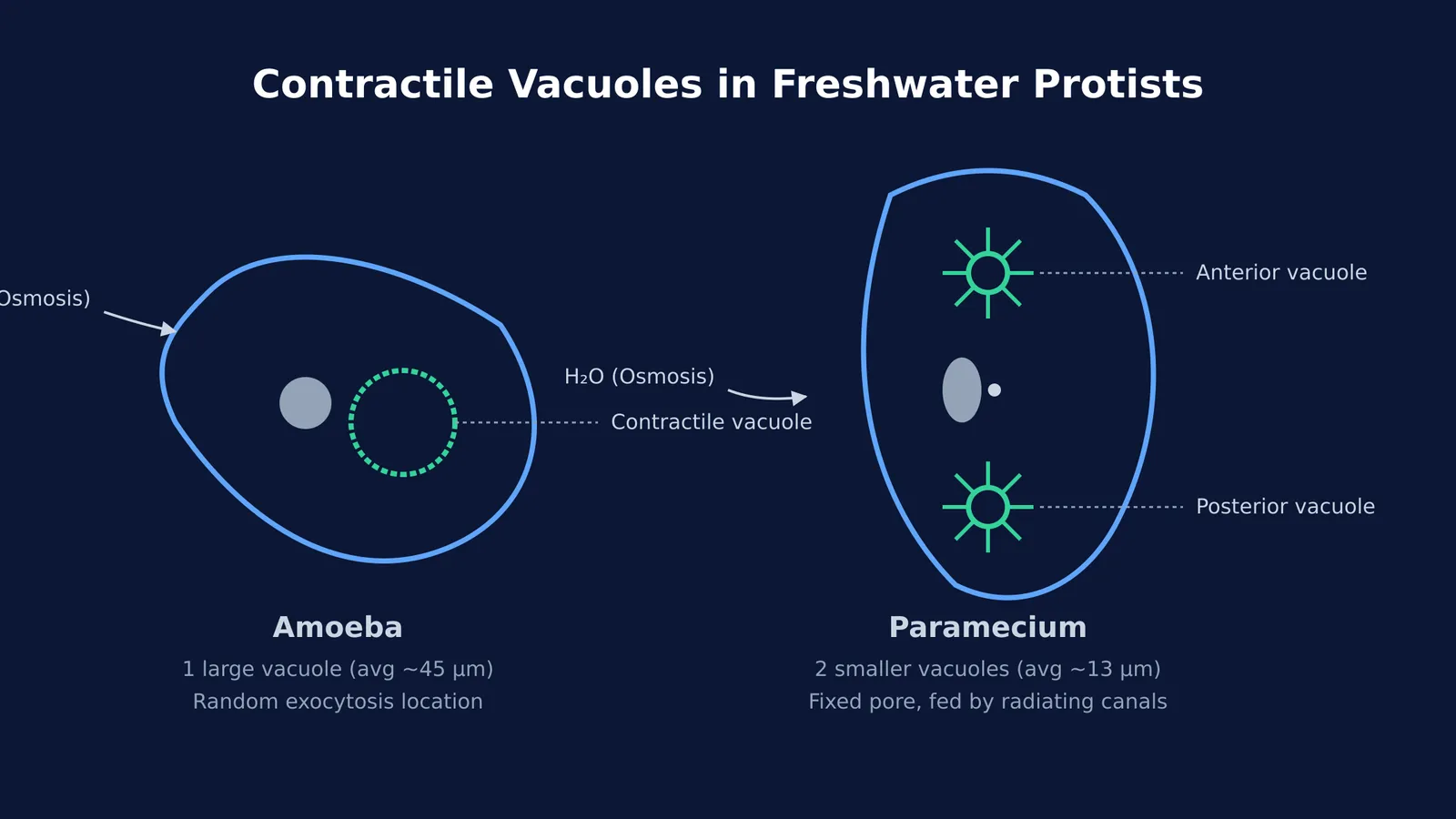
An Amoeba typically has one large contractile vacuole with an average diameter of 45 μm, as detailed on Wikipedia. As it undergoes diastole, ions are actively pumped into the vacuole to create a hyperosmotic environment, which then draws water in through aquaporin channels. Once full, the vacuole moves to the cell surface, fuses with the flexible plasma membrane, and releases the water through exocytosis. Because an Amoeba lacks a rigid shape, the vacuole can empty at almost any point on the cell membrane.
A Paramecium is structurally far more complex. Driven through the water by its cilia and flagella, it generally has two contractile vacuoles—one located at the anterior end and one at the posterior end—each averaging about 13 μm in diameter, according to Wikipedia. These vacuoles are fixed in specific positions and are fed by a star-shaped network of specialized radiating canals, known as the spongiome. The spongiome acts as a plumbing system, collecting water from the surrounding cytoplasm and channeling it into the central vacuole. During systole, the vacuole contracts and expels water through a permanent, dedicated pore in the cell's rigid outer covering (the pellicle).
If you are struggling to picture how these structures differ in three dimensions or how to calculate flow rates, the step-by-step solvers in the Fermi Problem Library explain the reasoning behind the math of cell biology.
Why do marine forms lack a contractile vacuole?
Not all protozoans require this pumping mechanism. Marine species live in seawater, which is typically isotonic—meaning the concentration of solutes outside the cell roughly matches the concentration inside the cytoplasm.
Because there is no significant osmotic gradient, there is no net influx of water forcing its way into the cell. Without the constant threat of swelling and bursting, marine forms do not need to spend precious metabolic energy running a contractile vacuole. Consequently, most marine protists lack the organelle entirely, relying instead on the natural balance of their saltwater environment to maintain cell volume.
A framework for exam questions on osmoregulation
Exam papers often test this concept by asking what happens to a freshwater protist when its environment changes. When you encounter a question about placing an Amoeba or Paramecium in different solutions, use this three-step framework to predict the outcome:
Identify the tonicity: Compare the new environment to the inside of the cell. Is the water hypotonic (less salty), isotonic (equal), or hypertonic (more salty)?
Determine the direction of osmosis: Water always moves toward the higher concentration of solutes. In a hypotonic solution, water enters the cell. In a hypertonic solution, water leaves the cell.
Predict the vacuole's response: If placed in distilled water (highly hypotonic), water enters faster, so the vacuole must contract more frequently to keep up. If placed in mild salt water (isotonic), water stops entering, and the vacuole will slow down or stop entirely. If placed in strong salt water (hypertonic), the cell loses water and shrinks, meaning the vacuole will stop contracting.


